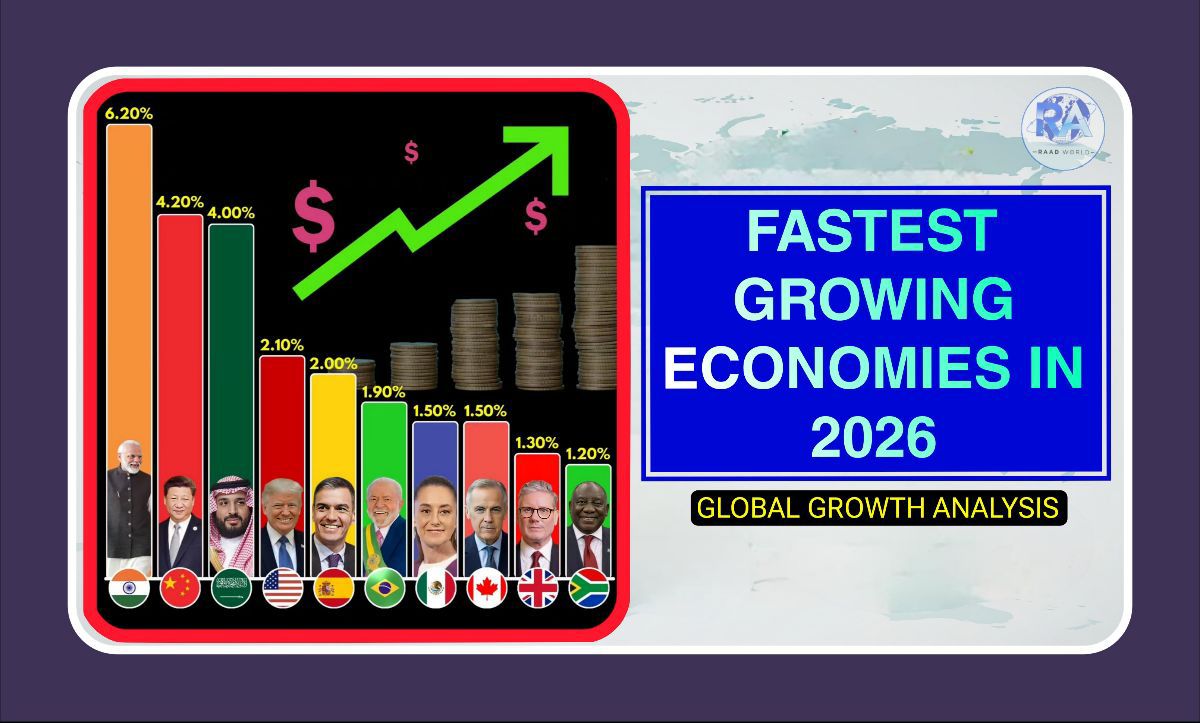
Every year, global economic growth shifts in new directions. Some countries slow down, some bounce back, and a few nations rise sharply due to strong demand, reforms, and demographic advantages. As 2026 approaches, the global economy is entering a very interesting phase. Big economies like the US and China are moving steadily, while developing countries especially India are taking the lead in global growth.
According to various international economic forecasts such as the IMF World Economic Outlook (2025-26), the world will see an average growth of around 3.1%, but some countries will grow far above this line.
This article breaks down why certain nations are leading growth, what’s behind their numbers, and what this means for the global future.
India – The Fastest Growing Major Economy
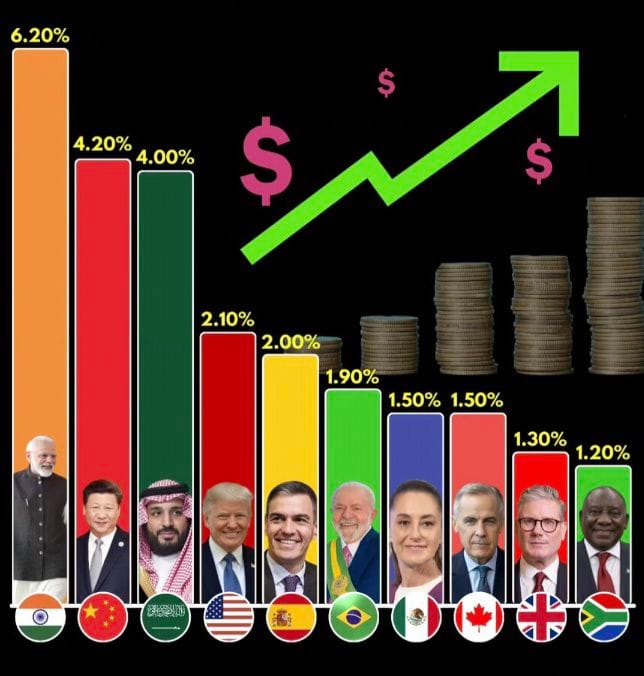
Expected Growth: ~6.2% in 2026
India continues to hold the crown as the fastest-growing major economy.
Why?
1. Huge Domestic Demand
India’s population is young, spending more, and driving strong consumption in every sector.
2. Investment Boom
From manufacturing (PLI schemes) to infrastructure, India is investing massively, creating a multiplier effect on jobs and income.
3. Stable Financial System
Controlled inflation, strong forex reserves, and growing digital payments support long-term stability.
4. Service Sector Strength
IT, digital services, startups, global outsourcing India remains a global service powerhouse.
Result: India not only grows fast but grows steadily. Experts predict India could climb to the world’s 4th-largest economy by 2026.

China – Slower But Still Powerful
Expected Growth: ~4–4.8% in 2026
China is not growing at 10% like before, but it still adds massive output due to its economic size.
Why growth is slower:
- Ageing population
- Weak real estate sector
- Lower global demand for exports
Why growth is still strong:
- Leadership in EVs, batteries, solar, and manufacturing
- Continuous government stimulus
- Strong export network
China remains a big force, but its high-growth era is over.
Saudi Arabia – Growth Driven by Transformation
Expected Growth: ~4% in 2026
Saudi Arabia’s Vision 2030 reforms are shifting the economy from oil-dependent to diversified sectors like:
- Tourism
- Technology
- Renewable energy
- Sports investments
Oil revenue still matters, but reforms are transforming the economy fast.
United States – Stable & Strong
Expected Growth: ~2.1%
The US remains the world’s largest economy.
Growth is lower (compared to developing nations) because the economy is already mature.
Growth drivers:
- Technology and AI boom
- Strong consumer spending
- High employment levels
Despite political fluctuations, the US economy remains resilient.
Spain – Europe’s Comeback Story
Expected Growth: ~2%
Spain has been recovering strongly from pandemic-era lows.
Growth supported by:
- Tourism revival
- Service sector expansion
- EU-backed investments
Spain is among Europe’s top performers.
Brazil – Agriculture & Energy Power
Expected Growth: ~1.9%
Brazil’s growth comes from:
- Massive agricultural output
- Growing renewable energy sector
- Commodity exports (soybeans, iron ore, oil)
Brazil grows steady but not fast, due to political and inflation pressures.
Mexico – North American Advantage
Expected Growth: ~1.5%
Mexico is benefiting from “nearshoring”companies moving factories out of China and closer to the US.
Also supported by:
- Automobile industry
- Remittances
- Tourism
Canada – Stable, Slow but Strong
Expected Growth: ~1.5%
Canada remains stable due to:
- Immigration-driven workforce
- Energy & mineral exports
- Strong institutions
Growth is slow due to high costs and aging population.
United Kingdom – Moderate Growth
Expected Growth: ~1.3%
Post-Brexit challenges continue, but the UK remains an innovation hub.
Growth depends on:
- Finance
- Tech
- Manufacturing reforms
South Africa – Struggling But Recovering Slowly
Expected Growth: ~1.2%
South Africa faces issues like unemployment and weak energy supply, but slow recovery comes from:
- Mining exports
- Agriculture
- Service sector stabilizing
Why Advanced Countries Grow Slowly
Developed nations grow slow because:
- Markets already saturated
- Ageing population
- High cost of living
- Slower manufacturing expansion
So even 2% growth is strong for countries like the US, UK, Germany, Canada.
Why Developing Nations Grow Faster
Developing economies grow faster because:
- Young population
- High consumer demand
- Room for infrastructure expansion
- Rapid digital growth
- Increased foreign investment
This is why India stands out globally.
Fastest Growing Economies in 2026 (Forecast)
| Rank | Country | Projected GDP Growth (2026) | Key Growth Drivers |
|---|---|---|---|
| 1 | India | ~6.2% | Domestic demand, investment boom, digital economy |
| 2 | China | ~4.0–4.8% | Manufacturing, exports, technology sectors |
| 3 | Saudi Arabia | ~4.0% | Vision 2030 reforms, tourism, energy diversification |
| 4 | United States | ~2.1% | Technology, AI innovation, consumer spending |
| 5 | Spain | ~2.0% | Tourism recovery, service sector growth |
| 6 | Brazil | ~1.9% | Agriculture, energy, commodity exports |
| 7 | Mexico | ~1.5% | Nearshoring, automotive sector, remittances |
| 8 | Canada | ~1.5% | Immigration-driven workforce, energy exports |
| 9 | United Kingdom | ~1.3% | Finance, tech innovation, manufacturing improvements |
| 10 | South Africa | ~1.2% |
Mining, agriculture, service sector stabilization |
Key Insight : 2026 will be a year where emerging economies lead global growth, not advanced economies. India is expected to stay No.1 among major economies, while China, Saudi Arabia, and the US follow behind.
⇒FAQ Section :
1. Which country will be the fastest-growing economy in 2026?
According to major forecasts like the IMF World Economic Outlook, India is expected to be the fastest-growing major economy in 2026, with growth around 6%+, supported by strong domestic demand, digital expansion, and rising investments.
2. Why are emerging economies growing faster than developed countries?
Emerging economies grow faster because they have younger populations, rising consumption, expanding infrastructure, and more room to industrialize. Developed countries already have mature markets and slower demographic growth, so their GDP increases at a slower pace.
3. Will China’s economy continue to slow down in 2026?
China’s growth is expected to remain moderate—around 4% to 4.8% in 2026. The country faces challenges like an ageing population and a weak real estate sector, but remains strong in manufacturing, exports, and advanced technologies.
4. How is the United States economy performing in 2026?
The US is projected to grow around 2–2.1% in 2026. Even though the percentage seems low, it is strong for a developed economy. America’s growth is supported by technology, AI innovation, consumer spending, and a stable job market.
5. Which regions will drive most of the global economic growth in 2026?
Most global growth in 2026 will come from Asia, especially India, China, Indonesia, and other emerging markets. Middle Eastern countries like Saudi Arabia and the UAE will also contribute due to economic reforms and diversification.
6. What factors influence a country’s economic growth in 2026?
GDP growth depends on factors like investment levels, consumer demand, government policies, global trade conditions, inflation control, technological adoption, and demographic trends.
7. Are advanced economies expected to grow slowly in 2026?
Yes. Countries such as the UK, Canada, Japan, and most of Europe are expected to grow between 1–2% in 2026 because they already have high living standards, older populations, and saturated markets.
8. Why is India outperforming other major economies?
India is outperforming due to its strong domestic market, digital infrastructure, startup ecosystem, manufacturing push (PLI), young workforce, and consistent government reforms. These elements create long-term sustainable growth.
9. What is the global growth forecast for 2026?
The IMF estimates global GDP growth around 3.1% in 2026. However, growth will not be equal. Emerging countries will grow much faster than advanced economies.
10. How can students or competitive exam aspirants use this information?
This topic appears in GK, current affairs, economics sections of exams like UPSC, KPSC, RRB, SSC, Banking. Understanding which countries are leading growth and why helps students answer economy-based questions confidently.
My Final Conclusion:
The world economy in 2026 is shaping into a new balance.
Developed nations will continue slow and steady growth, but the real momentum will come from Asia and emerging Markets.
- India remains the headline story fast, stable, and strongly positioned.
- China grows moderately but remains powerful.
- Saudi Arabia rises due to reforms.
- The US stays stable.
- European nations recover gradually.
For students, creators, analysts, and competitive-exam learners, understanding these trends is important this is the economic reality shaping the world you will work in.
2026 won’t be a year of equal growth, but it will be a year of clear winners.
And India is definitely leading that list.
This Article Infomation Reference Source :
IMF -World Economic Outlook 2025-26
Visual Capitalist – World’s Largest Economies 2026
FDI Intelligence – Fastest Growing Emerging Economies
Goldman Sachs – China Growth Forecast 2026
Indian Express – IMF India Growth Report
IBEF – India Growth Outlook 2025-26
Read This Article Also :
About The Author