Revisiting Economic Narratives: India’s ‘Hindu Rate of Growth’ Debate and the Modern Growth Imperative

The recent public discourse in India surrounding the phrase “Hindu rate of growth” serves as a potent illustration of the intricate connections between economic terminology, historical consciousness, and national identity within contemporary policy discussions. The revival of this debate, notably propelled by
Prime Minister Narendra Modi’s critiques of the term and his concurrent emphasis on India’s current phase of accelerated economic expansion, offers a significant opportunity for critical examination. It allows for an analysis of the phrase’s origins, its evolution, and the broader global economic context in which India is now positioning itself as a pivotal growth engine.
The expression “Hindu rate of growth” was originally coined by the economist Raj Krishna in the late 1970s. It was intended as an analytical descriptor for India’s relatively low average annual economic growth rate, which hovered around 3–4 percent in the decades following its Independence.
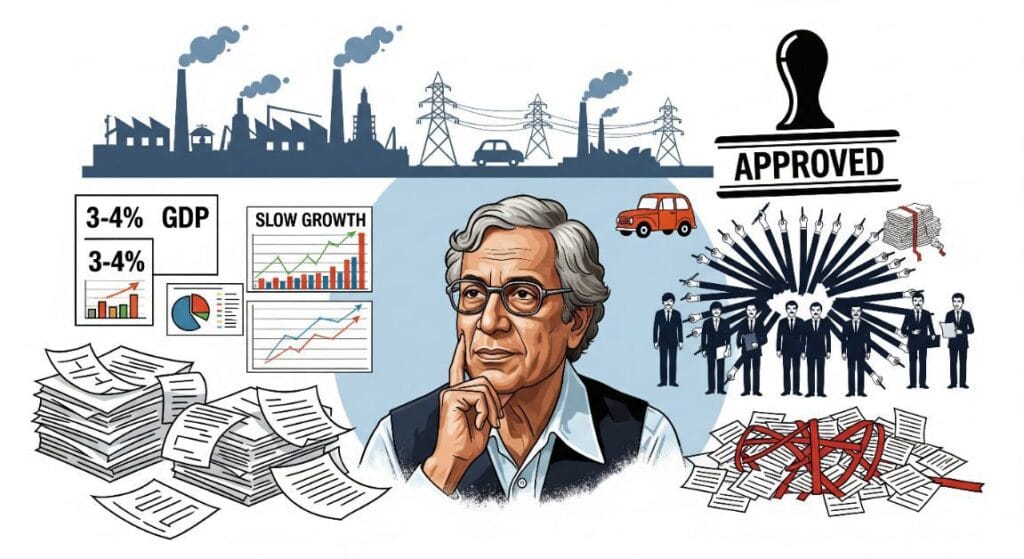
At its inception, the term captured a sense of frustration with the prevailing economic model, characterized by extensive state intervention, a focus on import substitution, and limited market competition. This policy framework, while aiming for self-reliance, inadvertently constrained income growth and hindered broad-based structural transformation.
Over time, however, the phrase transcended its origins as a mere analytical label. It gradually morphed into a controversial cultural metaphor, often implying that Hindu society, or India as a civilizational entity, was inherently predisposed to economic stagnation and poverty. This metaphorical shift detached the term from its policy-centric roots and imbued it with connotations of a fixed, inherent characteristic rather than an outcome of specific economic strategies.
Read This Article Also: Rupee Falls to ₹90.43 Against Dollar Reasons Impact on India and Expert Analysis
In subsequent years, critics increasingly challenged the validity and appropriateness of the phrase on both empirical and normative grounds. A primary argument was that the term misdirected attention from concrete policy choices such as stringent licensing controls, protective trade
barriers, and underdeveloped infrastructure towards perceived cultural attitudes. This critique gained further traction with the economic reforms initiated in 1991 and the subsequent decades that witnessed significantly higher growth rates.
India experienced periods when its expansion matched or even surpassed that of several advanced economies, reinforcing the perspective that the earlier low growth was a consequence of specific institutional frameworks and policy decisions, rather than an immutable civilizational destiny. Consequently, many economists have come to regard the concept as outdated and misleading for contemporary economic analysis.

Against this backdrop, Prime Minister Modi’s recent remarks target the symbolic and psychological weight of the phrase rather than its technical economic origins. Addressing a leadership summit in New Delhi, he characterized the “Hindu rate of growth” as a narrative that unfairly maligned an entire civilization by associating religious identity with economic backwardness.
He posited that such terminology reflects a “ slave mentality” and a lingering colonial mindset, advocating for a deliberate departure from intellectual frameworks that demean India’s cultural and historical legacy.
For the current administration, challenging this phrase is part of a broader strategic effort to reassess and reframe inherited intellectual categories across education, law, and public discourse.
The timing of this discourse is inextricably linked to India’s current macroeconomic performance. Recent national accounts data indicate robust real GDP growth, with figures around 8.2 percent year-on-year reported for the July–September quarter of the 2025–26 financial year.
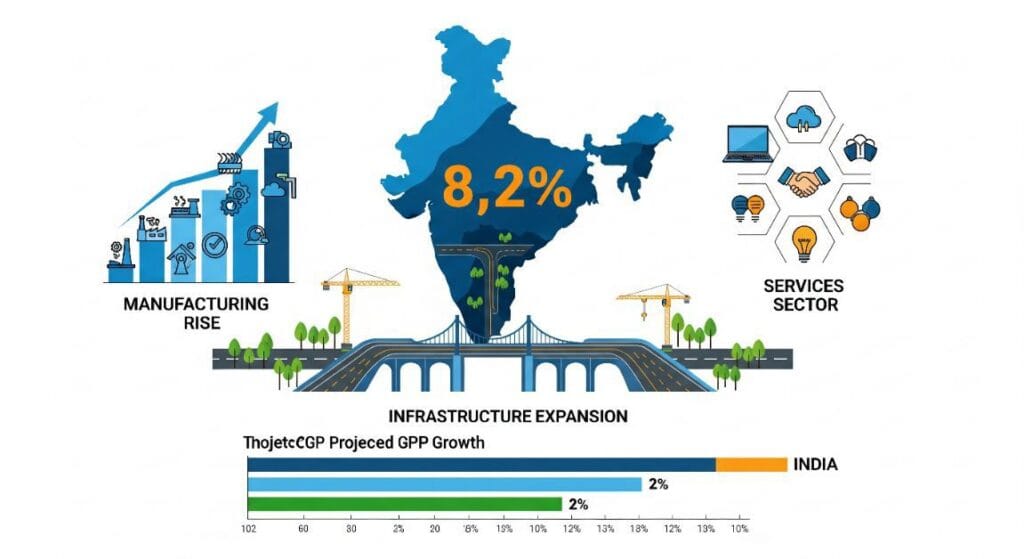
This represents the fastest pace in several quarters and has surpassed many economic forecasts. This expansion is underpinned by strong manufacturing output, buoyant construction activity, steady growth in the services sector, and sustained public and private investment in infrastructure and industry.
Government narratives leverage these figures as evidence that India has definitively moved beyond the era once symbolized by the older, critical economic label.
Viewed from a global perspective, India’s current growth trajectory stands out in an environment marked by geopolitical uncertainty, sluggish international trade, and tighter global financial conditions. Global output is estimated to be growing at approximately 3 percent, with
many major advanced economies, including members of the G7, expanding at rates closer to 1–2 percent. In this international context, India is frequently identified in global commentary as one of the principal drivers of world economic growth. Its robust domestic demand and investment are seen as crucial factors helping to offset economic weaknesses in other regions.
Concurrently, some multilateral institutions and analysts have raised important methodological questions regarding aspects of India’s GDP measurement, reminding observers that headline figures warrant careful statistical interpretation, even as the broad trend of relatively high growth is widely acknowledged.
Prime Minister Modi’s framing further links macroeconomic momentum to the cultivation of national confidence and “trust” within the international system. He contrasts global concerns over economic slowdowns, conflicts, and financial strains with a narrative positioning India as a stable and dependable partner for supply chains, investment, and technological collaboration.
In this perspective, moving beyond expressions like the “Hindu rate of growth” is not merely about rectifying an archaic phrase but about projecting a self-image of dynamism, innovation, and resilience. This projection is crucial for supporting India’s aspirations for an expanded global role.
From a neutral analytical standpoint, the controversy underscores the profound influence economic labels exert on public perception. The original phrase emerged within a vastly different policy and geopolitical milieu, and its continued invocation today can carry unintended cultural and political implications.
Simultaneously, India’s current growth performance, while impressive by international standards, raises substantive questions that transcend mere rhetoric. These include the sustainability of high growth, its inclusivity, and the institutional reforms necessary to foster long-term productivity, employment, and human development.
The present debate thus resides at the nexus of history, economics, and identity, illuminating how numerical data and prevailing narratives collectively shape a nation’s self-perception and its international standing.
Read This Article Also: Right To Disconnect Bill 2025: Will India Really Stop Work Calls After Office Hours?
Conclusion: India’s debate over the “Hindu rate of growth” is more than an argument about economics it is a conversation about identity, history, and how a nation sees its future. As seen in your article’s detailed analysis , the term began as a technical critique but slowly became a cultural label that many felt misrepresented India’s potential.
Today, with strong GDP numbers, global recognition, and a confident national narrative, India is reshaping how it wants to be perceived. The modern debate pushes us to reflect not only on past policy failures but also on the importance of building a balanced, sustainable, and inclusive growth model for the next generation. The shift from outdated labels to a forward-looking economic identity shows how India is redefining its place in the world.
About The Author

 Creator Adarsh