Understanding the Subtle Science of Yogic Energetics:
In the material science of the West, we have mapped the physical body with remarkable precision – bones, muscles, organs, nerves, and blood vessels laid bare in anatomical texts. Yet the ancient yoga masters perceived something deeper: a subtle body of extraordinary complexity and power, a whole universe of energy channels, spinning vortices, and concentrated centres of consciousness that interpenetrate and animate the physical form.
This subtle architecture is not metaphorical or imaginary. To those who have developed the sensitivity to perceive it through dedicated practice, it is as tangible and operative as the circulatory system, yet far more influential in determining the quality of one’s experience, the depth of one’s awareness, and the trajectory of one’s spiritual unfoldment.
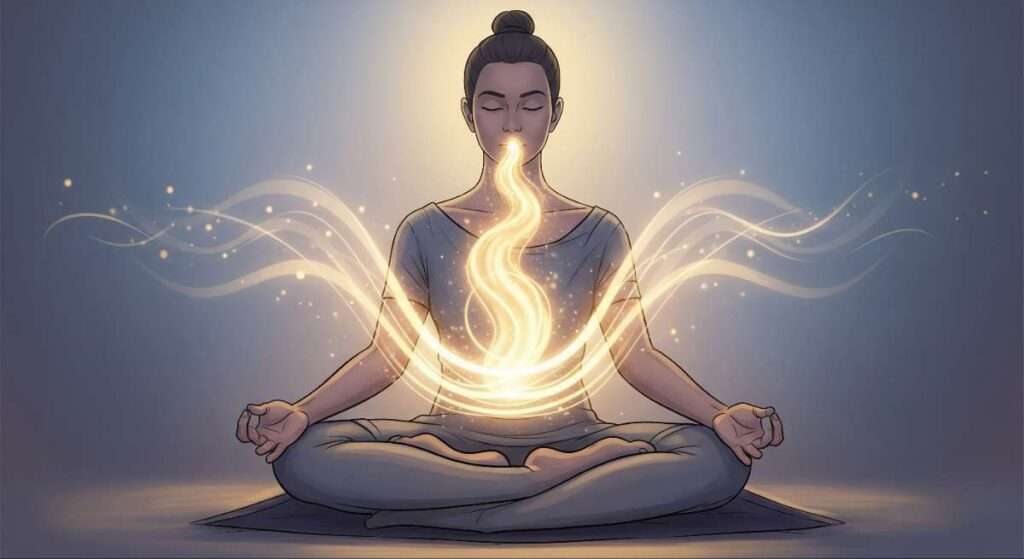
The foundation of this entire system is “prana” a word that carries within it the essence of what yoga seeks to understand and master. Prana is not merely breath or air, though breath is one of its pathways. Rather, “prana is the primordial life force, the intelligent cosmic energy that animates all existence, flows through all living beings, and underlies the very mechanics of consciousness itself.” It is the current that sustains the heartbeat, nourishes the organs, powers thought, energizes emotion, and is the fundamental material from which both body and mind are fashioned.
The ancient yogic texts present prana with lyrical precision. The “Upanishads” describe it as “that which is the life in all beings, the essence that moves within.” Paramahansa Yogananda, the great 20th-century master who brought yoga philosophy to the West, articulated it with scientific clarity: prana is not merely energy in the abstract sense, but a subtle substance ”what he termed “lifetrons” that possesses inherent intelligence and governs all vital processes. Just as the physical body has arteries and veins to carry blood, so too does the subtle body possess an intricate network of channels called “nadis” through which prana flows, and specific energy centers called “chakras” where prana concentrates and transforms.
This article explores that hidden architecture the nadis that conduct energy, the chakras where energy concentrates, the five vayus (winds or movements of prana) that govern different bodily and mental functions, and the profound implications of understanding how energy flows upward or downward, scatters or concentrates, in determining both spiritual progress and the quality of ordinary life.
Read This Article Also: Benefits of Brahmacharya: Physical, Mental & Spiritual Advantages Explained
Prana: The Master Energy
Before examining the channels and centers through which prana flows, we must understand prana itself not as a concept to be intellectually grasped, but as a living reality to be directly perceived and cultivated through practice. The Sanskrit word “prana” is composed of two roots “prana” (constant, continuous, perpetual motion) and “na” (to move, to flow).Thus, “prana literally means that which is constantly in motion.” It is not static energy but a ceaseless current, a dynamic force that never ceases to flow and transform.
In yogic physiology, prana operates at multiple levels simultaneously:
“At the cosmic level”, prana is the universal life force the energy that sustains all of existence. The sun radiates prana; the earth receives and transforms it; all plants and animals are expressions of prana in different forms. The “Chandogya Upanishad” speaks of this universal prana as “Vaisvanara”, the cosmic fire that pervades all things.
“”At the individual level””, prana is the vital life force animating the human being. It enters through the breath, through food, through sensory perception, and through every exchange with the environment. The quantity, quality, and direction of prana’s flow within an individual determines their health, mental clarity, emotional stability, and spiritual capacity.
“At the subtle level”, prana is the energetic substance through which consciousness operates. It is not consciousness itself, but rather consciousness’s vehicle of expression, the subtle medium through which awareness manifests as thought, feeling, and sensation. The yogic understanding recognizes that “prana is not monolithic.” Like white light separated by a prism into the spectrum of colors, prana divides within the body into different movements and qualities, each with distinct functions. These are called the “pancha prana” (five pranas) or “pancha vayu” (five winds)
The Five Pranas (Vayus): Governance of All Functions
The yogic texts describe five primary movements of prana, each governing specific regions of the body and specific functions:
- Prana Vayu: The Inward & Upward Force
- Location: Chest, head, and forward region of the body
- Function : Governs intake, inspiration, forward momentum, and upward propulsion of energy
Prana vayu is the force of reception and assimilation. It draws the breath inward, carries sensations upward to the brain, lifts the eyes upward, and propels awareness forward. When prana vayu is functioning optimally, one experiences enthusiasm, vitality, mental clarity, and the capacity to engage with life. When disturbed or deficient, one experiences lethargy, poor circulation, weak immunity, and mental fogginess.
This is the most accessible of the five vayus to cultivate, as it is naturally stimulated by pranayama (breathing practices), particularly practices that emphasize inhalation, and by practices that redirect attention upward and inward.
Apana Vayu: The Outward & Downward Flow
- Location: Pelvis, lower abdomen, and the eliminative and reproductive systems
- Function: Governs elimination, downward and outward movement, and the release of all forms of waste physical, emotional, and mental
- If prana vayu draws inward, apana vayu pushes outward and downward. It is the force of elimination and release governing the excretory and reproductive functions, and at the subtle level, responsible for releasing old patterns, stagnant emotions, and mental toxins.
Apana vayu is often misunderstood as merely the force of waste elimination. Yet the ancient texts recognized something more subtle: apana is the natural gravitational tendency of energy. In an unconscious person, apana is constantly pulling energy downward and outward through compulsive sexual release, unnecessary urination, excessive eating followed by elimination, emotional outbursts, and the constant leakage of vital force through the senses.
Here lies one of the most crucial insights of yogic practice: “The direction of energy flow upward or downward” is one of the fundamental determinants of spiritual progress.” A yogi must learn to contain apana, to master its movement, so that rather than energy perpetually draining downward, it is redirected upward through the central channel toward higher centers of consciousness. This is not suppression, which would create blockage and disease, but rather “redirection and transformation”.
The Hatha Yoga Pradipika, the great 15th-century yogic text, describes how practitioners should work carefully with apana. The various mudras (energetic seals) and bandhas (energy locks) detailed in classical texts serve precisely this function to redirect apana’s tendency to flow downward, allowing it to flow instead into the central Sushumna channel where it can unite with upward-moving prana vayu and fuel the ascent of kundalini.
- Samana Vayu : The Assimilating Force
- Location: Navel center, abdominal region
- Function: Governs assimilation, discernment, and the ability to consolidate and absorb
Samana vayu is the intelligence of metabolic transformation. Physically, it governs the digestive fire, allowing the body to extract nutrition from food and convert it into usable energy. At the subtle level, samana vayu is the discerning intelligence that allows the mind to absorb knowledge, distinguish between truth and falsehood, and consolidate experiences into wisdom. When samana vayu is strong, one has good digestion, clarity of discrimination, and the ability to consolidate learning. When disturbed, one experiences weak digestion, confusion, poor memory, and the inability to convert experience into wisdom.
Udana Vayu: The Ascending Force
- Location: Throat and upper region
- Function: Governs growth, speech, expression, and upward movement of energy
Udana vayu is the ascending force—it moves energy upward toward the head and the centers of higher consciousness. It governs speech, expression, growth, effort, and the will to rise above limitations. In spiritual practice, it is udana vayu that must be cultivated and strengthened for the ascent of kundalini to occur. When udana vayu is strong, one speaks with clarity and power, grows spiritually, and has the will to transcend obstacles. When weak, one’s words lack impact, growth stalls, and one lacks the motivation to overcome challenges.
Vyana Vayu: The Coordinating Force
- Location: Entire body, all extremities
- Function: Governs circulation on all levels—physical, mental, emotional, and energetic
Vyana vayu is the omnipresent force that coordinates and unifies all the other vayus. It circulates blood and lymph, distributes nutrients, coordinates muscular movement, and at the subtle level, ensures that different systems work in harmony. It also governs the boundaries and sense of individual identity—the feeling of being separate and contained within this particular body. When vyana vayu is balanced, one feels integrated and coordinated. When disturbed, one experiences fragmentation, clumsiness, and loss of boundaries.
The Three Nadis: The Highways of Energy
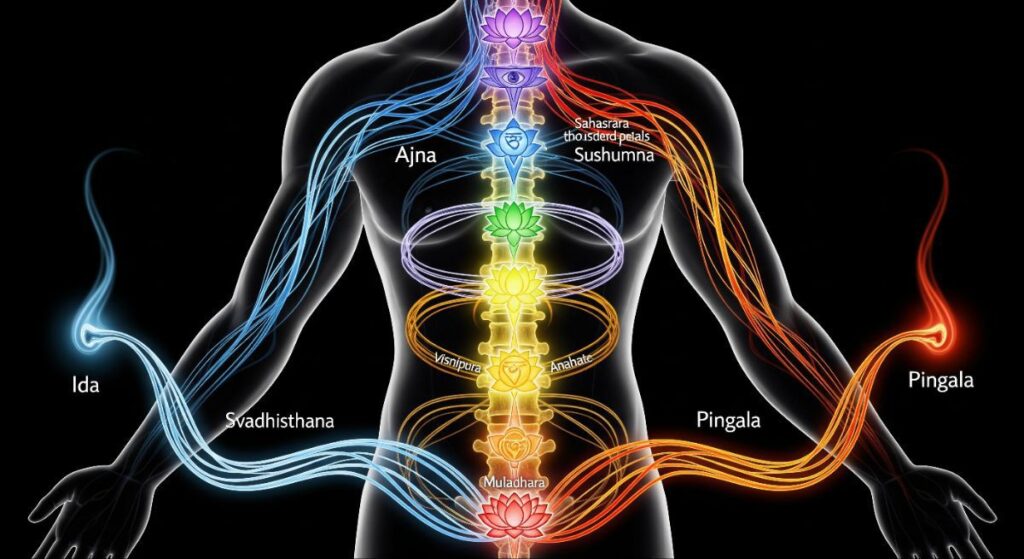
Understanding the five vayus gives us knowledge of energy movements and functions. Now we must turn to the channels through which energy flows the nadis. While yogic texts describe 72,000 nadis traversing the subtle body (a number that should not be taken literally but rather as indicating “countless”), three nadis are of supreme importance. These three are the foundation of all yoga practice
Ida Nadi: The Left Channel (The Moon Channel)
- Course: Begins at the base of the spine (Muladhara chakra) and ascends along the left side of the body, terminating in the left nostril and the left hemisphere of the brain
- Quality: Cool, receptive, lunar energy; associated with the parasympathetic nervous system
- Governs: Emotions, intuition, memory, feminine qualities, and the parasympathetic nervous system’s functions of rest, digestion, and renewal
The ida nadi is cooler in nature and corresponds to the moon—that which waxes and wanes, which receives and reflects light. When ida is flowing strongly (as indicated by the left nostril breathing predominantly), the mind tends toward introspection, emotional sensitivity, creativity, and receptivity. In a balanced state, ida channel allows for emotional richness, intuitive knowing, and connection to one’s inner world. When excessive or unbalanced, ida can lead to excessive emotionality, lethargy, depression, and loss of motivation.
Pingala Nadi: The Right Channel (The Sun Channel)
- Course: Begins at the base of the spine and ascends along the right side of the body, terminating in the right nostril and the right hemisphere of the brain
- Quality: Warm, active, solar energy; associated with the sympathetic nervous system
- Governs: Action, will, intellectual reasoning, masculine qualities, and the sympathetic nervous system’s functions of alertness, activity, and mobilization
Pingala is warmer in nature and corresponds to the sun that which illuminates, activates, and radiates outward. When pingala is flowing strongly (as indicated by the right nostril breathing), the mind tends toward action, planning, logical analysis, and external engagement. In a balanced state, pingala provides the energy for accomplishment, clear thinking, and purposeful action. When excessive or unbalanced, pingala can lead to agitation, aggression, restlessness, and burnout.
Sushumna Nadi: The Central Channel (The Divine Channel)
- Course: Ascends directly through the center of the spine, from the base (Muladhara chakra) to the crown of the head (Sahasrara chakra)
- Quality: The neutral, transcendent channel; represents the path to ultimate consciousness
- Governs: Spiritual development, inner balance, and the awakening of kundalini shakti
The Sushumna is the king of all nadis. While Ida and Pingala conduct the energies of mind and ordinary consciousness, Sushumna is the highway of enlightenment. According to all classical yoga texts,“the opening and activation of Sushumna is the prerequisite for all higher spiritual attainment.”
In the ordinary individual, Sushumna remains dormant. The prana instead oscillates perpetually between Ida and Pingala sometimes flowing through one, sometimes through the other creating the endless alternation of emotional and active states that constitutes ordinary consciousness. This constant oscillation between opposing channels creates exhaustion and keeps one trapped in the endless cycles of desire, action, reaction, and consequence.
The Hatha Yoga Pradipika states this most clearly:
“When the energy moves in Ida and Pingala, through either nostril, that is not yoga. When the breath flows evenly through both nostrils, that is the first sign of Sushumna awakening. When the breath enters Sushumna, the yogi is freed from all bondage.”
The activation of Sushumna occurs naturally when the Ida and Pingala channels are purified and balanced. Through practices like nadi shodhana (alternate nostril breathing), meditation, pranayama, and the mudras and bandhas detailed in yogic texts, one trains the prana to enter and remain in the central channel. When Sushumna is active, a profound shift occurs in consciousness.
The mind becomes centered, still, and luminous. Internal contradictions dissolve. One experiences neither the excessive emotionality of Ida nor the agitation of Pingala, but rather a transcendent equanimity and clarity. This is the gateway to meditation, to pratyahara (sense withdrawal), to dharana (concentration), and ultimately to dhyana (meditation) and samadhi (enlightened absorption).
The Chakras: Energy Centers and Consciousness
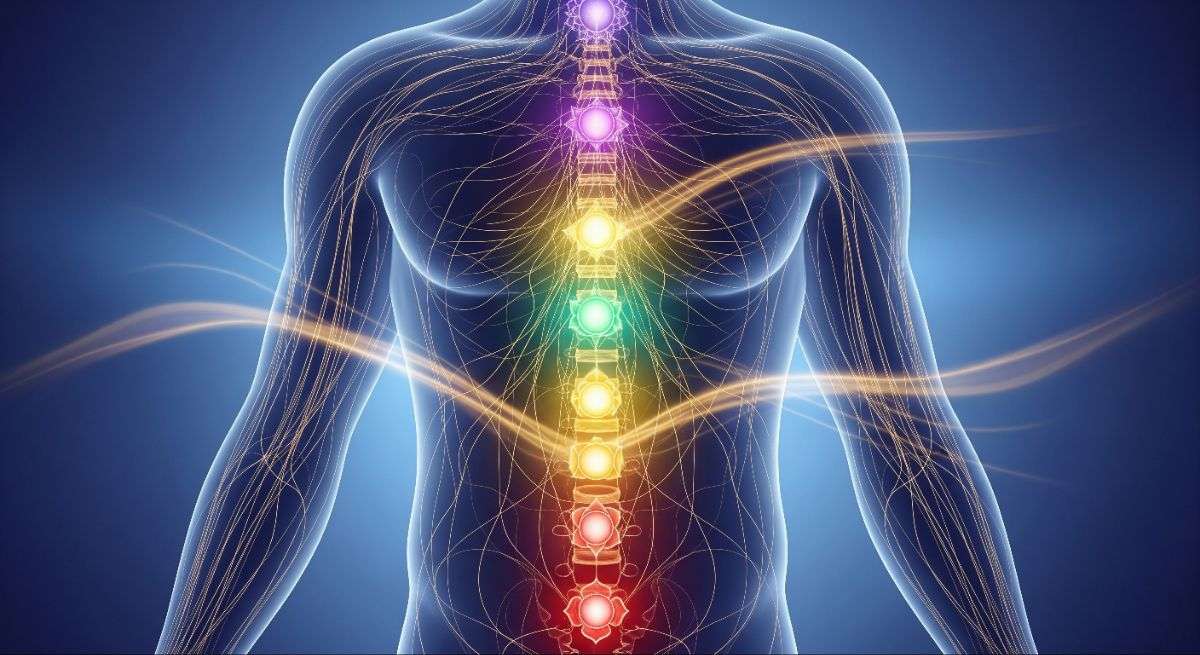
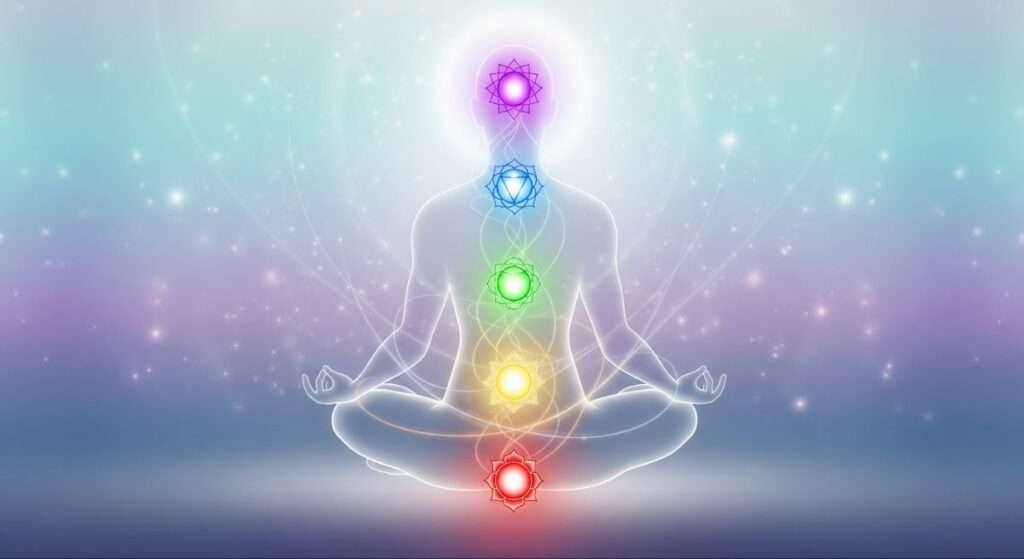
While the nadis are channels conducting energy, the chakras are the central hubs where energy concentrates, transforms, and is distributed throughout the being. The word “chakra” comes from Sanskrit meaning “wheel” or “disk,” and indeed, when perceived by those with developed subtle vision, chakras appear as spinning vortices of energy, each with its own color, sound, and vibrational quality.
The most widely known chakra system describes seven major chakras positioned along the Sushumna nadi, from the base of the spine to the crown of the head. This system, codified in the 16th-century “Sat-Chakra-Nirupana” (Description and Investigation of the Six Bodily Centers) by Swami Purnananda Yati, presents each chakra as a lotus with a specific number of petals, each associated with particular elements, deities, mantras, colors, and powers.
Understanding the Seven Chakras
Muladhara (Root Chakra)
- Location: Base of the spine, perineum
- Element: Earth “Color” Red “Petals “Four
- Governing Functions: Survival, grounding, security, stability, elimination
- Associated Glands: Adrenal glands
The Muladhara is the foundation upon which all other chakras rest. It is here that kundalini shakti (the dormant spiritual energy) lies coiled, waiting to be awakened. This is the realm of basic survival instincts, physical security, and the grounding force that anchors consciousness in the material realm. When Muladhara is balanced, one feels secure, grounded, and connected to the earth. When disturbed, one experiences fear, instability, and disconnection from the body.
Significantly, Muladhara is also the seat of apana vayu. The downward and outward pull of apana operates from this center. In an unconscious individual, this downward pull dissipates energy constantly. A yogi must learn to reverse this flow, transforming the downward momentum of apana into an upward surge through mudras, bandhas, and the conservation of sexual energy (brahmacharya). This is the first and most critical transformation in yogic practice.
Svadhisthana (Sacral Chakra)
- Location: Lower abdomen, reproductive organs
- Element: Water Color Orange “Petals” Six
- Governing Functions: Sexuality, creativity, pleasure, sensory experience, emotional flow
- Associated Glands: Reproductive glands
Svadhisthana is the creative center the seat of sexuality and sensory pleasure. It is where sexual energy (veerya) concentrates, where desires arise, and where the attractions and aversions that govern ordinary life originate. The Svadhisthana is crucial in understanding the relationship between sexual energy and spiritual progress. This is not a center to be rejected or suppressed, but rather understood and intelligently managed. The sexual energy that arises here is the very fuel that, when redirected through brahmacharya (conscious channeling) and yogic practices, becomes transmuted into ojas (spiritual power) and drives the kundalini’s ascent.
Manipura (Solar Plexus Chakra)
- Location: Navel center
- Element: Fire Color Yellow Petals Ten
- Governing Functions: Will, power, transformation, digestion, ego
Associated Glands: Pancreas
Manipura is the seat of samana vayu and the fire element. It is the transformative center where energy is refined and converted into usable power. In the physical body, this is where digestive fire burns; in the subtle body, this is where experience is transformed into wisdom and potential is converted into actualized power. When Manipura is balanced, one has strong will, good metabolism, and the power to manifest one’s intentions. When weak, one lacks willpower and feels powerless.
Anahata (Heart Chakra)
- Location: Heart center, chest
- Element: Air Color Green (or pink) Petals Twelve
- Governing Functions: Love, compassion, devotion, spirituality, balance
Associated Glands: Thymus gland
Anahata marks the transition from the lower three chakras (which govern instinct, sensation, and personal power) to the upper three (which govern communication, intuition, and transcendence). The name “Anahata” means “unstruck” or “unbeaten” it refers to the mystical sound that reverberates within, the inner sound of creation that does not arise from the striking together of two objects. Anahata is the seat of prana vayu in its highest expression as universal love and spiritual connection. When Anahata is open and balanced, one experiences compassion, forgiveness, and the recognition of the divine in all beings.
Vishuddha (Throat Chakra)
- Location: Throat
- Element: Ether Color Blue Petals Sixteen
- Governing Functions: Communication, truthfulness, will, expression, purification
Associated Glands: Thyroid gland
Vishuddha is the seat of udana vayu and ether. The name “Vishuddha” means “purified” or “cleansed.” This is the center through which thought becomes speech, inspiration becomes expression, and internal truth becomes external communication. The opening of Vishuddha is essential for spiritual unfoldment. Here one learns the power of words that speech can create or destroy, heal or wound. A yogi cultivates truthful speech and learns that the power of udana can lift consciousness upward or, through careless words and negative communication, drag it downward.
Ajna (Third Eye Chakra)
- Location: Center of the forehead, between the eyebrows
- Element: Light/Mind Color Indigo Petals Two
- Governing Functions: Intuition, insight, inner vision, discrimination, will
Associated Glands: Pineal gland
Ajna is often called the “command center” because from here the whole being is coordinated. It is here that the individual will aligns with the cosmic will. This center corresponds to the pineal gland, which modern science has associated with the production of melatonin and the regulation of circadian rhythms, and which some researchers suggest may be more subtle than its physical function.The opening of Ajna confers remarkable powers the capacity to perceive beyond ordinary sensory data, to access intuitive knowing, and to see through illusion to truth.
Sahasrara (Crown Chakra)
- Location: Crown of the head
- Element : Pure Consciousness Color Violet/White Petals One Thousand
- Governing Functions: Enlightenment, unity consciousness, divine realization
Associated Glands: Pineal gland (subtle aspect)
The Sahasrara is not, strictly speaking, a chakra in the ordinary sense, but rather the culmination and transcendence of all chakras. Depicted as a thousand-petaled lotus, it represents the infinite nature of consciousness. The ascent of kundalini through the six lower chakras culminates in the union of individual consciousness with universal consciousness in the Sahasrara.
Sexual Energy, Energy Flow, and Spiritual Progress
To understand how sexual energy influences the upward or downward flow of energy is to grasp one of the most transformative insights of yogic science. Sexual energy is not inherently impure or corrupt it is among the most powerful and creative forces in the human system. The question is not whether one has this energy, but how one directs it.
Veerya: The Generative Force
The term “veerya” (literally “hero” or “heroic strength”) refers to the vital generative force the seminal fluid in men and the corresponding vital essence in women. In the yogic understanding, veerya is not merely the physical semen or sexual secretion, but rather the subtle vital essence that generates creative power on all levels physical, mental, emotional, and spiritual.
When veerya is dissipated through compulsive sexual indulgence, through lustful fantasy, or through uncontrolled sexual activity, energy flows downward. The Svadhisthana chakra, the seat of this energy, becomes depleted rather than strengthened. The person experiences weakness, mental fogginess, emotional instability, and spiritual aridity. This is apana in its destructive expression energy draining downward and outward, never accumulating but always leaking.
The classical texts describe this state precisely. A person with depleted veerya has dull eyes, weak skin, poor concentration, anxiety, premature aging, and weak immunity. In the spiritual domain, such a person cannot meditate effectively, cannot maintain focus on higher truths, and remains enslaved to the impulses of the lower chakras.
Transformation of Veerya into Ojas and Tejas
Conversely, when veerya is consciously conserved and channeled through brahmacharya (the conscious direction of sexual energy) and yogic practices, a remarkable transformation occurs. This precious vital essence is transmuted into what the texts call “ojas” a subtle spiritual nectar that accumulates in the brain and is the foundation of all higher consciousness.
The “Hatha Yoga Pradipika” describes this transformation in precise terms. When the sexual energy is not dissipated, when it is contained and directed upward through pranayama, mudras, and meditation, it rises in the central Sushumna channel and merges with the higher centers of consciousness. This ascending energy is then transformed into “tejas” spiritual radiance which manifests as a luminous presence, clarity of consciousness, and compelling spiritual magnetism.
A yogi abundant in ojas possesses qualities that are unmistakable: lustrous eyes, radiant skin, exceptional mental clarity, emotional stability, and a presence that others naturally feel. This is not the artificial appearance of someone suppressing their nature, but the natural radiance that comes from energy being consolidated and directed toward the highest aims.
Swami Vivekananda, the great 19th-century yoga master, spoke of this transformation with scientific precision: “Power comes to him who observes unbroken brahmacharya for a period of twelve years. Complete continence gives great intellectual and spiritual strength.” He was not speaking from dogma but from direct observation of those who had mastered their sexual nature through yoga practice.
The Mechanism of Upward Flow
How, precisely, is energy redirected upward rather than downward? The mechanism involves both understanding and practice:
Understanding: The first step is intellectual clarity recognizing that the dissipation of sexual energy depletes the being and that its conservation and redirection is the gateway to higher consciousness. This clarity itself redirects energy, as one naturally desires what one understands to be beneficial.
Mudras and Bandhas: The classical yogic texts describe various mudras (energetic seals) and bandhas (locks) that physically redirect energy flow. For example, Mula Bandha (the root lock) engages the pelvic floor and literally prevents apana from flowing downward, instead directing it into the Sushumna channel. When combined with breath control and visualization, these practices create a literal reversal of energy flow.
Pranayama: Breathing practices, particularly those that emphasize longer exhalation and breath retention, naturally strengthen udana vayu and promote upward energy flow. Alternate nostril breathing (Nadi Shodhana) purifies both Ida and Pingala, creating the conditions for Sushumna activation.
Meditation and Visualization: When combined with concentration, the mind itself can direct energy. Visualization of energy rising through the central channel while seated in meditation creates actual energetic movement. The ancient texts understood what modern neuroscience is beginning to confirm: thought and consciousness can directly influence subtle energy flows.
Brahmacharya: Perhaps most fundamentally, the practice of conscious channeling of sexual energy through brahmachary not through repression, but through understanding and conscious direction naturally elevates energy. When one is not constantly depleted through sexual dissipation, the accumulated vital force naturally seeks higher expression.
Scattered Energy: Why Mental Distraction Weakens Yogic Practice
Understanding the distinction between concentrated and scattered energy is crucial to understanding why yogic practice requires mental discipline and why scattered attention weakens both ordinary effectiveness and spiritual progress. In an ordinary person’s life, mental energy is dispersed in countless directions. One thinks about the past, worries about the future, replays conversations, imagines scenarios that may never occur, fantasizes about desires, and dwells on grievances. This constant mental scattering corresponds to energy being pulled in myriad directions through all the nadis, depleting the being of vital power.
Consider what happens in the nervous system when attention is scattered: the sympathetic nervous system remains partially activated, cortisol and adrenaline remain elevated, and the body is in a state of chronic low-grade stress. The mind cannot rest, the nervous system cannot fully relax, and energy is consumed in this agitated state even when one is sitting idle. This scattered state directly impedes yogic practice. When one sits for meditation, if the mind immediately begins its habitual patterns of distraction, energy flows through the lateral nadis (Ida and Pingala) rather than the central channel (Sushumna). The mind cannot touch deeper states; the body remains tense; and the practice yields little fruit. One can sit for thirty minutes and feel as though only five minutes have passed—a sign that deep mental absorption has not occurred.
The ancient yogic texts describe this condition precisely. The “Gheranda Samhita”, the classical yoga text describing the sevenfold path to enlightenment, emphasizes that the first requisite is “purification” of the body, yes, but especially of the nadis and the mind. Without this purification, scattered energy remains scattered, and higher practice is impossible.
The Cost of Mental Distraction
The modern world has conspired to scatter human attention with unprecedented effectiveness. Digital devices, social media, entertainment, advertising, and the cultural valorization of multitasking have created a collective condition of what might be called “attention fragmentation.” The mind has been trained to jump from stimulus to stimulus, never resting, never consolidating.
In the context of yoga and spiritual practice, this scattered attention has devastating consequences:
- Weakening of Will: When energy scatters constantly, the will grows weak. One cannot manifest one’s intentions, one cannot maintain discipline, one cannot follow through on commitments.
- Emotional Instability: Scattered energy corresponds to disturbance in Vyana Vayu, the coordinating force. The emotions become reactive and unstable, swinging between highs and lows with little stability.
- Spiritual Aridity : No matter how much one practices, scattered energy produces no real spiritual progress. Meditation cannot occur; inner silence cannot be found; the subtle perceptions that come from concentrated energy remain closed.
- Physical Disease: At the deepest level, scattered energy creates imbalance in all the vayus. This manifests as various physical ailments, digestive problems, sleep disturbances, and chronic fatigue despite adequate rest.
The Ancient Yogic Perception of Subtle Energy
How did the ancient yogis develop this remarkably precise understanding of an invisible energy system? Modern Western science, having mapped the physical body exhaustively, has no instruments that directly perceive nadis or chakras yet the ancient texts describe them with remarkable specificity and consistency.
The answer is not that the ancient yogis were guessing or creating metaphorical systems. Rather, through thousands of years of systematic meditation practice, the developed the direct perception of subtle energy. A yogi who has purified their nervous system, who has spent years in meditation and pranayama, can directly perceive the flow of energy in their own subtle body and in others. For such a being, the chakras and nadis are as tangible as the blood vessels are to the anatomist.
The oldest systematic description of this subtle anatomy appears in the “Hatha Yoga Pradipika”, written in the 15th century by Swami Svatmarama. Drawing on even older tantric traditions, this text describes how the yogi can directly perceive the flow of prana through the nadis, feel the awakening of kundalini at the base of the spine, and guide it through the chakras via the central Sushumna channel.
The “Sat-Chakra-Nirupana” (Description of the Six Chakras), written by Swami Purnananda Yati in the 16th century, provides the most detailed description of the chakra system available in classical literature. Rather than abstract theory, it describes the visual appearance of each chakra as perceived by the advanced yogi, the precise location of each, the deities and mantras associated with each, and the specific experiences that come from the awakening of each center.
What is striking about reading these ancient texts is their consistency. Different lineages, different texts from different time periods, describe essentially the same system. This consistency suggests not invention or cultural diffusion from a common source, but rather independent confirmation by different practitioners of the same internal reality.
How Spiritual Practice Opens Perception of Subtle Energy
The development of the ability to perceive subtle energy happens naturally through consistent practice:
- Through Pranayama: Breath control practices create enhanced sensitivity to energy flow. As one becomes aware of the subtle sensations accompanying the movement of breath, one begins to perceive the prana itself moving through the nadis.
- Through Meditation: Prolonged meditation naturally quiets the gross mind and allows the subtle perceptions to emerge. After months and years of practice, internal sounds, internal lights, and the movement of energy become directly perceptible.
- Through Mudras and Bandhas: These practices produce specific energetic effects that become perceptible with sensitivity. The application of Mula Bandha, for instance, is felt as a particular internal sensation. With time, one learns to recognize these sensations and to distinguish different qualities of energy flow.
- Through Awakening Kundalini : Perhaps most dramatically, when kundalini energy awakens and begins to rise through the chakras, the process is unmistakable. The awakening of each chakra is accompanied by specific physical sensations, emotions, and states of consciousness. The ascent of kundalini through the channels is felt as a subtle current of energy moving upward through the spine.
The ancient yogis were not spiritual fiction writers but empirical observers of internal reality, developing a science of subtle perception as rigorous in its way as modern neuroscience is in mapping the brain.
Practical Implications: From Theory to Lived Experience
The understanding of prana, nadis, and chakras is not merely intellectual. It has profound practical implications for how one practices yoga, lives one’s life, and pursues spiritual development:
- On Asana Practice: Understanding that different postures affect different chakras and vayus allows one to practice with greater intelligence. Hip openers and grounding poses activate and balance apana; backbends and chest openers awaken Anahata; inversions and subtle throat practices activate Vishuddha. A yoga practice becomes not merely physical exercise but a precise calibration of energy.
- On Pranayama: Knowing that breath control directly manipulates prana allows one to use pranayama therapeutically and spiritually. Practices that extend inhalation strengthen prana vayu; practices that extend exhalation strengthen apana; alternate nostril breathing purifies Ida and Pingala.
- On Energy Conservation: Understanding veerya and ojas makes clear why brahmacharya is not a harsh moral imperative but a practical wisdom. The conservation of vital energy is a prerequisite for advanced practice, not because celibacy is virtuous, but because dissipated energy cannot be transformed into higher consciousness.
- On Meditation: Knowing that meditation requires the movement of energy into Sushumna explains why meditation without preparation often yields little. Purification practices, energy work, and ethical development must precede deep meditation if one wishes to enter states of absorbed consciousness.
- On Everyday Life: Understanding that energy scatters through distraction and dissipates through compulsive desires gives one a clear incentive to develop discipline, to withdraw attention from unnecessary stimuli, and to direct energy toward meaningful purposes.
Read This Article Also: Brahmacharya: Walking in God-Consciousness The True Yogic Meaning Beyond Celibacy
Conclusion: The Energy Architecture and the Path of Mastery
The subtle energy system prana flowing through nadis, concentrating in chakras, expressing itself through five vayus is not a belief system to be accepted on faith. It is a precise technology of consciousness, developed and refined over thousands of years of systematic practice. For the yogi who undertakes the journey of understanding and working with this energy system, a remarkable transformation occurs. The scattered, depleted state of ordinary consciousness gradually consolidates into focused, abundant vitality. The downward pull of apana and the compulsive dissipation of sexual energy gradually reverses into an upward flow of kundalini through the central channel.
Content & Media Disclaimer: This article is original and educational any real-world images, video clips, or external links used are edited and referenced solely for educational and informational purposes in accordance with Indian Copyright Act, 1957 (fair use).
About The Author

 Creator Adarsh