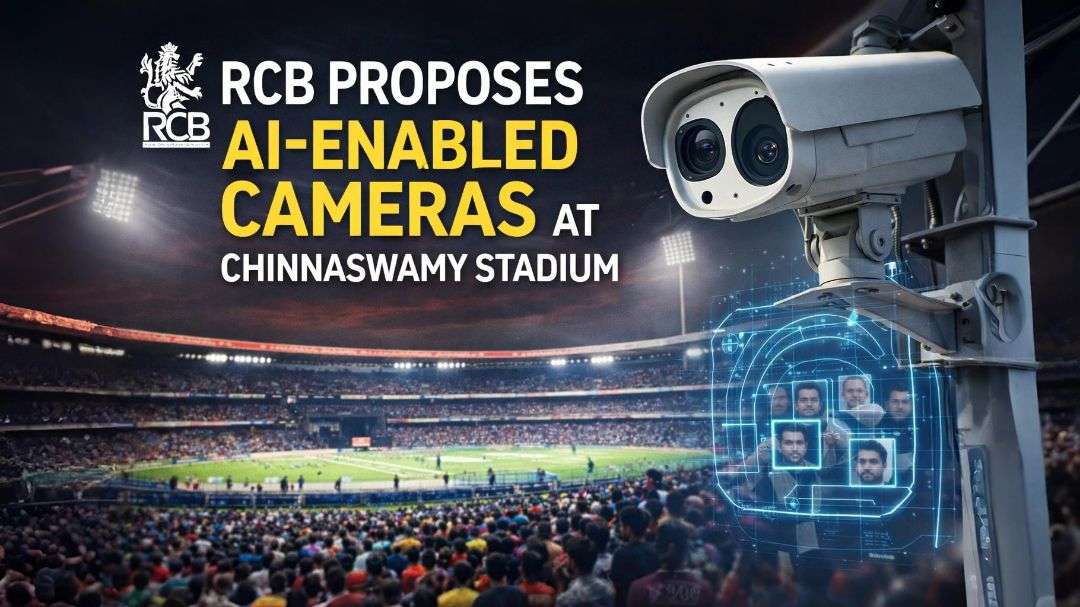
Bengaluru: In a major step towards strengthening fan safety and crowd control, Royal Challengers Bengaluru (RCB) has proposed the installation of large-scale AI-enabled surveillance infrastructure at the iconic M. Chinnaswamy Stadium.
300–350 AI Cameras Planned
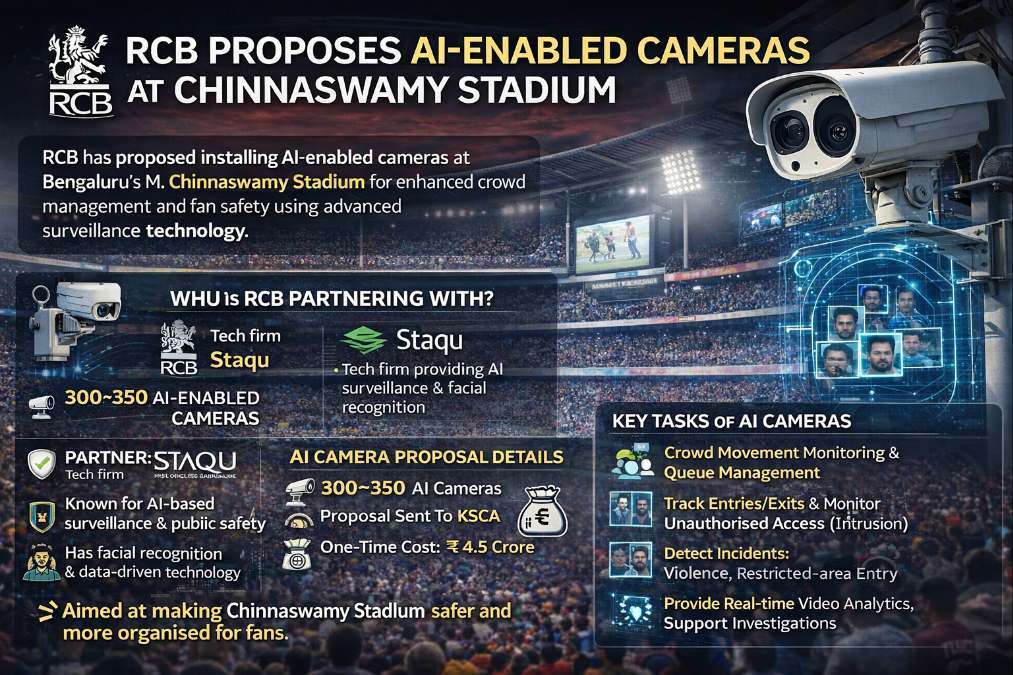
In a formal communication to the Karnataka State Cricket Association (KSCA), RCB has proposed deploying 300 to 350 AI-enabled cameras across the stadium premises. The move is aimed at significantly improving crowd management, access control, and overall matchday safety.
Partnership with Staqu
As part of the initiative, RCB has partnered with Staqu, a technology firm known for its work in AI-driven public safety, facial recognition, and intelligent surveillance systems. Staqu’s solutions are already used by multiple State Police forces in India for monitoring and investigations.
Real-Time Monitoring & Incident Detection
According to the proposal, the AI system will enable:
- Real-time tracking of entries and exits
- Monitoring of crowd density and movement
- Enforcement of disciplined queueing
- Detection of unauthorised access or intrusions
The technology also includes advanced AI video analytics, capable of identifying incidents such as violence, restricted-area breaches, and suspicious activity, allowing swift response by law-enforcement agencies.
Boost to Fan Safety & Investigations
The integrated solution leverages analysis of video, audio, and text data to support faster and more accurate decision-making. Beyond live match operations, it can also assist authorities in post-incident investigations, further strengthening stadium security standards.
RCB to Bear Full Cost
RCB has committed to bearing the entire one-time cost of the project, estimated at approximately ₹4.5 crore. This means the financial burden will not fall on KSCA or government agencies.

Credits: RCB CARES | RAAD WORLD (AI-assisted presentation)
A Step Towards Smarter Stadiums
Chinnaswamy Stadium is one of India’s busiest cricket venues, especially during IPL matches. With large crowds and high-energy environments, effective crowd management remains a critical challenge.
The proposed AI-enabled surveillance system is expected to elevate safety benchmarks and deliver a secure, seamless experience for fans. If approved, the initiative could set a new benchmark for technology-driven crowd management at sports venues across India.
Conclusion:
RCB’s proposal to install AI-enabled cameras at the M. Chinnaswamy Stadium reflects a forward-looking approach to fan safety, crowd management, and smart stadium operations.
By partnering with a proven AI technology provider and committing to bear the full cost of the project, RCB has demonstrated strong responsibility beyond the field of play.
If implemented, this initiative has the potential to not only enhance security and streamline matchday operations in Bengaluru but also set a national example for technology-driven crowd control at major sporting venues across India.
About The Author