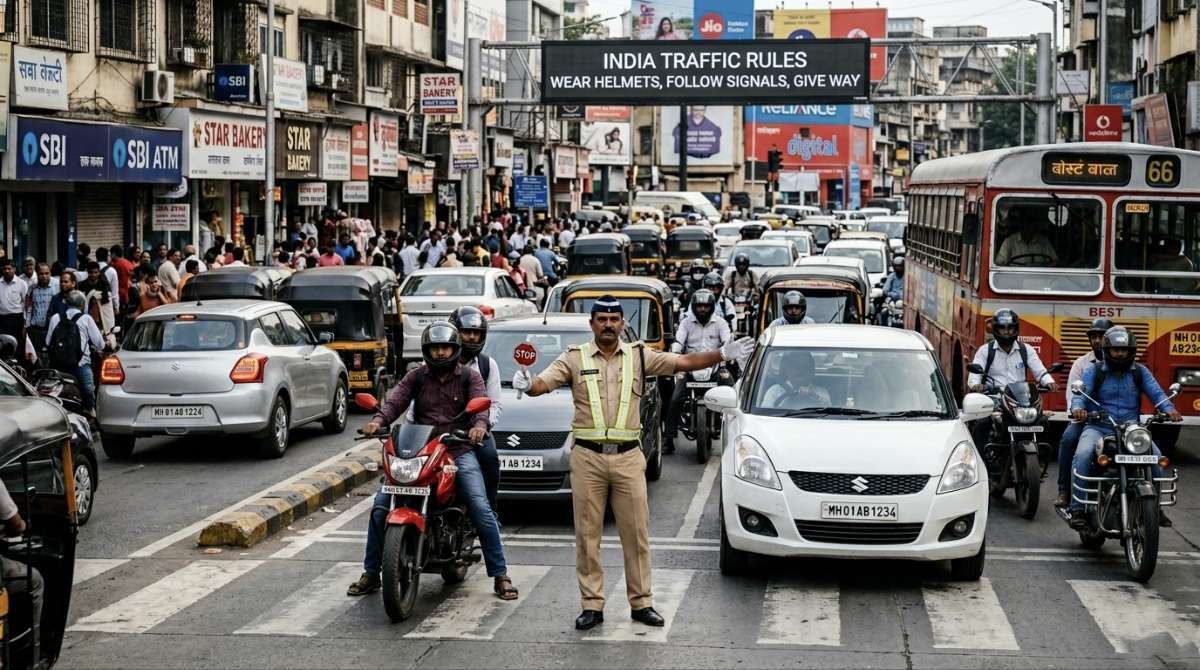
Traffic rules in India are governed by the Motor Vehicles (Amendment) Act, 2019, which continues to be the foundation of road safety laws in 2026. While the central government sets the framework, enforcement and fine amounts may vary slightly across different states.
Overview of Traffic Rules in India
India follows a unified traffic regulation system under the Ministry of Road Transport and Highways (MoRTH). However, state traffic police departments have the authority to enforce and slightly modify penalties. Law Base Motor Vehicles (Amendment) Act, 2019 Applies To All states and union territories Enforcement State Traffic Police + RTO
Common Traffic Violations & Penalties (India)
| Violation | Penalty |
|---|---|
| Driving Without Licence | ₹5,000 |
| Without Insurance | ₹2,000 (First), ₹4,000 (Repeat) |
| Without Helmet | ₹1,000 + Licence Suspension |
| Seat Belt Not Wearing | ₹1,000 |
| Triple Riding | ₹1,000 + DL Suspension |
| Overspeeding (LMV) | ₹1,000 – ₹2,000 |
| Overspeeding (Heavy Vehicle) | ₹2,000 – ₹4,000 |
| Drunk and Drive | ₹10,000 + Jail |
READ THIS: New Aadhaar App Update 2026
State-Wise Traffic Rules in India
Karnataka Traffic Rules
Karnataka follows central rules but imposes strict enforcement in cities like Bengaluru. Overspeeding fines can go up to ₹3,000 depending on severity.
Maharashtra Traffic Rules
Maharashtra (Mumbai, Pune) has strict penalties for signal jumping and drunk driving. E-challan system is widely used.
Delhi Traffic Rules
Delhi has one of the strictest traffic enforcement systems with high penalties and digital surveillance.
Tamil Nadu Traffic Rules
Tamil Nadu enforces helmet rules strictly and uses AI-based traffic monitoring in cities like Chennai.
Telangana Traffic Rules
Hyderabad traffic police impose heavy fines for signal violations and rash driving.
Uttar Pradesh Traffic Rules
UP has increasing enforcement with digital challan systems across major cities.
West Bengal Traffic Rules
Kolkata traffic police focus on pedestrian safety and signal discipline. Kerala Traffic Rules
Kerala uses AI cameras and has strict drunk driving enforcement policies.
Gujarat Traffic Rules
Ahmedabad and Surat have strict monitoring with heavy fines for violations.
Rajasthan Traffic Rules
Rajasthan enforces highway safety rules and overspeeding penalties strictly.
Important Note About “New Traffic Rules 2026”
There is no official nationwide announcement stating that new traffic rules came into effect in April 2026. Most viral posts circulating on social media are misleading.
Digital Enforcement in India
- E-Challan System
- AI-Based Traffic Cameras
- Online Fine Payment Portals
Tips to Avoid Traffic Fines
- Always carry valid driving licence
- Wear helmet and seat belt
- Follow speed limits
- Keep insurance and RC updated
- Avoid drunk driving
READ THIS: New Parliament Attendance Rule 2026
Conclusion
Traffic rules in India are strict and designed to improve road safety. While penalties are mostly uniform, slight variations exist across states. Always verify updates from official sources like MoRTH or your state traffic police website.
About The Author