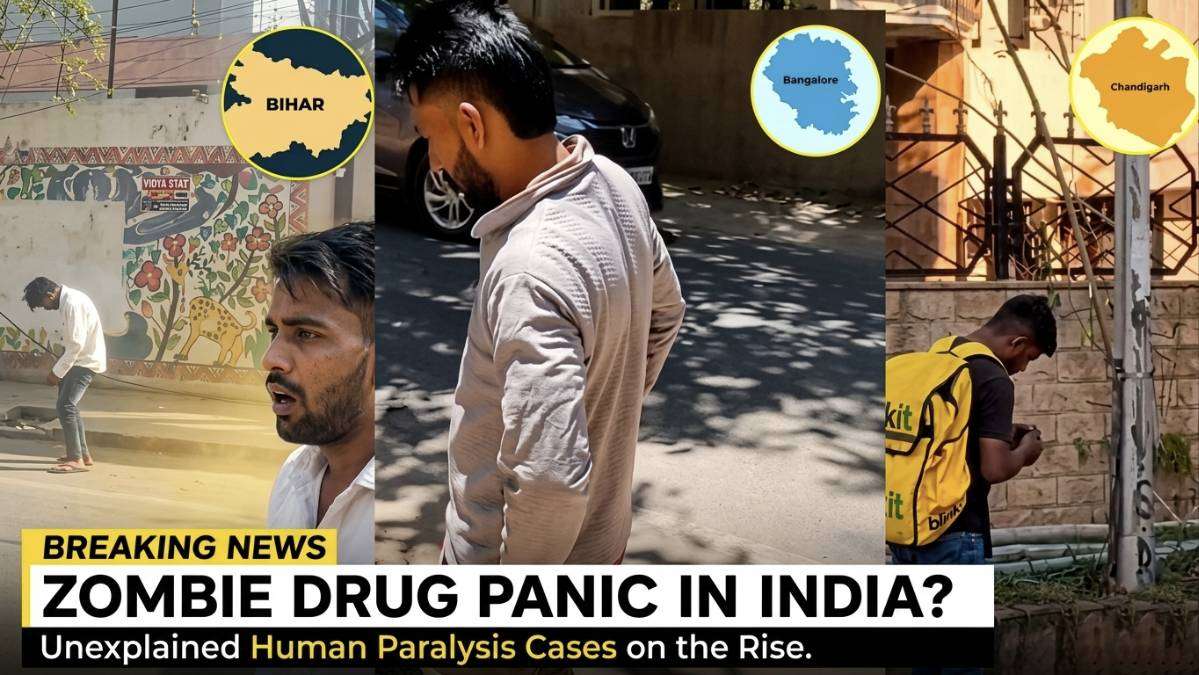
In recent days, social media platforms have been flooded with alarming posts claiming that a so-called “zombie virus” or “zombie drug” has reached India.
Viral visuals showing individuals standing motionless in public places have triggered panic, especially with claims linking incidents to Bengaluru, Punjab, and Bihar. However, a closer look at verified reports and official statements reveals a very different reality.
This article presents a fact-checked, evidence-based analysis of these claims.
Source: Social Media Video|Verified and Published by RAAD WORLD
Bengaluru Case: Official Investigation and Findings
The most widely circulated viral video originated from Bengaluru, where a man was seen standing still on a roadside, leading to speculation that he was under the influence of a “zombie drug.”
However, Bengaluru Police conducted a detailed investigation and issued a clear clarification. According to official findings, the individual in the viral video was not under the influence of any narcotic or psychotropic substance.
Medical examination confirmed that no drugs were present in his system. Authorities stated that his unusual behavior was likely caused by a combination of prescribed medication and alcohol, not any illegal substance.
Police also took legal action against individuals responsible for spreading misleading content, emphasizing that sharing unverified information can create unnecessary panic in society.
This makes it clear that the Bengaluru case, which fueled the entire narrative, has been officially debunked.
Punjab and Bihar Claims: No Verified Evidence
The viral posts also mention Punjab and Bihar as locations where “zombie drug cases” have reportedly emerged. However, there is no official confirmation from police departments, health authorities, or government agencies in either state.
No FIR records, public advisories, or medical alerts have been issued to support these claims. Available information originates primarily from social media posts and short-form videos, which lack credibility and verification.
In fact, even in cases where unusual behavior was observed in public, authorities have not linked such incidents to any specific drug or chemical substance.
Therefore, claims about widespread cases in Punjab and Bihar remain unverified and should be treated as misinformation.
Understanding the “Zombie Drug” Term
The term “zombie drug” is not a scientific or medical classification. It is commonly used in media to describe substances like xylazine, a veterinary sedative not approved for human use.

Globally, xylazine has been reported in certain countries, particularly in parts of the United States, where it is sometimes mixed with illegal opioids. It can cause extreme drowsiness, slowed movement, and a trance-like state.
However, there is no confirmed evidence of widespread xylazine abuse or outbreaks in India. Even authorities in Karnataka have clarified that the Bengaluru incident had no connection to such substances.
Role of Social Media in Spreading Panic
The rapid spread of this misinformation highlights a growing issue: the power of viral content to shape public perception without verification.
Videos showing unusual human behavior can easily be misinterpreted, especially when combined with dramatic captions and edited visuals. In this case, the use of terms like “zombie virus” and “India outbreak” amplified fear, despite the absence of factual backing.
Officials have repeatedly urged citizens to verify information before sharing it online, warning that misinformation can lead to public anxiety and unnecessary law enforcement involvement.
The claim that a “zombie virus” or widespread “zombie drug outbreak” has reached India is false. The Bengaluru case, which triggered national attention, has been officially investigated and debunked.
No drugs were involved. Claims related to Punjab and Bihar lack any credible or official confirmation. While the term “zombie drug” refers to real substances reported in other parts of the world, there is no evidence to suggest that such a crisis currently exists in India.
Conclusion
This incident serves as a reminder of how easily misinformation can spread in the digital age. Viral content, when not verified, can distort reality and create unnecessary fear among the public.
Relying on official sources, verified news reports, and factual evidence remains the only reliable way to understand such situations. In this case, the facts are clear: there is no zombie virus outbreak in India.
About The Author