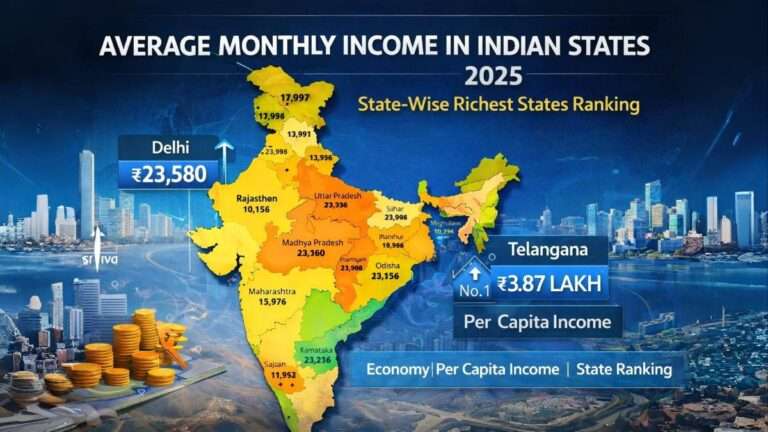
Average Monthly Income in Indian States 2025: State-Wise Richest States Ranking
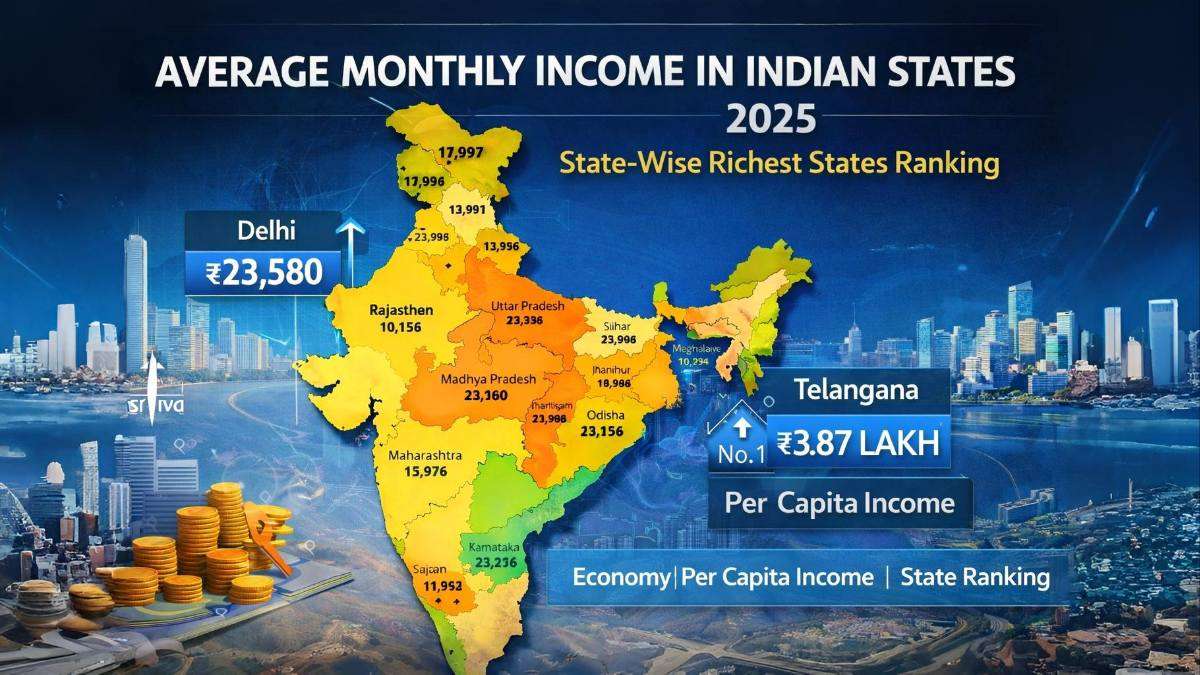
Infographic showing state-wise average monthly income and richest states ranking in India based on recent economic and labour data (2025).
Understanding the average monthly income across Indian states provides a clear picture of economic development, employment opportunities, and regional inequality in the country. Income levels vary significantly due to factors such as industrialization, urbanization, education levels, and job availability.
Recent economic studies and government surveys show that southern and western states generally have higher income levels, while several eastern and central states continue to face lower average earnings due to higher dependence on agriculture and informal labour.
This article analyzes the latest available information from official economic reports and labour surveys for 2024–2025, highlighting which states earn the most and why these differences exist.
Official Sources of the Data
The information about state-wise income levels comes from multiple official and research datasets, including:
- National Statistical Office (NSO)
- Reserve Bank of India economic data
- Centre for Sustainable Employment research
- State of Working India 2023 Report
- Periodic Labour Force Survey (PLFS)
These sources compile worker earnings from salaried employment, self-employment, and casual labour to estimate average labour income by state.
Average Monthly Labour Income in Indian States
Recent labour-market analysis shows large variations in worker earnings across India.
States with Higher Average Monthly Income
| State / UT | Average Monthly Income |
|---|---|
| Delhi | ₹23,580 |
| Goa | ₹21,849 |
| Mizoram | ₹20,205 |
| Ladakh | ₹17,977 |
| Arunachal Pradesh | ₹17,407 |
| Haryana | ₹16,246 |
| Kerala | ₹16,043 |
These regions tend to have higher service-sector employment, tourism industries, or government jobs, which increases income levels.
Middle-Income States
| State | Average Monthly Income |
|---|---|
| Karnataka | ₹14,938 |
| Punjab | ₹14,856 |
| Maharashtra | ₹14,471 |
| Rajasthan | ₹13,990 |
| Tamil Nadu | ₹13,593 |
| Gujarat | ₹13,266 |
| Andhra Pradesh | ₹12,873 |
These states benefit from industrial growth, agriculture, and expanding urban economies.
For example, the technology industry in Bengaluru has significantly improved earnings in Karnataka.
States with Lower Average Monthly Income
| State | Average Monthly Income |
|---|---|
| Bihar | ₹11,172 |
| Assam | ₹11,335 |
| Jharkhand | ₹10,254 |
| Uttar Pradesh | ₹10,156 |
| Odisha | ₹10,104 |
| West Bengal | ₹9,867 |
| Chhattisgarh | ₹9,716 |
These states often face challenges such as:
- Higher rural population
- Dependence on agriculture
- Lower industrial investment
- Limited high-paying job opportunities
Richest Indian States by Per Capita Income (2025)
Another way to measure prosperity is per capita income, which represents the average income per person in a state.
According to recent economic estimates, the leading states include:
| Rank | State | Per Capita Income |
|---|---|---|
| 1 | Telangana | ₹3.87 lakh |
| 2 | Karnataka | ₹3.80 lakh |
| 3 | Tamil Nadu | ₹3.61 lakh |
| 4 | Haryana | ₹3.50 lakh |
| 5 | Gujarat | ₹3.13 lakh |
Rapid economic growth in Telangana is driven by strong investment in technology, pharmaceuticals, and infrastructure development in Hyderabad.
Largest State Economies in India
By total economic size (Gross State Domestic Product), the largest state economies include:
| Rank | State | Estimated Economy Size |
|---|---|---|
| 1 | Maharashtra | ₹42+ lakh crore |
| 2 | Tamil Nadu | ₹31+ lakh crore |
| 3 | Karnataka | ₹28+ lakh crore |
| 4 | Gujarat | ₹27+ lakh crore |
| 5 | Uttar Pradesh | ₹24+ lakh crore |
The economic strength of Maharashtra is largely supported by financial services, manufacturing, and trade centered in Mumbai, India’s financial capital.
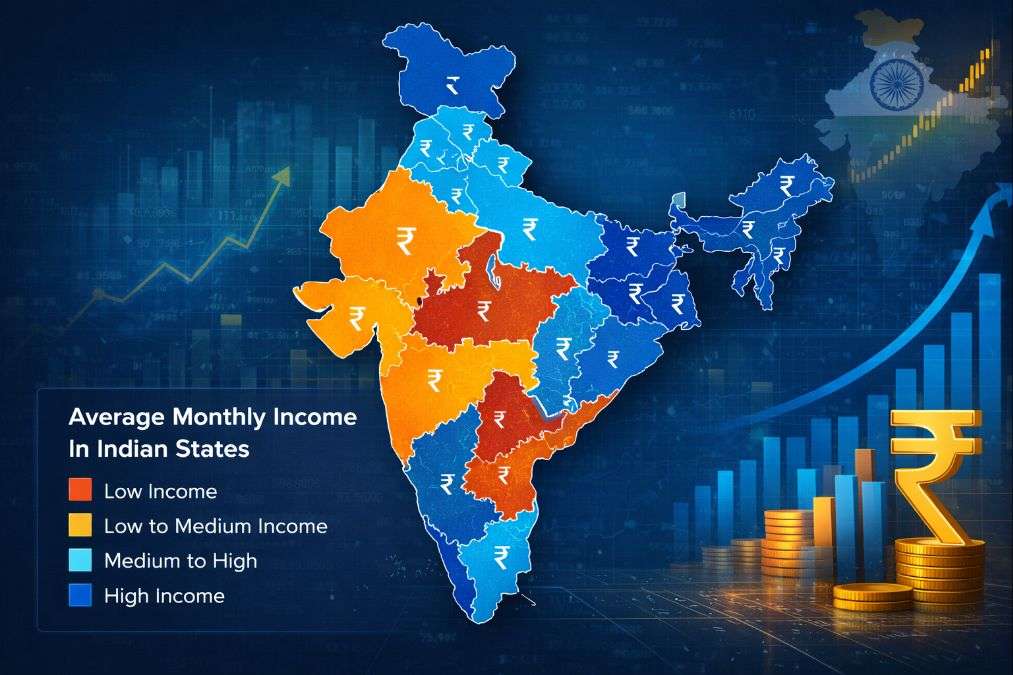
Why Income Levels Differ Between States
Several factors influence income differences across regions:
1. Industrial Development
States with strong industries and technology sectors generate more high-paying jobs.
2. Urbanization
Cities create more employment opportunities compared to rural areas.
3. Education and Skills
States with better education systems often produce skilled workers who earn higher wages.
4. Infrastructure
Transport, electricity, and digital connectivity help attract businesses and investment.
Key Economic Observations
- Southern India dominates economic growth in India.
- States with large metropolitan cities generally have higher income levels.
- Agriculture-dependent regions continue to have lower average earnings.
- Government employment plays a major role in smaller northeastern states.
Important Clarification
Average labour income does not represent the salary of all citizens. It includes:
- Casual labourers
- Self-employed workers
- Farmers
- Salaried employees
Because many workers in India are part of the informal sector, average income figures appear lower than typical urban salaries.
Conclusion:
India’s economic landscape shows significant regional differences in income and development. While states such as Telangana, Karnataka, Tamil Nadu, and Maharashtra continue to lead in economic growth, several central and eastern states still face challenges in improving worker earnings.
Bridging this gap will require in6dustrial investment, skill development, and improved infrastructure, ensuring that economic growth benefits all regions of the country.
Understanding these income trends is essential for policymakers, businesses, and citizens to evaluate India’s economic progress and future opportunities.
Frequently Asked Questions (FAQ)
1. Which state has the highest average income in India?
According to recent economic data, Telangana and Delhi are among the regions with the highest income levels in India due to strong service sectors, IT industries, and government employment opportunities.
2. What is the average monthly income in India?
The average monthly income in India varies by state and occupation. Labour income data suggests many states have average worker earnings between ₹10,000 and ₹23,000 per month.
3. Why do some Indian states have higher income levels?
States with strong industries, technology sectors, urban development, and better education systems generally have higher income levels compared to agriculture-dependent states.
4. Which states have the lowest average income in India?
States such as Bihar, Odisha, Chhattisgarh, and Jharkhand tend to have lower average incomes due to higher rural populations and fewer industrial job opportunities.
5. How is average monthly income calculated?
Average income is calculated using labour surveys that include salaries of regular workers, self-employed people, and casual labourers across different sectors.
6. What is per capita income and why is it important?
Per capita income is the average income earned per person in a state. It helps measure economic prosperity and compare living standards across regions.
About The Author



 Rahul Bidnal