CBSE 3-Language Policy 2026 Explained: What Changes from Existing Hindi-English System
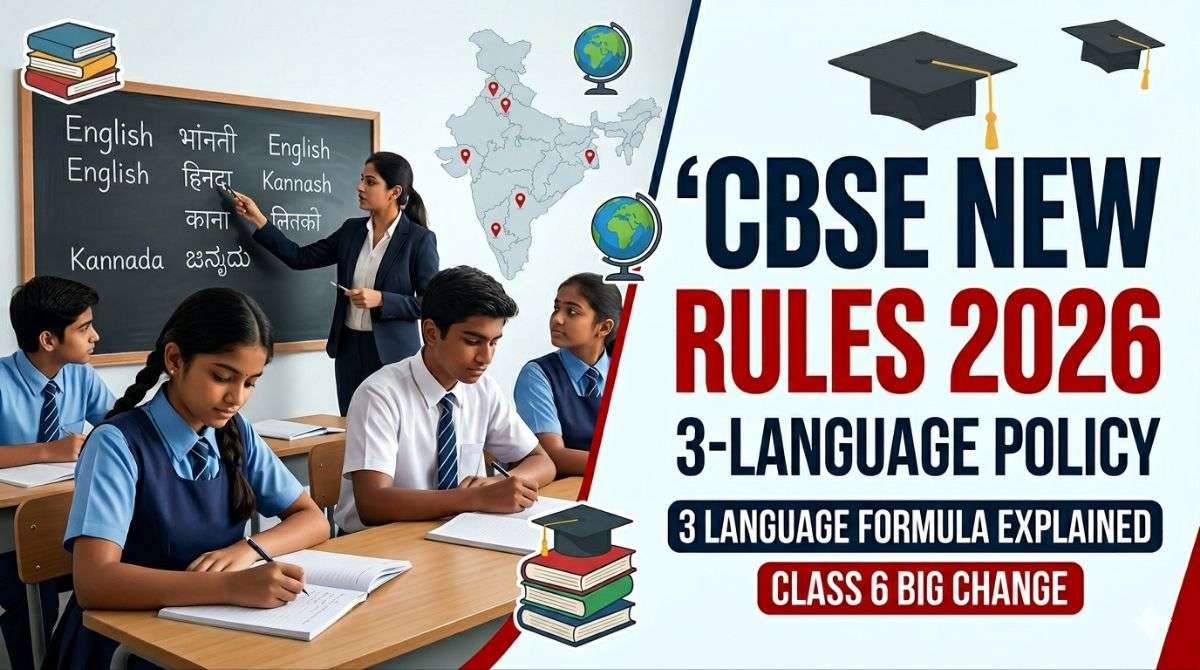
The Central Board of Secondary Education (CBSE) is set to implement a structured three-language formula from Class 6 starting the 2026–27 academic year. While language learning has always been part of the CBSE curriculum, the new policy introduces a clear and compulsory framework, replacing the earlier flexible system.
This reform is aligned with the National Education Policy 2020 (NEP 2020), which emphasizes multilingual education across India.
Existing CBSE Language System (Before 2026)
Before the new policy, CBSE schools followed a relatively flexible approach:
Most schools offered two mandatory languages:
- English
- Hindi or a regional language
A third language was available in many schools (such as Sanskrit, French, or German)
However, the third language was:
Not uniformly mandatory across all schools Often dependent on school policy and regional preferences In several southern states, including Karnataka, students commonly studied English and a regional language, with Hindi not always compulsory.
What Changes Under the New Policy
Mandatory Three-Language Structure From 2026 onwards Students must study three languages from Class 6
Languages are categorized as:
- R1 (First Language)
- R2 (Second Language)
- R3 (Third Language – compulsory)
Key Rule
At least two of the three languages must be Indian languages This removes earlier flexibility and introduces uniform implementation across CBSE schools nationwide.
Hindi Subject: Then vs Now
A major point of confusion is whether Hindi was already compulsory. Earlier Situation Hindi was widely taught in CBSE schools However It was not mandatory in all regions Some schools replaced Hindi with other Indian languages
Current Policy Position
Hindi is not specifically compulsory
But: Students must study two Indian languages This means Hindi may be one option, but not the only one
Example Combinations
- Kannada + English + Hindi
- Kannada + Tamil + English
- Hindi + Sanskrit + English
Academic and Examination Impact
From Classes 9 and 10: Students must pass all three languages The third language is no longer optional Evaluation standards are expected to be more structured under CBSE guidelines This change increases academic accountability and ensures consistent multilingual proficiency.
Policy Rationale
The three-language formula is designed to Promote multilingual competence Strengthen Indian linguistic diversity Improve cognitive and communication skills.
Align school education with national education reforms The policy reflects NEP 2020’s vision of creating students who are proficient in multiple languages from an early stage.
Karnataka Perspective
In Karnataka, the development has sparked debate The state government has shown preference for a two-language formula (Kannada and English)
However: CBSE-affiliated schools in the state are required to follow central board policies This creates a structural difference between state board and CBSE curriculum frameworks.
Key Differences: Old vs New System
| Aspect | Previous System | New Policy (2026) |
|---|---|---|
| Number of Languages | Mostly 2 mandatory | 3 mandatory |
| Third Language | Optional / flexible | Compulsory from Class 6 |
| Hindi Requirement | Common but not universal | Not compulsory, but 2 Indian languages required |
| Policy Basis | Traditional CBSE structure | NEP 2020 framework |
CBSE Schools in India: Availability and National Presence
Central Board of Secondary Education (CBSE) is one of the largest school education boards in India, with a widespread presence across urban, semi-urban, and rural regions.
As per official data, over 28,000 schools in India are affiliated with CBSE. In addition, more than 240 schools operate internationally, reflecting the board global reach.
National Distribution
CBSE schools are available in almost every state and union territory in India. States such as Uttar Pradesh, Maharashtra, Karnataka, Tamil Nadu, and Delhi have a high concentration of affiliated institutions.
Urban centers account for a significant share of CBSE schools, but the network has steadily expanded into rural and semi-urban regions as well.
Types of CBSE Schools
CBSE-affiliated institutions in India broadly fall into three categories:
Private Schools:
These form the majority, offering English-medium education with modern infrastructure and facilities.
Government Schools:
Institutions such as Kendriya Vidyalaya and Jawahar Navodaya Vidyalaya provide CBSE curriculum with affordable or free education, especially benefiting rural and transferable families.
International CBSE Schools:
Located mainly in metropolitan cities, these schools follow CBSE with a global-oriented approach.
Growth and Demand
The number of CBSE schools has grown rapidly in recent years, particularly after the implementation of the National Education Policy 2020. Increasing preference for CBSE is driven by.
Alignment with national-level competitive exams such as JEE and NEET Standardized curriculum across India English-medium instruction and broader career opportunities.
Karnataka Perspective
In Karnataka, CBSE has a strong and growing presence, with over 1,000 affiliated schools. Major cities such as Bengaluru, Hubballi-Dharwad, and Mysuru have a high concentration of CBSE institutions, making it one of the most preferred education boards in the state.
READ THIS: Karnataka SSLC 2026 New Rules Explained
Conclusion
The CBSE three-language policy does not introduce language learning for the first time but transforms an existing flexible system into a structured and compulsory framework.
While Hindi and other languages were already part of the curriculum, the key change lies in uniform enforcement and earlier implementation from Class 6.
As the policy rolls out from 2026, students, parents, and schools will need to adapt to a more standardized multilingual education system aligned with national policy goals.
About The Author