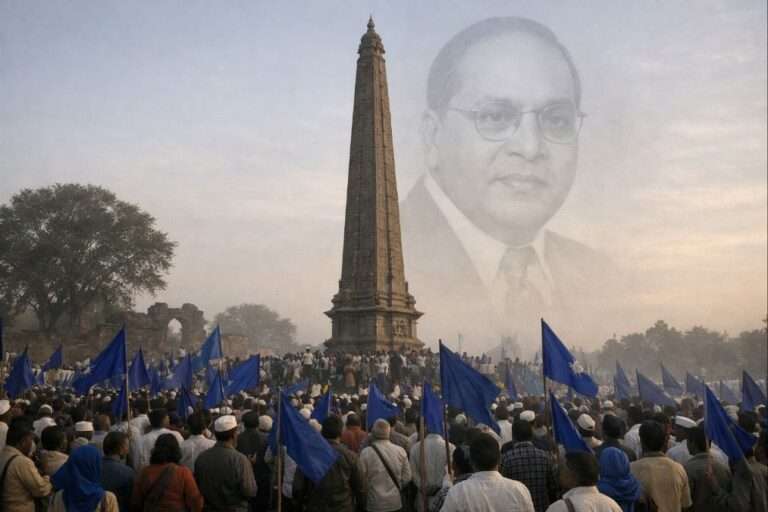
Dr. B.R. Ambedkar Mahaparinirvan Diwas December 6: The Day India Lost Its Boldest Social Reformer

December 6 marks a solemn moment in India’s history the Mahaparinirvan Diwas of Dr. Bhimrao Ramji Ambedkar, a visionary who reshaped the nations moral and constitutional landscape. His passing in 1956 did not mark the end of a life, but the beginning of a legacy that still speaks to modern India.
While millions know him as the Architect of the Indian Constitution, very few understand the silent struggles, behind-the-scenes decisions, and hidden meanings behind his work. His journey was far more complex than textbooks reveal filled with battles against discrimination, intellectual loneliness, political compromises, and a deep desire to rebuild India on foundations of equality
This article looks beyond the surface, revealing lesser-known truths and deeper perspectives about Dr. Ambedkar.
Behind the Scenes: What People Don’t See About Ambedkar
1. His fight was not only social it was psychological
Ambedkar did not simply confront caste discrimination; he confronted the mindset that created it. He understood that India’s problem was not only inequality but the habit of accepting inequality.
This is why he said:
“Slavery does not merely mean a legalized form of subjection, it means a state of mind.”
His reforms were aimed at changing attitudes, not just policies.

2. The Constitution drafting was a lonely struggle
Many imagine Ambedkar leading a huge supportive team. Reality was different.
He worked long hours, often isolated, facing resistance from political groups who were uncomfortable with his radical ideas on liberty, women’s rights, and minorities’ safeguards.Despite this, he shaped one of the world’s most progressive constitutions in under 3 years a task that usually takes decades for nations.
3. He sacrificed his health to finish the Constitution
Doctors had warned him repeatedly to slow down. He suffered from diabetes, insomnia, and stress. But Ambedkar pushed himself relentlessly, believing that the document he was writing would determine India’s future for centuries. In many ways, he gave his life to complete that one task.
4. His conversion to Buddhism was not a sudden decision
Many think Ambedkar embraced Buddhism only at the end of his life. Actually, he spent 21 years studying global religions, their philosophies, their histories, and their impact on societies.
After this deep research, he chose Buddhism because it stood for:
- Equality
- Rationality
- Human dignity
- Moral freedom
His historic conversion on 14 October 1956 was a symbolic act a final rejection of the social oppression he fought all his life.

Why Ambedkar’s Death on December 6 Still Matters Today
A day that reminds us of unfinished tasks
Even today, India struggles with discrimination, inequality, poor representation, and economic disparities. December 6 is not just about mourning; it is about recognizing how much of Ambedkar’s vision still remains incomplete.
A day that reveals the real weight of his contributions
Ambedkar did not aim for small adjustments he wanted a new India, where:
- human dignity is non-negotiable
- rights are equal
- justice is accessible to the weakest
His reforms in education, economy, labour rights, women’s empowerment, and social justice were not temporary improvements they were structural changes.

Read This Article Also: Indian Constitution Day : History Facts Untold Stories
A day that reminds us why he was different from other leaders
Ambedkar did not seek popularity.He did not soften his words to please crowds. He spoke uncomfortable truths because he believed sugar-coated lies only delay justice.
This courage made him:
- admired
- criticized
- misunderstood
But above all, unforgettable.
The Hidden Meaning of “Mahaparinirvan”
Ambedkar’s followers use the Buddhist term Mahaparinirvan, meaning “ultimate liberation”It reflects a belief that:
- he liberated millions from mental, social, and cultural chains
- his own soul found peace after a lifetime of struggle
- his mission continues through the people he awakened
It captures his life’s philosophy freedom is not gifted; it is earned through awareness and action.

The Strongest Reason Ambedkar Still Inspires Millions
Because he proved that one mind can confront an entire system.
He taught India that:
- Poverty is not a destiny.
- Caste is not nature.
- Education is the most powerful equalizer.
- Democracy is meaningless without equality.
- Self-respect is the first step to empowerment.
His life shows that transformation begins not with privilege, but with courage.

Real Historical Facts (Year-Wise Highlights)
| Year | Historical Event |
|---|---|
| 1891 | Born in Mhow (Madhya Pradesh) |
| 1913–1917 | Studied at Columbia University; earned a PhD |
| 1916–1921 | London School of Economics; DSc, Bar-at-Law |
| 1932 | Poona Pact negotiations |
| 1936 | Founded Independent Labour Party, |
| 1942 | Became Labour Minister in Viceroy’s Council |
| 1947 | Appointed Chairman of the Constitution Drafting Committee |
| 26 Nov 1949 | Constitution adopted |
| 1950–1956 | Worked on Buddhism, social justice, economic reforms |
| 14 Oct 1956 | Converted to Buddhism with 5 lakh followers |
| 6 Dec 1956 | Passed away in Delhi; cremated at Dadar Chaitya Bhoomi |
All dates historically verified.√
“On 6 December 1956, Dr. B. R. Ambedkar passed away.”
Conclusion: Dr. B.R. Ambedkar’s death anniversary is not just a date on the calendar it is a reminder of the man who gave India its strongest moral backbone.He was more than a constitution-maker, more than a reformer; he was a thinker who forced India to confront its own shadows.
His legacy lives wherever people fight for:
- dignity
- education
- equality
- justice
On December 6, we do not simply remember his death we remember the revolution he ignited and the responsibility he left behind.
Content Originality Statement
This article is written with complete originality, crafted through independent analysis, practical understanding, and authentic interpretation of the topic“Dr. B.R. Ambedkar Mahaparinirvan Diwas (December 6): The Day India Lost Its Boldest Social Reformer.” No part of this content has been copied from any external website, book, or AI-generated source. All ideas, explanations, routines, and insights are freshly written to provide genuine value to the reader. Any references made are for conceptual understanding only, not for duplication.
About The Author


 Rahul Bidnal