Prologue: The Tyranny of the Single Name
We tell the story of science as a procession of solitary geniuses Newton under his apple tree, Einstein in his patent office, Curie in her shed. This mythology is clean, compelling, and almost entirely wrong. For every household name etched in textbooks, there are dozens whose contributions were equally vital, yet whose stories have been erased by time, prejudice, circumstance, or sheer bad luck. Their insights course through the veins of our modern world in the devices we hold, the medicines that save us, the equations that unlock the cosmos yet their names stir no recognition.
This is not merely an exercise in historical housekeeping. To recover these stories is to correct a profound injustice, but also to understand the true, collaborative, and often messy nature of discovery. It is to meet the human beings with their resilience, their heartbreak, their quiet dedication who built our reality from the shadows.
The Woman Who Mapped the Stars: Williamina Fleming and the Harvard Computers
In 1879, a Scottish woman named Williamina Paton Stevens Fleming found herself in Boston, abandoned by her husband and forced to support herself and her infant son. She took a job as a housemaid for Professor Edward Charles Pickering, director of the Harvard College Observatory. Frustrated with his male assistants, Pickering famously declared, “My Scottish maid could do better!” He soon gave her a chance to prove it.
Her Unseen Work: Pickering hired Fleming to do clerical work, but her sharp mind quickly grasped the fundamentals of astronomy. She was placed in charge of a revolutionary project: analyzing photographic plates of the night sky. Pickering had hired dozens of women called “computers” for their mathematical skill to catalog the stars. Fleming, eventually titled the Curator of Astronomical Photographs, became their leader.
She developed a system to classify stars by their hydrogen spectral signatures, cataloging over 10,000 stars. She discovered 59 gaseous nebulae, over 310 variable stars, and 10 novae. Most famously, she identified the “Horsehead Nebula” on a photographic plate in 1888. Her work created the foundation for the Harvard Classification Scheme, the direct precursor to the modern OBAFGKM stellar classification system that every astronomy student learns.
The Heartbreak & The Legacy: Despite her monumental output, Fleming was paid a fraction of a man’s wage. Her official title was a battle. Her male colleagues received accolades for work built on her systems. In her diary, she wrote with poignant frustration: “A woman’s work must be twice as good as a man’s to receive half the credit.” She died of pneumonia in 1911, largely unknown to the public.
Her true legacy is not just in the stars she cataloged, but in the pipeline of genius she mentored: Annie Jump Cannon, who perfected the classification system; Henrietta Swan Leavitt, who discovered the period-luminosity relationship that allowed us to measure the universe’s size Cecilia Payne-Gaposchkin, who first determined stars are composed mostly of hydrogen. They were the “Harvard Computers,” and Williamina Fleming was their pioneering heart, mapping the cosmos from a desk in Cambridge.
[RAAD WORLD AI-Generated Image]
READ THIS: Ravindra Kaushik The Black Tiger of India Untold Story of RAW’s Greatest Spy
The Forgotten Father of the Computer: John Atanasoff
The story of the computer’s invention is often told as a straight line from Charles Babbage’s Difference Engine to Alan Turing’s theoretical machine to the ENIAC, built at the University of Pennsylvania. Lost in this telling is a frustrated physicist in a basement in Ames, Iowa.
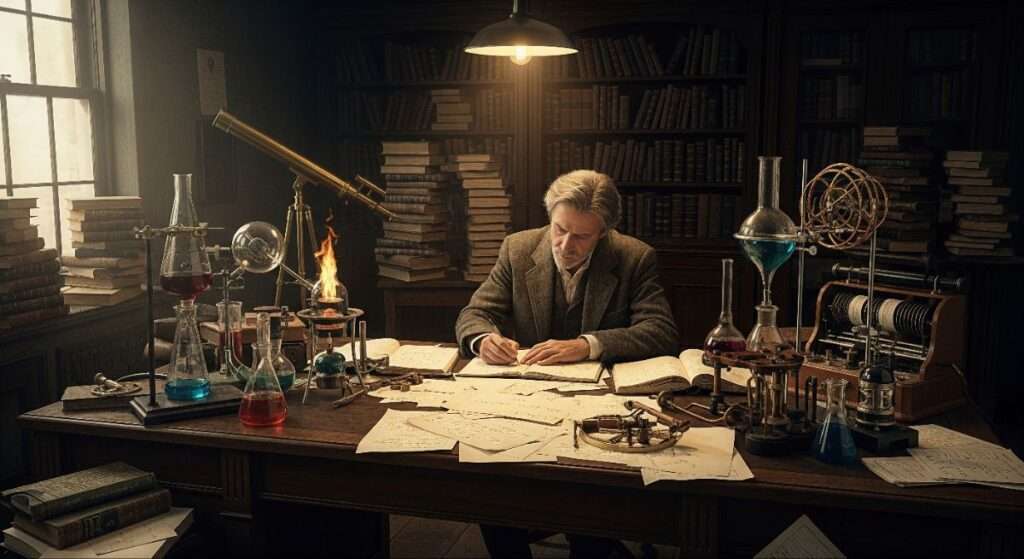
His Unseen Work: In the late 1930s, John Atanasoff, a professor at Iowa State College, grew exasperated with the slow, mechanical grind of solving complex linear equations. On a long, solitary winter drive in 1937, the core concepts flooded his mind: a machine that would use binary numbers, direct logical action (not enumeration), regenerative capacitor memory, and electronic switching (not mechanical). With a brilliant graduate student, Clifford Berry, he built the Atanasoff-Berry Computer (ABC) by 1942. It was the first machine to use binary digits for all data, to separate computation from memory, and to use electronics for arithmetic. It worked.
The Heartbreak & The Legacy: Then, World War II intervened. Atanasoff was called to a naval ordnance lab. The ABC, left in the Iowa State basement, was cannibalized for parts and forgotten. In 1945, the ENIAC was unveiled to global acclaim as the “first electronic digital computer.” Atanasoff watched, knowing what he had built. For decades, he received no credit.
The truth only emerged in a 1973 federal lawsuit (Honeywell v. Sperry Rand). After a lengthy trial, a judge unequivocally ruled: “Eckert and Mauchly [ENIAC’s inventors] did not themselves first invent the automatic electronic digital computer, but instead derived that subject matter from one Dr. John Vincent Atanasoff.” It was a landmark vindication, but history’s narrative had already hardened. Atanasoff died in 1995, remembered by the tech world as a footnote, despite a judge’s decree that he was the true originator. His story is a testament to the cruel accident of timing and the power of institutional public relations to shape history.
[RAAD WORLD AI-Generated Image]
READ THIS: World’s Biggest Bike Nations in 2026 | Global Motorcycle Ownership
The Man Who Saw the Unseen: Fritz Haber’s Tragic Counterpart, Clara Immerwahr
The name Fritz Haber is infamous: the Nobel Prize-winning chemist who pioneered the fixation of nitrogen from air, feeding billions, and who also pioneered chemical warfare in WWI, poisoning thousands. But the story of his first wife, Clara Immerwahr, is a haunting tale of moral conscience crushed by patriarchal ambition.
Her Unseen Work: Clara was a brilliant scientist in her own right. In 1900, she became the first woman to earn a PhD in chemistry from the University of Breslau, with a dissertation on electrochemistry that was praised for its precision. After marrying Haber, she sacrificed her formal career, as was expected, but remained his intellectual partner, translating and editing his work, and conducting critical laboratory research. She was intimately involved in the early nitrogen fixation experiments, though her name appears nowhere on the papers. Her scientific mind was sharp, and her ethical compass was even sharper.
The Heartbreak & The Legacy: When Haber enthusiastically donned a uniform to deploy chlorine gas at Ypres in 1915, Clara was horrified. She called his work a “perversion of the ideals of science” and a “sign of barbarity.” They had furious, private arguments. Haber dismissed her, celebrating his “success” with an officer’s party at their home. That same night, May 2, 1915, Clara took Haber’s service revolver, walked into their garden, and shot herself in the heart. She was 44.
Her suicide was a private, profound protest against the weaponization of science. History wrote her off as a depressed wife. But in recent decades, scholars see Clara Immerwahr as a martyr of scientific ethics. In a world celebrating Haber’s “genius” while wrestling with his legacy, Clara represents the silenced voice of conscience the brilliant scientist whose greatest, most tragic contribution was to ask, at the cost of her life, “Just because we can, does it mean we should?”
[RAAD WORLD AI-Generated Image]
READ THIS: The Psychology Behind Human Behavior
The Man Who Could Have Been Einstein: Satyendra Nath Bose
In 1924, a young Indian physicist from Dhaka, Satyendra Nath Bose, sent a paper to Albert Einstein. It was a radical derivation of Planck’s quantum radiation law, treating light as a gas of identical particles and using a novel statistical method. The journal Philosophical Magazine had already rejected it.
His Unseen Work: Bose, undeterred, mailed his paper directly to Einstein in Zurich, writing, “I am anxious to know what you think of it.” Einstein immediately recognized its brilliance. He translated the paper into German himself and submitted it to the prestigious Zeitschrift für Physik with his strong endorsement. Furthermore, Einstein extended Bose’s ideas to atoms, predicting a new state of matter: the Bose-Einstein Condensate.
Bose returned to India, becoming a revered teacher and researcher, but he worked in relative isolation from the European centers of scientific fame. He embodied a colonial-era tragedy: the genius from the periphery who provides a foundational piece of the puzzle but is never fully centered in the story. The term “boson” is his eternal, if under-sung, monument.
The Architect of the Genetic Age: Rosalind Franklin
No story of forgotten genius is more emblematic than that of Rosalind Franklin. Her name is now often attached to the discovery of DNA’s structure, but for decades she was a caricature: the difficult, sidelined woman who produced “Photo 51.”
Her Unseen Work: At King’s College London in the early 1950s, Franklin, an expert in X-ray crystallography, was tasked with imaging DNA fibers. With meticulous skill, she created the sharpest images of DNA yet seen. Her famous Photo 51, taken by her student Raymond Gosling under her direction, was a revelation—an X-shaped pattern that screamed “helix.” Her notebooks show she was close to solving the structure, carefully analyzing the dimensions and the phosphate-backbone-outward orientation. In early 1953, without her knowledge or consent, her colleague Maurice Wilkins showed Photo 51 to James Watson. It was the crucial piece Watson and Francis Crick needed.
The Heartbreak & The Legacy: When Watson and Crick published their double helix model in Nature in April 1953, they included a single, dismissive sentence acknowledging Franklin’s work: “We have also been stimulated by a knowledge of the general nature of the unpublished experimental results and ideas of Dr. M.H.F. Wilkins, Dr. R.E. Franklin, and their co-workers…” They presented her data as confirmatory, not foundational. Franklin, a stickler for rigor, reportedly felt their model was plausible but wanted more proof. She tragically died of ovarian cancer in 1958 at 37. In 1962, Watson, Crick, and Wilkins received the Nobel Prize. The rules prohibit posthumous awards, so Franklin could not be considered.
Her story is not just one of data theft (though it includes that). It is the story of a brilliant, precise, and independent scientist working in a hostile, sexist environment, whose critical contribution was minimized until historians and activists fought to restore her to her rightful place in the narrative. She did not just take a picture; she provided the essential architectural blueprint.

[RAAD WORLD AI-Generated Image]
READ THIS: Bhima Koregaon History
Epilogue: Why Remember?
Why does it matter to dig up these stories? It matters because the myth of the lone (usually male) genius is not just inaccurate; it is harmful. It discourages collaboration, inflates egos, and writes out the essential contributions of women, people of color, and those from outside traditional power centers.
Recovering these lives does something profound: it humanizes science. We see the maid supporting her son, the father fighting for credit, the wife dying of despair, the colonial subject mailing a letter into the void, the meticulous woman barred from the common room. Their genius was not a superhuman trait; it was a human one persistent, creative, and often born of struggle.
When we learn their names Fleming, Atanasoff, Immerwahr, Bose, Franklin we do more than correct a historical record. We change our understanding of how discovery truly happens. We see that the edifice of human knowledge is built not by solitary titans, but by a countless, often unnamed, multitude. It is built in basements in Iowa and at drafting tables in India, in the notebooks of women whose colleagues ignored them, and in the moral courage of those who said “no.” Their legacy is the world we live in. The least we can do is learn who they were.
Conclusion:
History is not always fair. It remembers loud victories but often ignores silent brilliance. Many genius minds worked in isolation, without support, fame, or reward, yet their ideas shaped science, philosophy, and human progress in ways we still benefit from today.
Remembering these forgotten minds is not just about correcting history it is about understanding that true intelligence does not always receive instant recognition. Their stories remind us that value is not measured by popularity, and that even ignored ideas can change the future. By learning about these unsung geniuses, we keep their legacy alive and inspire a new generation to think beyond fame and recognition.
About The Author


 Creator Adarsh