Since Independence in 1947, India has had several Prime Ministers who shaped the country’s politics, economy and society in different ways. Each leader worked in a different historical situation – from food shortages and wars to globalization, IT growth and today’s digital economy.
Before we go Prime Minister–wise, remember one important point about GDP:
- GDP growth is not controlled by one person. It depends on world conditions, monsoon, oil prices, global crises, domestic reforms, etc.
- Data also changes slightly from source to source because of methods and base-year changes. Here, GDP numbers are rounded and meant to show general trend, not an exact exam-table.
Sources used include World Bank and India’s official statistics, plus compiled averages (for example, Government of India statistics posts and independent analyses).
1. Jawaharlal Nehru (15 Aug 1947 – 27 May 1964)
Context:
- India had just become independent, with Partition violence, refugees, weak industry and almost no modern infrastructure.
Major Work and Policies
- Built the base of a parliamentary democracy, with a strong Constitution and institutions.
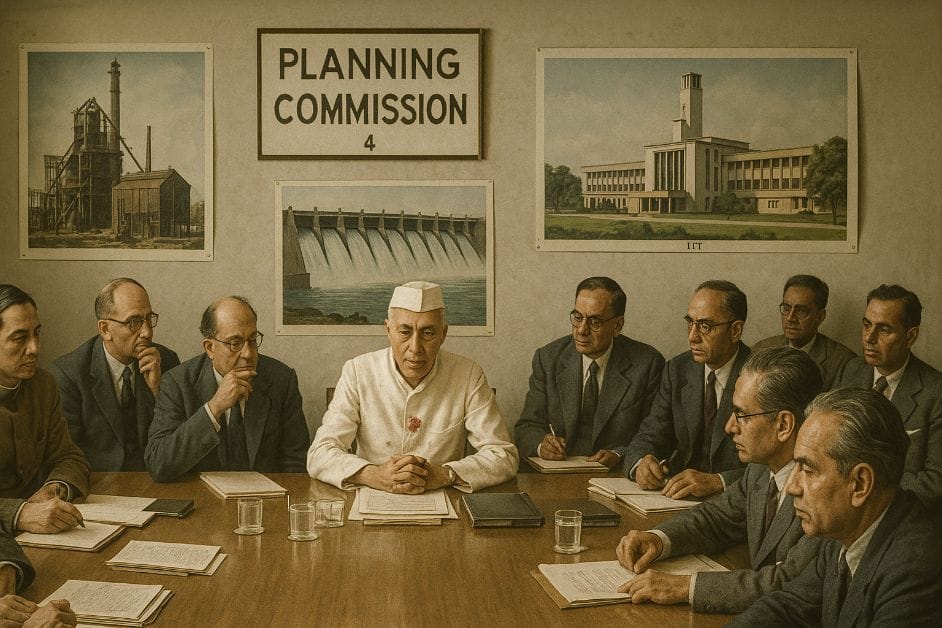
- Introduced planned economic development through Five-Year Plans and a mixed economy (public + private sectors).
- Focus on heavy industries (steel, power, engineering) and large public sector units like Bhilai and Rourkela steel plants.
- Promoted scientific temper – creation of IITs, CSIR, atomic energy programme and large dams (“temples of modern India”).
- Foreign policy of Non-Alignment (NAM) and leadership in Afro-Asian solidarity.
Economy & GDP
- Early decades are often called the “Hindu rate of growth”, roughly around 3–4% per year in real terms on average.
- However, this period laid the industrial and institutional foundation for later growth.
Important Schemes / Initiatives
- Community Development Programmes and early rural schemes.
- Expansion of irrigation and power through big dam projects (Bhakra-Nangal, Damodar Valley, etc.).
2. Gulzarilal Nanda (Acting PM: May–Jun 1964, and Jan 1966)
He served twice as acting Prime Minister after the deaths of Nehru and Lal Bahadur Shastri.
Role and Work
- His main work was to ensure continuity and stability until the Congress party chose the next full-time Prime Minister.
- No major long-term economic policies started in these very short interim periods.
3. Lal Bahadur Shastri (9 Jun 1964 – 11 Jan 1966)
Context:
- Food shortages, war with Pakistan (1965), and pressure on the economy.
Major Work
- Famous call “Jai Jawan, Jai Kisan” – focus on both defence and agriculture.
- Encouraged Green Revolution seeds, fertilizers and irrigation, especially in Punjab, Haryana and western UP (implementation expanded
- under Indira Gandhi).
- Led India during the 1965 Indo-Pak war and signed the Tashkent Agreement before his sudden death.
Economy & GDP
- Very short tenure (~18 months), with stress from war and food imports (PL-480 wheat from USA).
- Growth was uneven; agriculture was under pressure due to monsoon and structural problems.
4. Indira Gandhi (Two Terms: 1966–77 and 1980–84)
Context:
- Severe food shortages, high inflation, political turbulence, then later a phase of consolidation and some industrial growth.
Major Work
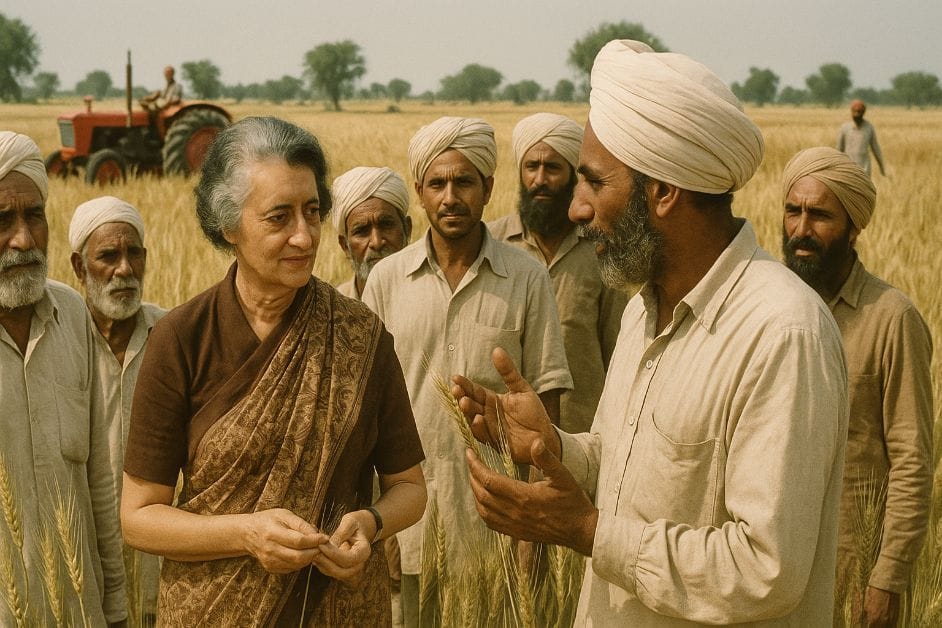
- Pushed the Green Revolution strongly – high-yield wheat seeds, assured MSP, irrigation and fertilizer support. This helped India move
- towards food self-sufficiency in the 1970s.
- Bank nationalisation (1969) to extend credit to agriculture and weaker sections.
- Abolition of privy purses and slogan of “Garibi Hatao” (Remove Poverty).
- Led India in 1971 war, creation of Bangladesh, and signing of Simla Agreement.
- Declared Emergency (1975–77), suspending civil liberties and centralising power – a very controversial period.
Economy & GDP
- Early years saw improvement in agricultural output due to Green Revolution.
- Overall, 1970s growth was moderate (around 3–4%), affected by oil shocks and political instability.
Important Schemes
- Twenty-Point Programme for poverty alleviation.
-
Large expansion of public distribution system (PDS) and rural programmes.
5. Morarji Desai (24 Mar 1977 – 28 Jul 1979)
Context:
- First non-Congress Prime Minister heading the Janata Party government after the Emergency.
Major Work
- Tried to restore democracy and civil liberties after the Emergency.
- Followed a relatively conservative economic policy, stressing fiscal discipline.
- Attempted to decentralise power and reverse some of Indira’s centralising tendencies.
Economy & GDP
- Growth was mixed; the late 1970s still suffered from oil shocks, inflation and internal political instability.
6. Charan Singh (28 Jul 1979 – 14 Jan 1980)
Context:
- Short-lived government, supported from outside and then losing majority.
Major Work
- Known for strong pro-farmer views and advocacy of rural interests.
- Due to very short tenure (about six months), no major long-term national economic reforms could be fully implemented.
7. Indira Gandhi (Return: 14 Jan 1980 – 31 Oct 1984)
In her second spell:
Major Work
- Focused on stability and control of inflation after the chaotic late 1970s.
- Encouraged public sector growth, some limited liberalisation, and support for heavy industries.
- Faced serious challenges: Punjab militancy, Operation Blue Star, and finally her assassination in 1984.
Economy & GDP
- Early 1980s saw slightly higher growth (around 5–5.5% in some years) as India slowly moved away from the strictest controls.
8. Rajiv Gandhi (31 Oct 1984 – 2 Dec 1989)
Context:
- Youngest PM, came to power after Indira’s assassination with a huge majority.
Major Work
- Started early economic liberalisation – lowering some industrial licensing and import controls.
- Pushed telecom and computerisation, laying the base for India’s IT revolution.
- Passed the Anti-Defection Law to curb political defections.
- Focused on Panchayati Raj reforms (later fully implemented under 73rd/74th amendments).
Economy & GDP
- Mid-1980s growth improved significantly; some estimates show average annual growth above 5–6%, higher than previous decades.
Programmes
- Expanded rural development and technology missions (e.g., drinking water, literacy, immunisation).
9. V. P. Singh (2 Dec 1989 – 10 Nov 1990)
Major Work
- Known mainly for implementing the Mandal Commission recommendations, giving OBC reservations in central government jobs.
- Tried to tackle corruption (Bofors issue) and improve governance.
Economy & GDP
- Short tenure, in a period when India was slowly moving into a balance-of-payments crisis that exploded by 1991.
10. Chandra Shekhar (10 Nov 1990 – 21 Jun 1991)
Context:
- Minority government with external support, during severe economic crisis.
Major Work
- Managed a difficult macroeconomic situation, including pledging India’s gold reserves to avoid default.
- No major structural reforms because of political fragility.
Economy & GDP
- Growth slowed sharply; crisis pressures led directly into the 1991 reforms under the next government.
11. P. V. Narasimha Rao (21 Jun 1991 – 16 May 1996)
Context:
- India faced a serious balance-of-payments crisis and near-default on external payments.
Major Work
- With Finance Minister Dr. Manmohan Singh, launched the New Economic Policy (1991) – Liberalisation, Privatisation, Globalisation (LPG).
- Dismantled the Licence-Permit-Quota Raj, opened many sectors to private investment, reduced import tariffs, and encouraged foreign investment.
- Started disinvestment of some public sector units.
- Also pushed for Look East Policy and strengthened relations with many countries.
Economy & GDP
- After one or two difficult years, India’s growth picked up sharply. Some analyses show average growth during his term around 6–7%, with one of the highest per-PM averages in later compiled data.
12. Atal Bihari Vajpayee (Three terms; main full term 19 Mar 1998 – 22 May 2004)
Context:
- Coalition era; India testing nuclear weapons, Kargil conflict, and then early 2000s IT boom.
Major Work
- Conducted Pokhran-II nuclear tests (1998), declaring India a nuclear weapons state.
- Handled Kargil conflict (1999) and tried peace process with Pakistan (Lahore bus, Agra Summit).
Focus on infrastructure:
- Golden Quadrilateral and national highway projects.
- Pradhan Mantri Gram Sadak Yojana (PMGSY) for rural roads.
- Reforms in telecom, encouraging competition; helped mobile and internet revolution.
Economy & GDP
- Late 1990s had external shocks (Asian Financial Crisis, sanctions), but early 2000s saw strong growth, helped by IT and services.
- Compiled averages show growth around 5–6% per year during his time.
Key Schemes
- PMGSY rural road scheme.
- Various rural and infrastructure development programmes.
13. H. D. Deve Gowda (1 Jun 1996 – 21 Apr 1997)
Major Work
- Led a United Front coalition; focused on federal balance and gave attention to rural and agrarian issues, especially irrigation.
- Could not push large reforms due to limited time and coalition politics.
Economy & GDP
- Economy was already on a higher growth path after 1991 reforms; continued that trajectory with moderate growth.
14. I. K. Gujral (21 Apr 1997 – 19 Mar 1998)
Major Work
- Famous for the “Gujral Doctrine” in foreign policy – offering unilateral goodwill gestures to neighbours without expecting reciprocity.
- Short term, mainly caretaker style, no big structural economic policy shifts.
Economy & GDP
- Growth remained on the reform-driven track of the 1990s.
15. Dr. Manmohan Singh (22 May 2004 – 26 May 2014)
Context:
- Two consecutive UPA governments in a period of rapid globalisation, commodity booms and then the 2008 global financial crisis.
Major Work
- Continued and deepened economic liberalisation and integration with global economy.
- Signed the India–US Civil Nuclear Deal.
- Major welfare and rights-based programmes:
- Mahatma Gandhi National Rural Employment Guarantee Act (MGNREGA) – legal guarantee of 100 days of manual work in rural areas.
- Right to Information (RTI) Act.
- Right to Education (RTE) Act for free and compulsory education for children 6–14.
- Expansion of National Rural Health Mission (NRHM) and other social schemes.
Economy & GDP
- 2003–08 period saw very high growth, sometimes above 8–9% per year.
- Even after the 2008 crisis, India remained one of the fastest-growing major economies.
- Compiled per-PM averages show around 8%+ growth for his decade in office, though later years saw slowdown and issues of inflation and policy paralysis.

16. Narendra Modi (26 May 2014 – Present)
Context:
- Came with a majority in 2014 and again in 2019. Period marked by digital revolution, GST introduction, Covid-19 pandemic, and big infrastructure push.
Major Economic and Governance Changes
Structural Economic Reforms
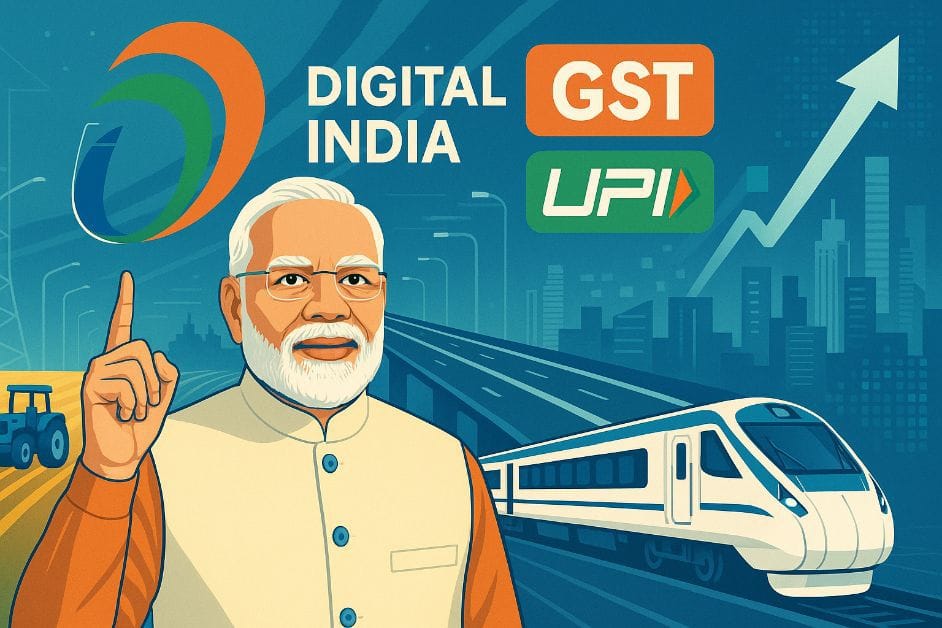
- Goods and Services Tax (GST), 2017 – unified indirect tax system across India, replacing multiple state and central taxes.
- Insolvency and Bankruptcy Code (IBC) – a modern system to resolve corporate insolvency and reduce bad loans.
- Demonetisation (2016) – withdrawal of ₹500 and ₹1000 notes, aimed at curbing black money and promoting digital payments.
- Focus on Ease of Doing Business, moving India up significantly in global rankings between 2014–2019.
Digital and Financial Inclusion
- Pradhan Mantri Jan Dhan Yojana (PMJDY) – massive financial inclusion programme; hundreds of millions of new bank accounts opened.
- Digital India mission, promoting broadband, e-governance and digital services.
- UPI (Unified Payments Interface) and BHIM app – explosion of digital payments, making India a global leader in low-cost real-time transactions.
Social Welfare and Basic Needs
- Pradhan Mantri Ujjwala Yojana – free LPG connections to poor women, reducing dependence on biomass for cooking.Swachh Bharat
- Mission – building toilets and promoting sanitation.
- Ayushman Bharat – PM Jan Arogya Yojana (PMJAY) – health insurance cover for poor families.
- PM Kisan Samman Nidhi – direct income support to small and marginal farmers.
- Housing for All (PMAY) – support for affordable housing.
Infrastructure Push
- Rapid expansion of highways, Expressways, Bharatmala projects.
- Modernisation of railways, introduction of Vande Bharat trains.
- UDAN scheme to improve regional air connectivity.
- Expansion of renewable energy, especially solar (International Solar Alliance).
Covid-19 Response
- Nationwide lockdown in 2020, followed by gradual reopening.
- PM Garib Kalyan Yojana – free food grains, cash transfers to poor and vulnerable groups.
- Large-scale vaccination drive with Make-in-India vaccines.
Economy & GDP Under Modi
- Pre-Covid years (2014–2019) saw strong growth, though gradually slowing in later years due to global and domestic factors.
- Covid-19 caused a sharp contraction in 2020–21, followed by rebound and recovery in later years.
- Recent assessments by RBI and Finance Ministry project India to grow around or above 7% in coming years, keeping it among the fastest-growing major economies.
- Compiled per-PM averages (based on Government of India statistics posts) put growth during his years so far at around 5–6% average, with big shocks in between due to Covid and global slowdown.
Putting It All Together: How India’s PMs Shaped Growth
- Foundational Era (Nehru–Shastri)
Built institutions, democracy and heavy-industry base but with modest growth. - State-Led and Green Revolution Phase (Indira Gandhi, early 1980s)
Strong state control plus big agricultural gains; India moved from food-deficit to near self-sufficiency. - Early Liberalisation and Technology Push (Rajiv Gandhi)
Smaller doses of deregulation and strong focus on telecom and computers. - Full-Scale Reforms and Global Integration (Narasimha Rao, Vajpayee, early Manmohan Singh years)
1991 LPG reforms and continued liberalisation made India a globalised, service-driven economy with much higher average growth. - Rights-Based Welfare with High Growth (UPA under Manmohan Singh)
Combined high growth with flagship welfare laws like MGNREGA, RTI and RTE. - Big Structural Reforms + Digital & Welfare State (Modi Era)
GST, IBC, large digital and financial inclusion, infrastructure push, and targeted welfare schemes with direct benefit transfers.
| FAQ Question | Answer |
|---|---|
| Who was the first Prime Minister of India? | Jawaharlal Nehru was the first Prime Minister of India, serving from 1947 to 1964. |
| Which PM implemented the 1991 economic reforms? | The 1991 LPG reforms were introduced by P. V. Narasimha Rao with Dr. Manmohan Singh as Finance Minister. |
| Which Prime Minister led the Green Revolution? | Indira Gandhi implemented the Green Revolution nationwide, leading to food self-sufficiency. |
| Who introduced GST in India? | The Goods and Services Tax (GST) was launched in 2017 under Prime Minister Narendra Modi. |
| Which PM achieved the highest GDP growth? | The highest average GDP growth was recorded during Dr. Manmohan Singh’s tenure (2004–2014). |
| Who made India a nuclear weapons state? | Atal Bihari Vajpayee conducted the Pokhran-II nuclear tests in 1998, declaring India a nuclear state. |
| Who introduced MGNREGA? | The MGNREGA employment guarantee scheme was launched by Dr. Manmohan Singh’s government in 2005. |
| Which PM launched Digital India? | Digital India was launched in 2015 under Prime Minister Narendra Modi. |
Read This Article Also: Indian Constitution Day : History Facts Untold Stories
Conclusion: Every Prime Minister of India worked in a different historical situation. Nehru gave India its democratic base and industrial backbone. Indira Gandhi strengthened food security and centralised the state. Rajiv Gandhi opened doors to technology. Narasimha Rao and Manmohan Singh changed the very structure of the economy through liberalisation. Vajpayee expanded infrastructure and telecom. In the current era, Narendra Modi has focused on big-bang reforms like GST, digital payments, Jan Dhan, Ujjwala, and a strong infrastructure and welfare push.
GDP numbers go up and down with global cycles, crises and domestic reforms, but the story of India’s growth is cumulative – each Prime Minister built on what came before. Understanding their years, schemes and economic impact helps you see how today’s India was created step by step over nearly eight decades.
Content Originality Statement
This article is original, plagiarism-free, and created using publicly available government and research data. It follows the Copyright Act 1957, IT Act 2000, and DMCA standards. All facts are rewritten uniquely and sourced from public domain reports, not copied from any website.
About The Author