Indian Army No-Marriage Rule for Agniveers Full Truth, Dates & Official Clarification
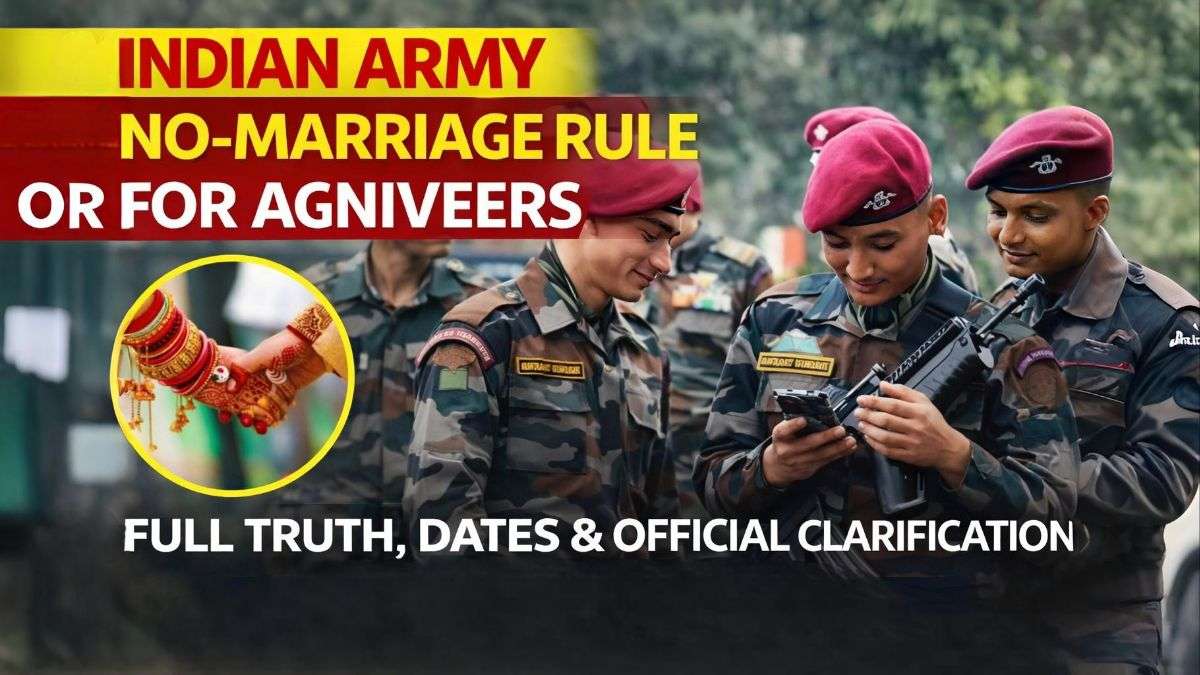
recent days, social media posts and viral images have claimed that the Indian Army has newly banned marriage for Agniveers until permanent appointment. This has created confusion, anger, and fear among students preparing for defence recruitment.
However, when verified with official government documents, it becomes clear that this rule is not new, not sudden, and not permanent.
This article explains the real meaning of the no-marriage rule, why it exists, when it was introduced, and what happens after permanent selection in simple, honest words.
What Is the Agnipath Scheme?
The Agnipath Scheme was officially launched on 14 June 2022 by the Ministry of Defence, Government of India.
Under this scheme:
- Youth are recruited as Agniveers
- Service duration is 4 years
- After 4 years, around 25% are selected for permanent service in the Indian Army, Navy, or Air Force
The scheme aims to create a young, disciplined, and combat-ready force.
What Is the No-Marriage Rule?
The Actual Rule (Official Meaning)
According to the official Agnipath terms and conditions:
Agniveers are not permitted to marry during their four-year engagement period.
This rule:
- Applies only during the 4-year Agniveer service
- Ends after permanent absorption
- Was included from the beginning of the scheme in 2022
- This is not a new rule
- This is not a recent decision
Why Is Marriage Not Allowed During Agniveer Service?
The rule exists for professional and operational reasons, not social control.
Key reasons include:
- Agniveers undergo intensive military training
- They are posted in high-readiness and mobile roles
- The short tenure demands full focus on duty and discipline
- Family obligations during this period can affect operational efficiency
Similar restrictions already exist during training periods of regular soldiers as well.
What Happens After 4 Years?
After completing 4 years:
- Approximately 25% of Agniveers are selected for permanent enrolment
- Once permanently selected:
✅ Marriage is fully allowed
✅ Family accommodation rules apply
✅ Regular service benefits begin
The marriage restriction automatically ends after permanent appointment
What the Rule Does NOT Say
To clear major misunderstandings:
❌ Marriage is not banned forever
❌ Existing marriages are not cancelled
❌ No new punishment rule was announced in 2025 or 2026
❌ This rule is not against any caste, religion, or community
Why Is This Issue Trending Now?
The confusion is mainly due to:
- Old rules being presented as breaking news
- Misleading thumbnails using emotional words like “NO-MARRIAGE ALLOWED”
- Partial information spreading without official context
This has caused unnecessary panic among SC, ST, OBC, and general category students, even though the rule has not changed.
Official Government Sources (Verified)
For authentic information, refer only to:
- Indian Army Recruitment Portal https://www.joinindianarmy.nic.in
- Press Information Bureau (PIB) https://www.pib.gov.in
- Ministry of Defence https://www.mod.gov.in
All Agnipath terms, including the no-marriage condition, are clearly mentioned in official notifications issued since June 2022.
Important Information Often Missed in Reports
One key point that is often missing in viral posts and short news reports is that the no-marriage condition is a standard service clause, not a punishment or restriction imposed later. The condition is clearly mentioned in the Agnipath enrolment undertaking, which every Agniveer signs at the time of joining.
This undertaking legally defines the service period as a temporary engagement, which is why benefits like family accommodation, spousal allowances, and dependent facilities are also not applicable during the four-year tenure.
Another important detail is that Agniveers are covered under a separate insurance and compensation framework during their service period. Even though family benefits are limited, Agniveers are provided with non-contributory life insurance cover during the engagement period, ensuring financial protection in case of any unfortunate incident.
This shows that the restriction on marriage does not reduce the government’s responsibility toward the safety and welfare of recruits.
It is also important to understand that the no-marriage rule does not affect post-service life. Agniveers who are not selected for permanent enrolment after four years are free to marry immediately after release and face no legal or service-related restrictions. Their civil rights remain fully intact, which contradicts claims suggesting long-term personal limitations.
Additionally, there has been no fresh notification, amendment, or circular issued by the Ministry of Defence or the Indian Army in 2024, 2025, or 2026 regarding any change to the marriage rule. All current discussions are based on existing conditions notified in June 2022, and no official authority has announced stricter or extended restrictions.
Finally, many reports fail to clarify that similar temporary personal restrictions exist in several defence and uniformed services worldwide, especially during training and short-term contractual service. This places the Agniveer rule within a global military practice, rather than an exceptional or discriminatory policy.
Read This Article Also: Karnataka SSLC Preparatory Exams 2026 Go Online
Conclusion: The no-marriage rule for Agniveers is real but temporary. It was introduced in June 2022, applies only during the 4-year service, and ends after permanent selection. There is no new ban, no sudden change, and no hidden agenda.
Understand the rule completely before reacting facts matter more than viral posts.
About The Author