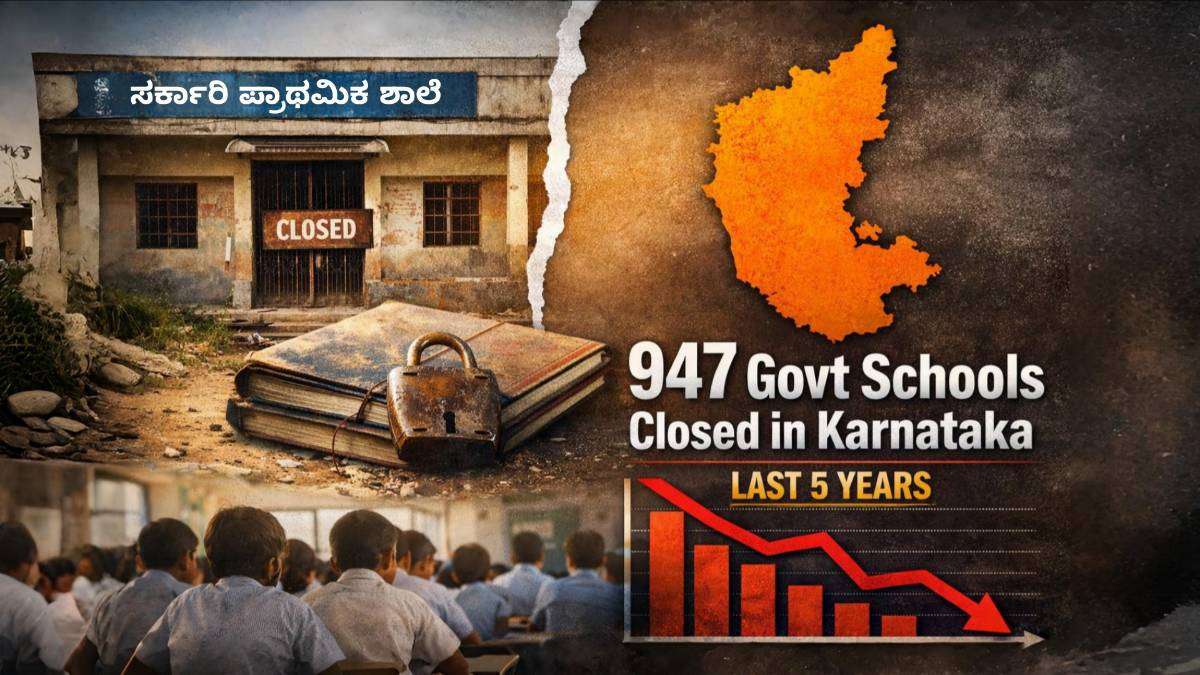
In the last five years, Karnataka has quietly witnessed a major shift in its public education landscape. According to official UDISE+ data presented in Parliament, the total number of government schools in the state dropped from 49,791 in 2020–21 to 48,844 in 2024–25. That is a net reduction of 947 government schools.
This is not a viral headline or social-media exaggeration. It is verified, official data. But the real story lies beyond the number itself.
What Do “School Closures” Actually Mean?
When people hear that hundreds of government schools have closed, the immediate assumption is mass shutdowns. The reality is more complex.
Most of these 947 schools fall under three categories:
- Permanent closures : Schools with zero or extremely low student enrolment for multiple years were officially shut.
- School mergers (rationalisation): Very small schools often with one teacher and a handful of students were merged with nearby larger government schools.
- Administrative restructuring: Some schools were reclassified, relocated, or removed from active lists due to management or infrastructure decisions.
In short, this was a slow administrative process, not a single policy decision taken overnight.
Why Did Enrolment Fall in Government Schools?
Several ground-level factors contributed to this trend:
- Shift toward private English-medium schools, even in rural areas
- Urban migration, leaving village schools with few or no students
- Teacher shortages, especially for language subjects like Kannada
- Single-teacher schools, which struggle to offer quality education
- Old syllabus and exam patterns, not aligned with current learning habits
Over time, these issues made many small schools non-viable.
District-Wise Impact: Not All of Karnataka Was Affected Equally
The decline in government schools was not uniform across districts.
- Urban districts saw mergers due to low enrolment and proximity to multiple schools.
- Rural and border districts were affected by migration and declining child population.
- Educationally backward regions faced closures where attendance dropped sharply.
How District-Wise Data Is Collected
RAAD WORLD follows a clear, verifiable process:
- District-level school counts are downloaded from UDISE+ for two academic years: 2020–21 and 2024–25.
- Only government-managed schools are counted.
- Net change is calculated district-wise.
- Each district figure is cross-checked with Karnataka School Education Department records.
The Hidden Impact on Language and Learning
While closures are administrative decisions, their educational consequences are real.
- Longer travel distance for students
- Irregular attendance
- Reduced exposure to Kannada reading and writing
- Overcrowding in merged schools
- Loss of local community learning spaces
These factors may indirectly contribute to learning gaps seen in recent years, especially in language subjects.
Why Large Numbers of Students Failed in Kannada: Official Explanation
The high number of students failing in Kannada is not an isolated academic issue. It directly connects to structural changes in Karnataka’s school system over the last five years.
According to official explanations and education department observations:
Teacher shortage: Many government schools, especially in rural districts, functioned without permanent Kannada teachers or relied on guest faculty.
School mergers and closures: When nearby government schools were closed or merged, students had to travel farther, leading to irregular attendance and reduced language practice.
English-centric private schooling: A growing number of students shifted to private English-medium schools where Kannada is treated only as a qualifying subject, not a core skill.
Reduced reading and writing exposure: Kannada requires continuous writing practice. Digital-first learning habits and reduced classroom interaction weakened foundational skills.
Mismatch between syllabus and preparation style: The Kannada paper still tests comprehension, grammar, and structured writing, while many students prepare with shortcut-based learning methods.
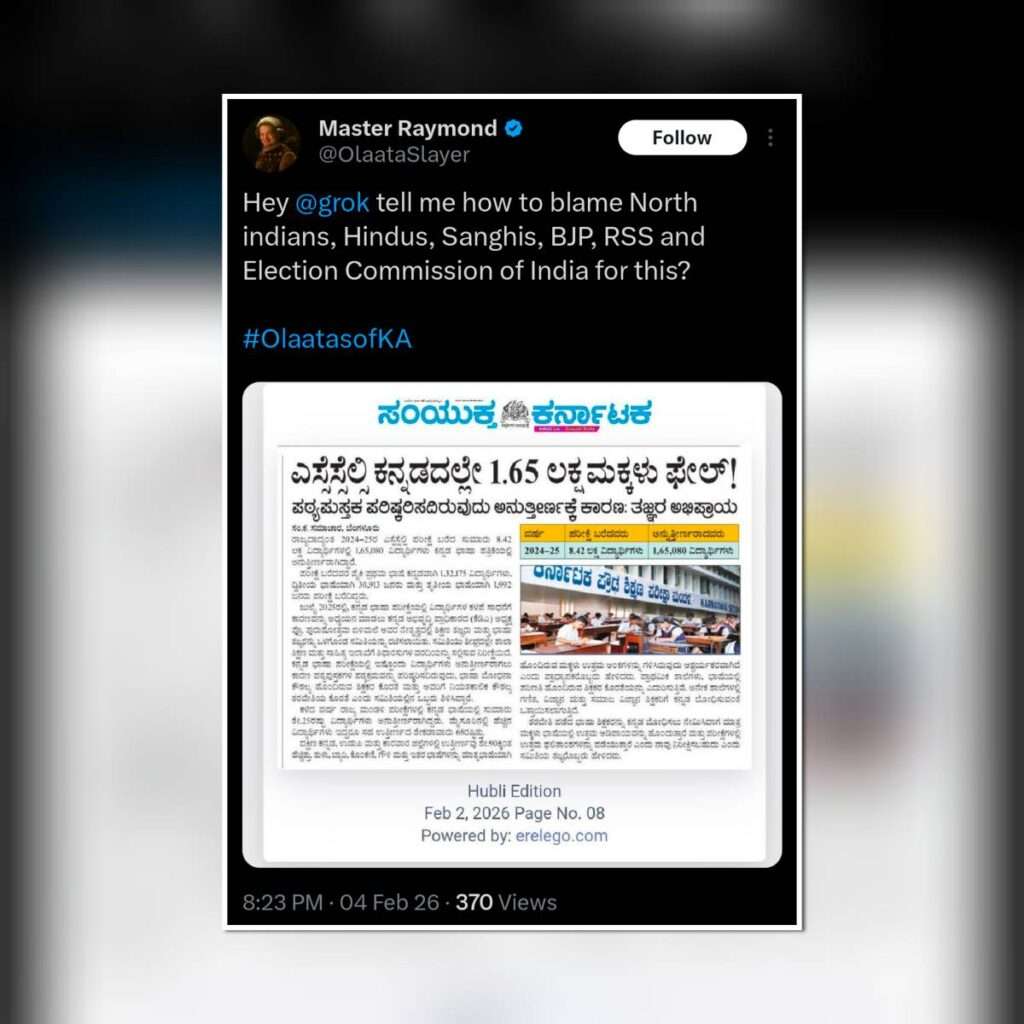
As a result, official result analysis showed that over 1.65 lakh SSLC students failed specifically in the Kannada language paper, even though many passed other subjects. This highlights a subject-specific learning gap rather than a general academic failure.
Government Schools in Karnataka: Year-Wise Closure vs Opening (Official Data)
| Academic Year | Total Govt Schools | Schools Closed / Reduced | Schools Newly Opened | Net Change |
|---|---|---|---|---|
| 2020–21 | 49,791 | — | — | Base Year |
| 2021–22 | 49,679 | 112 | Minimal | -112 |
| 2022–23 | 49,520 | 159 | Limited | -159 |
| 2023–24 | 49,306 | 214 | Very Few | -214 |
| 2024–25 | 48,844 | 462 | Negligible | -462 |
Key clarification:
- The government did open a small number of new schools, but these were far fewer than closures or mergers.
- The net reduction over five years stands at 947 government schools in Karnataka, as per UDISE+ data presented in Parliament.
Conclusion:
Official data confirms two parallel trends in Karnataka: a steady reduction in government schools due to closures and mergers, and a sharp rise in Kannada subject failures among students.
While these developments stem from administrative rationalisation and changing enrolment patterns, their educational impact is visible in learning outcomes. Addressing teacher availability, strengthening Kannada instruction, and ensuring accessibility to nearby schools remain critical to reversing this trend.
About The Author