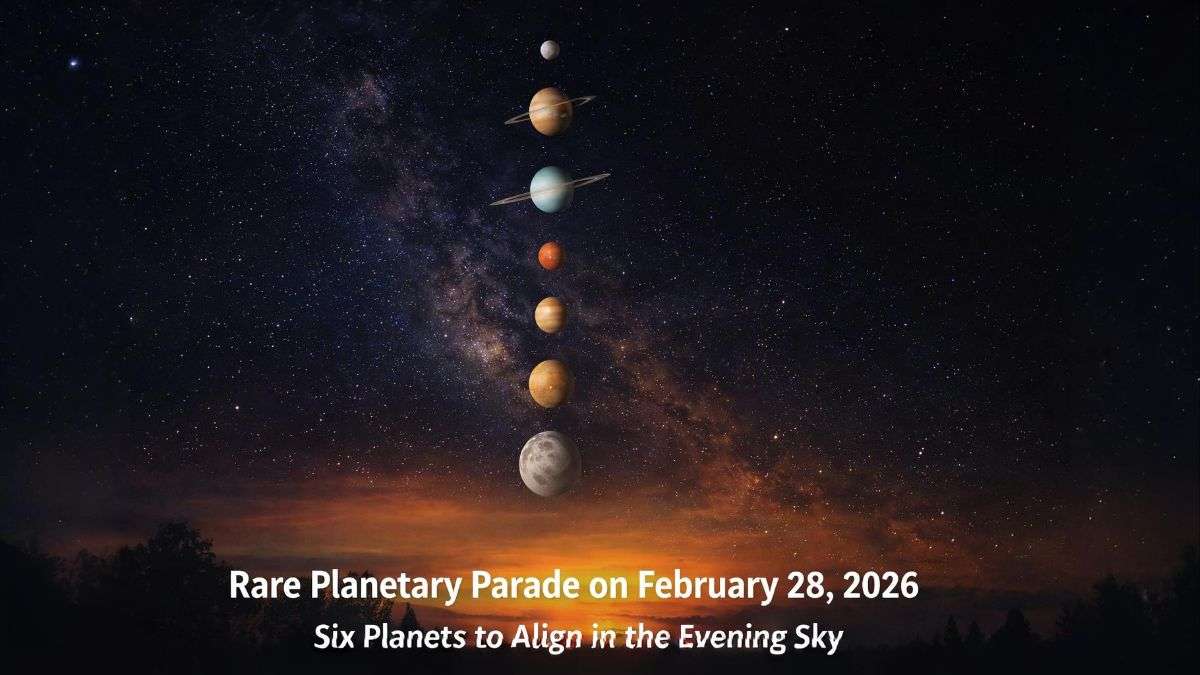
February 28, 2026, will offer skywatchers a rare opportunity to witness a planetary parade, a celestial event in which multiple planets appear aligned in the night sky when viewed from Earth.
While the event has been widely shared on social media with dramatic claims, astronomers clarify that the real phenomenon is impressive but often misunderstood.
What Is a Planetary Parade?
A planetary parade occurs when several planets become visible along the same general path in the sky, known as the ecliptic plane. This happens because the planets orbit the Sun on nearly the same flat plane, making them appear lined up from Earth’s viewpoint.
This alignment is visual only. The planets are not physically arranged in a straight line in space.
Which Planets Will Be Visible on February 28, 2026?
On this date, six planets will be positioned close together in the evening sky:
- Mercury
- Venus
- Jupiter
- Saturn
- Uranus
- Neptune
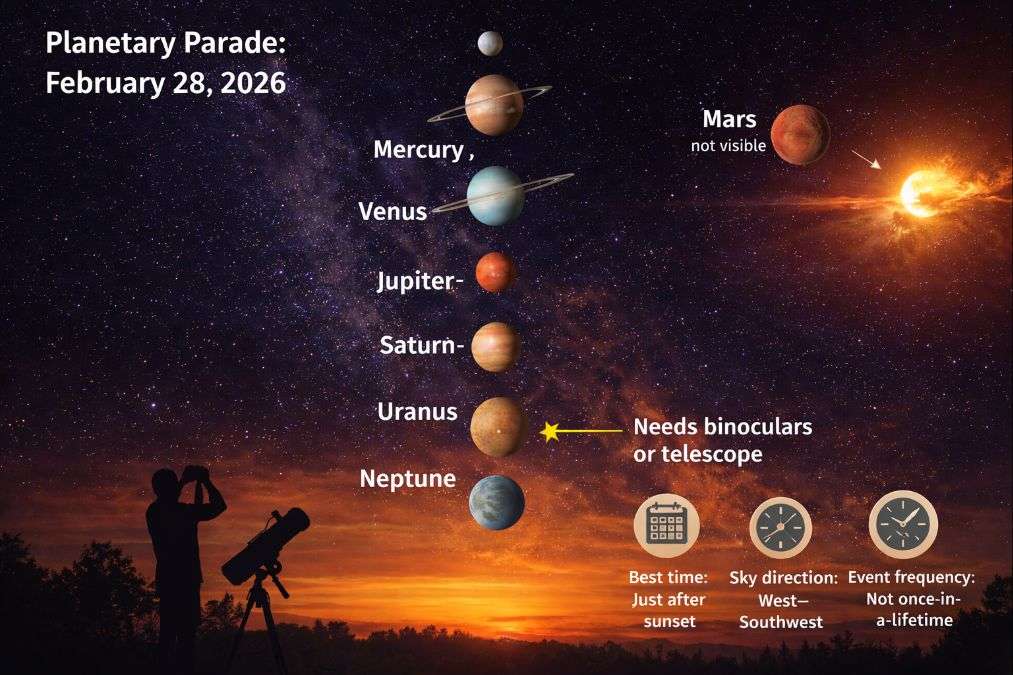
Among these, Mercury, Venus, Jupiter, and Saturn will be bright enough to see with the naked eye under clear skies. Uranus and Neptune will require binoculars or a telescope due to their faint brightness.
Mars will not be visible during this planetary parade. Contrary to viral claims, Mars will be located too close to the Sun in the sky and cannot be observed on that day.
READ THIS: Saffron flag hoisting Ayodhya
Is the February 2026 Planetary Alignment a Once-in-a-Lifetime Event?
No. While the February 2026 planetary parade is relatively rare, it is not a once-in-a-lifetime occurrence.
Similar planetary groupings have occurred in the past and will happen again in the future. What makes this event notable is the number of planets visible in a short time frame, not its uniqueness in astronomical history.
Claims suggesting that such an alignment will not happen again for decades are scientifically inaccurate.
Best Time and Direction to Watch the Planetary Parade
- Date: February 28, 2026
- Best time: Shortly after sunset
- Sky direction: West to south-west
- Viewing conditions: Clear skies and minimal light pollution
Observers are advised to choose an open location with a clear horizon. Astronomy apps or star maps can help identify each planet accurately.
Why the February 2026 Planetary Parade Is Important
Planetary parades provide valuable opportunities for:
- Public engagement in astronomy
- Educational awareness of planetary motion
- Amateur stargazing and astrophotography
They also highlight the predictable and precise nature of planetary orbits governed by gravity.
Key Facts at a Glance
- A planetary parade will occur on February 28, 2026
- Six planets will appear aligned from Earth’s perspective
- Mars is not part of this alignment
- Some planets will require telescopes to observe
- The event is not once-in-a-lifetime
Conclusion:
The planetary parade on February 28, 2026, is a genuine and fascinating astronomical event, but it should be viewed with realistic expectations. Understanding the science behind the alignment allows skywatchers to appreciate the beauty of the night sky without falling for misleading or exaggerated claims.
For astronomy enthusiasts and casual observers alike, this event offers a memorable chance to connect with the wonders of our solar system.
About The Author