Supreme Court SC, ST & OBC Candidates Eligible for General Category Government Jobs 2026
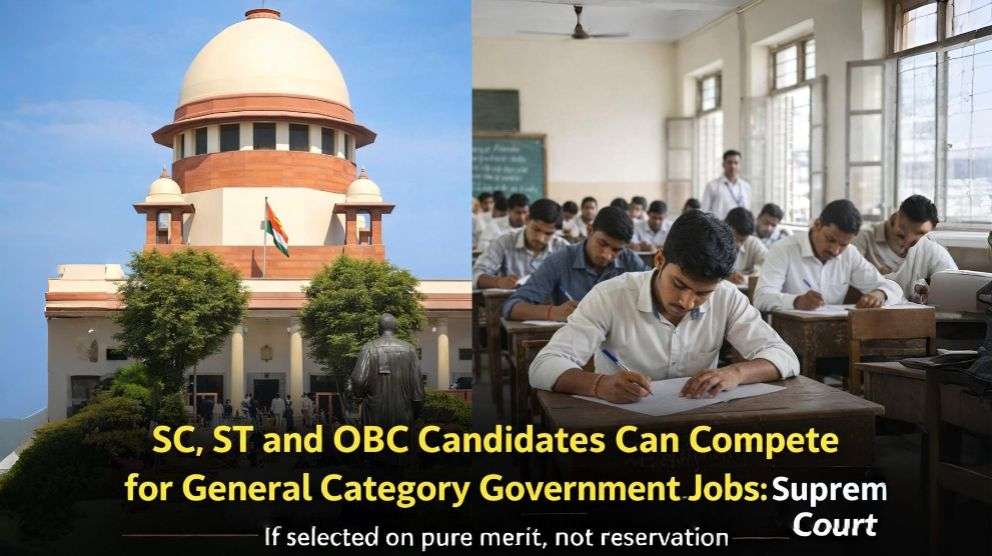
In recent years, a recurring question has appeared in public discussions, social media debates, and competitive exam circles: Can SC, ST, and OBC candidates compete for General category government jobs?
The Supreme Court of India has answered this question clearly and consistently through multiple judgments. The Court has held that candidates belonging to reserved categories are fully eligible to compete for General (Unreserved) category posts, provided their selection is based purely on merit.
This article explains what the Supreme Court actually ruled, the constitutional basis behind it, and why this principle is important for both merit and social justice.
What the Supreme Court Actually Ruled
The Supreme Court clarified that reservation does not prevent SC, ST, or OBC candidates from competing in the General category.
If a candidate from a reserved category:
- Appears in an open competitive examination, and
- Scores marks equal to or higher than the General category cut-off without using any reservation benefit,
then that candidate must be selected under the General category. Such a selection cannot be counted against reserved category vacancies.
Merit Comes First, Category Comes Later
The Court emphasized a fundamental principle:
Merit-based selection cannot be denied merely because a candidate belongs to a reserved category.
Reservation is a protective measure, not a restriction. It exists to ensure representation for socially and educationally backward communities, not to block high-scoring candidates from open competition.
When a reserved category candidate qualifies on merit alone, they stand equal to any other candidate under the General category.
What This Judgment Does NOT Mean
There has been widespread confusion and misinformation. The Supreme Court ruling does not mean:
- Reservation has been removed
- General category posts are reserved for SC/ST/OBC
- Category-based cut-offs are abolished
- General candidates lose their rights
The reservation system continues exactly as provided under the Constitution.
Constitutional Provisions Supporting This Rule
The Supreme Court’s view is rooted in the Indian Constitution:
- Article 14 – Equality before law
- Article 16(1) – Equal opportunity in public employment
- Article 16(4) – Provision for reservation for backward classes
The Court harmonized these articles by holding that equality of opportunity includes the right of a reserved candidate to compete openly on merit.
Important Supreme Court Judgments (Source Reference)
This principle has been affirmed in several landmark cases, including:
- Indra Sawhney vs Union of India (1992)
- Union of India vs Virpal Singh Chauhan (1995)
- R.K. Sabharwal vs State of Punjab (1995)
- Jarnail Singh vs Lachhmi Narain Gupta (2018)
Across these rulings, the Court consistently stated that merit-based selection must remain open to all citizens, irrespective of caste or category.
Simple Example for Better Understanding
Suppose:
- Total posts: 100
- General category posts: 60
If an SC, ST, or OBC candidate ranks within the top 60 purely by marks, that candidate:
- Will be appointed under the General category
- Will not occupy a reserved seat
- Will not reduce reservation benefits for others
This ensures fairness, balance, and constitutional equality.
Why This Rule Is Important
This legal position:
- Encourages healthy competition
- Protects merit without undermining reservation
- Prevents discrimination against high-performing reserved candidates
- Maintains constitutional balance between equality and social justice
The Supreme Court made it clear that social justice and merit are not enemies; they must function together.
Read This Article Also: Karnataka CET 2026 Exam Update Dates, Application Process & Official Details
Conclusion: The Supreme Court’s position is clear and legally settled
- SC, ST, and OBC candidates can compete for General category government jobs
- Selection must be based purely on merit
- Reservation continues unchanged
- Equality under the Constitution is fully protected
Any claim suggesting otherwise is misleading or incomplete. This principle strengthens India’s constitutional promise of equal opportunity for all citizens.
About The Author