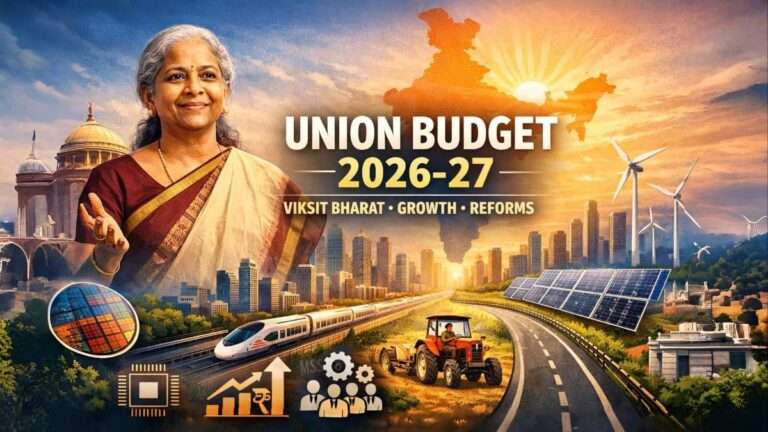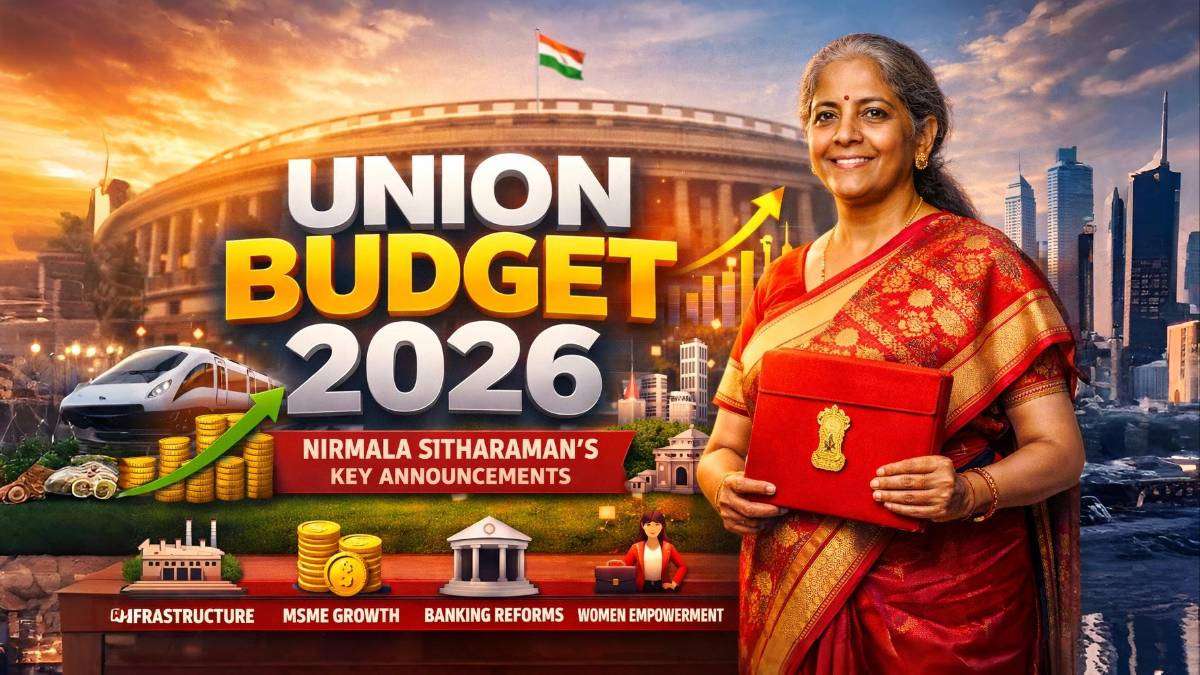
New Delhi | Feb 1, 2026: Finance Minister Nirmala Sitharaman presented the Union Budget 2026–27 in Parliament today, outlining the government’s roadmap for economic growth, fiscal discipline, infrastructure expansion, and social development. This is her ninth consecutive Budget, with a clear focus on jobs, investment, and future-ready reforms.
Big Picture: Budget Theme
The 2026 Budget balances growth with stability. The government aims to keep public finances under control while pushing capital expenditure, strengthening manufacturing, and improving opportunities for youth, women, and MSMEs.
Budget Announcements
Fiscal Discipline & Government Spending
- Fiscal deficit targeted at around 4.3% of GDP (FY27), continuing consolidation.
- Capital Expenditure (Capex) raised to ₹12.2 lakh crore, signalling a strong push for roads, railways, logistics, and urban infrastructure.
Why it matters: Higher capex supports job creation and long-term growth without excessive welfare spending.
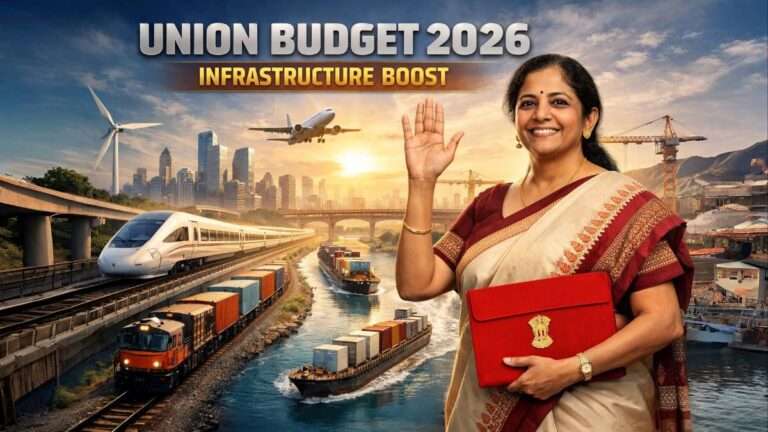
Infrastructure & Connectivity Boost
- Announcement of 7 high-speed rail corridors across major economic routes.
- Continued focus on Tier-2 and Tier-3 cities for urban development and transport connectivity.
Impact: Faster movement of goods and people, regional development, and private investment attraction.
Banking & Financial Sector Reforms
- Proposal to set up a high-level committee to review and strengthen the banking and NBFC sector under the Viksit Bharat vision.
- Focus on improving governance, capital efficiency, and financial stability.
Impact: A stronger banking system means better credit flow to businesses and MSMEs.
Tax & Market-Related Updates
- Securities Transaction Tax (STT) on Futures & Options (F&O) increased to curb excessive speculation.
- No major overhaul of income-tax slabs; policy stability maintained.
- Simplification under the new Income Tax framework expected through future notifications.
Impact: Markets may see short-term volatility, but long-term stability is the goal.
MSMEs & Manufacturing Push
- ₹10,000 crore MSME Growth Fund announced to help small businesses expand and compete globally.
- New initiatives in semiconductors, biopharma, and rare-earth manufacturing corridors.
Impact: Strengthens “Make in India” and reduces import dependence.
Education, Skills & Youth
- Strong emphasis on skill-linked education, AI learning, and employability.
- Expansion of technical institutions and training programs aligned with industry needs.
Impact: Prepares youth for future jobs rather than just degrees.
Women & Social Development
- Proposal to build at least one girls’ hostel in every district.
- Continued support for women-led self-help groups and entrepreneurship.
Impact: Improves safety, education access, and economic participation of women.
Health, Tourism & Ayurveda
- New Ayurveda and healthcare institutions announced.
- Push for medical value tourism hubs to attract global patients.
Impact: Healthcare expansion + tourism revenue growth.
Market Reaction Today
Stock markets showed initial volatility, with pressure on F&O-linked stocks due to STT changes.
Infrastructure-linked sectors remained in focus due to higher capex allocation.
This Budget is not a “freebie” budget. Instead, it focuses on:
📌 Long-term infrastructure
📌 Financial system stability
📌 Manufacturing & jobs
📌 Youth and women empowerment
While middle-class tax relief is limited, the government is clearly betting on investment-led growth to drive income and employment over time.
Conclusion:
The Union Budget 2026–27 sends a strong message India’s growth story will be built on infrastructure, skills, and fiscal discipline not short-term populism.
About The Author