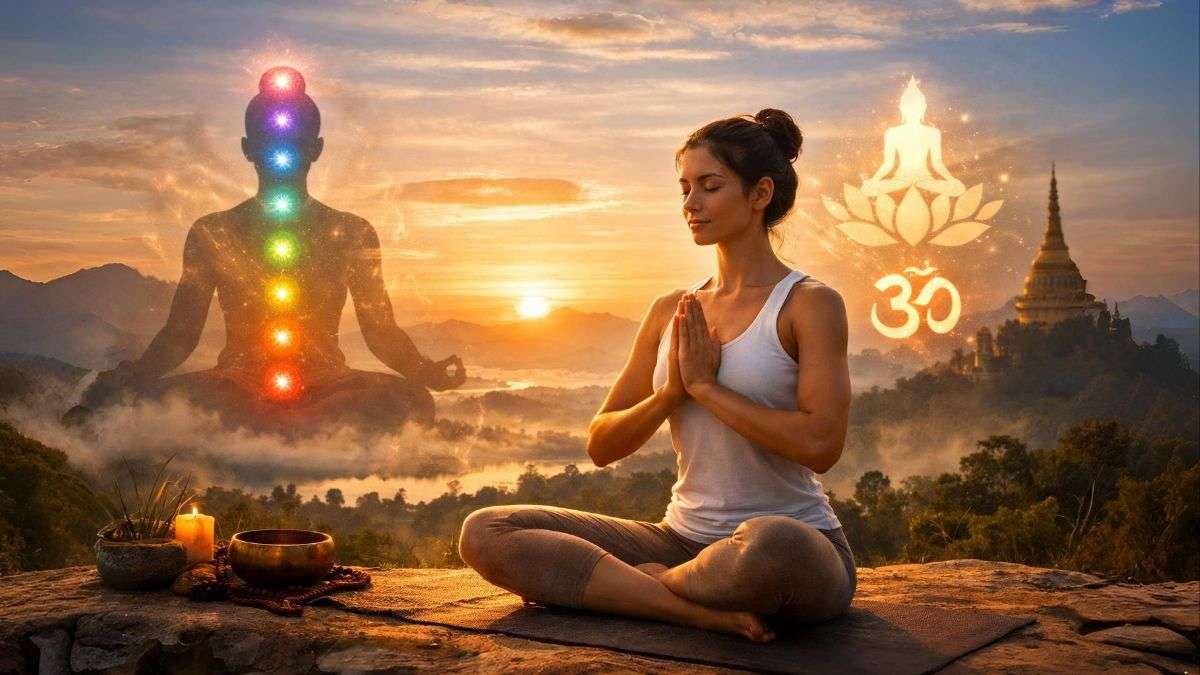
In the modern world, yoga has been reduced to a pursuit of the perfect pose the deepest backbend, the most challenging balance, the photograph-worthy asana. Yet this represents a profound misunderstanding of yoga’s true purpose. The ancient yogic traditions never intended the body to be the destination; rather, the body is merely the threshold. To understand yoga authentically is to recognize that the practice exists not to sculpt the external form, but to transform the infinite consciousness imprisoned within it.
he foundational definition of yoga, as articulated in Patanjali’s Yoga Sutras, states: “yogaś citta-vṛtti-nirodhaḥ” yoga is the cessation of the fluctuations of consciousness.This definition reveals the entire spiritual architecture underlying the practice. Yoga is fundamentally about the mastery and transcendence of the mind, not the mastery of the body. When the restless waves of mental activity settle, when the constant chatter of desires, fears, and attachments quietens, then the eternal Self pure, unchanging consciousness reveals itself in its pristine nature.
Consider the modern yoga studio: practitioners flowing through sequences with athletic precision, achieving impressive physical feats, yet leaving the practice with their fundamental suffering unchanged. Their minds remain scattered, their identities still wrapped in social conditioning, their hearts still defending against vulnerability. They have become gymnastics performers, not yogis. The great spiritual masters understood that a person could possess a body of perfect flexibility and strength yet harbor a mind imprisoned by ignorance, attachment, and ego.
The ancient masters constructed yoga differently. They recognized that the body is simply a reflection of mental consciousness. When the mind is agitated, confused, and dominated by impulses, the body manifests tension, rigidity, and disease. When the mind becomes calm, clear, and aligned with higher truth, the body naturally follows. This is why yoga’s true progression moves from the physical (asana) to the energetic (pranayama) to the mental (pratyahara and dharana), and finally to the transcendent (dhyana and samadhi). Each stage dissolves the practitioner deeper into consciousness itself.
The Gateway of Brahmacharya: Beyond the Misunderstanding
Brahmacharya stands as one of yoga’s most misunderstood principles, commonly reduced to celibacy. Yet the true meaning of this ancient practice opens doorways to spiritual realization that celibacy alone cannot achieve. The Sanskrit etymology reveals the deeper truth: Brahma means “the ultimate reality or the divine,” and charya means “conduct” or “way of living.”Brahmacharya, therefore, literally translates as “moving in Brahman” or “conduct aligned with the sacred.”
This is not about denying sexuality through suppression, but rather about recognizing that human existence contains a finite reservoir of vital energy what yogic sciences term prana, shakti, or ojas. Every thought, emotion, desire, and action consumes this energy. The modern person, despite unprecedented comfort and technology, finds themselves perpetually exhausted drained by anxiety about the future, rumination about the past, endless consumption of information, and endless pursuit of sense gratification. The energy that could illuminate consciousness and catalyze spiritual realization instead leaks away through countless small channels of dissipation.
Brahmacharya is the practice of conserving and wisely directing this sacred life energy. It means becoming conscious of where your vital force flows and deliberately redirecting it toward the highest spiritual aim. This applies not merely to sexuality, but to every domain of human activity: food consumed, words spoken, thoughts entertained, desires pursued. A practitioner of brahmacharya becomes a guardian of their own energy, recognizing that every impulse to indulge in unnecessary sensory experience is a theft from their own spiritual evolution.
READ THI8: Energy Leaks In Modern Life Hidden Habits Draining Your Power Daily
The transformation is alchemical. Through brahmacharya through the conservation of energy combined with sincere spiritual practice something extraordinary occurs: the procreative energy transforms into pure spiritual energy, what Sanskrit texts call Ojas. This is not suppression that breeds neurosis, but sublimation a conscious elevation of raw biological energy into subtle spiritual power.
This incomparable benefit surpasses all other gains. A practitioner who establishes themselves in brahmacharya develops exceptional resilience, clarity, spiritual power, and the capacity for deep meditation that would be impossible for someone constantly exhausting themselves through sensory indulgence.
Consider Swami Vivekananda’s insight: complete continence gives great intellectual and spiritual power. This is not theory but lived experience across millennia of yogic tradition. The energy conserved through brahmacharya becomes fuel for the meditative mind. Instead of consciousness being fragmented across a thousand desires and anxieties, it concentrates itself with laser-like intensity upon the Supreme Self. Meditation deepens. Insights arise spontaneously. The veils of ignorance begin to thin.
The Architecture of Ego and Its Dissolution
At the heart of all human suffering lies a fundamental misidentification: we believe ourselves to be the body, the mind, the personality, the social role we perform. We mistake the fluctuating contents of consciousness for consciousness itself. We identify with our thoughts, our emotions, our preferences, our accomplishments and failures. This misidentification creates the illusion of separation aham, the ego-sense of “I” as isolated from all others and all things.
But yoga offers a radical revelation: this sense of a separate “I” is itself a distortion, not an ultimate reality. Behind the body, behind the mind, behind all personality, exists the eternal Witness the Seer (draṣṭā) who observes all experience but remains untouched by it, unchanging and free.The Yoga Sutras teach that liberalization (kaivalya) is achieved through the disengagement from these mental modifications the vṛttis or fluctuations of consciousness.
To experience this freedom directly, the practitioner must begin the sacred work of ego dissolution. This is not destruction of the self; rather, it is the release of the ego’s grip, allowing the authentic Self to emerge. Yoga guides this dissolution through several profound pathways
Asana as Non-Attachment to Outcome: Through conscious physical practice, one learns to release attachment to perfection, to comparison, to the approval others might give for achieving impressive postures. Each pose becomes a meditation on surrender. The practiced yogi learns to move with full presence and effort, yet without desperately grasping for results. This cultivates the mental muscle of *non-attachment*, which eventually penetrates all aspects of life.
Pratyahara as Sensory Withdrawal: The practice of consciously withdrawing attention from the constant bombardment of external stimuli allows the senses to settle, revealing the mind’s hidden machinery. The endless stream of wanting, fearing, and comparing which constitutes most mental activity begins to slow.
Meditation as Direct Inquiry: In meditation, the practitioner turns awareness inward with one pointed focus. As mental chatter subsides, the profound question arises: Who is aware? Who observes all experience without being touched by it? As this inquiry deepens, identification with thought and personality gradually loosens. The ego’s voice becomes recognizable as simply another object in awareness, not the true “I.”
Selfless Service (Seva) as Ego Transcendence: To serve others without seeking recognition, reward, or personal gain is a direct antidote to ego’s dominion. In the moment of genuine selfless action, the boundary between “me” and “other” dissolves. There is no servant, no served only the flow of loving action. This lived experience of non-separation gradually rewrites one’s sense of identity.
As the ego loosens its restrictive hold, something beautiful emerges: authentic peace arises not from achievement but from the dissolution of the one who was seeking achievement.Relationships transform from transactions into expressions of genuine love and compassion, no longer mediated by comparison and competition. Freedom from fear emerges, because fear depends upon the false belief that there is a vulnerable “I” that can be harmed.What remains is the timeless presence of Being itse lf spacious, aware, and unafraid
READ THI8: The Psychology Behind Human Behavior
The Realization of Non-Duality
The destination of yoga is comprehensively described in the ancient texts: it is the realization of kaivalya (liberation) and moksha (freedom from suffering), the ultimate recognition that the individual self (Atman) and the Supreme Reality (Brahman) are not two but one.This is not a concept to be intellectually understood, but a direct experiential truth to be lived and embodied.
This realization is often described as non-dual consciousness the direct perception that apparent separations between objects, beings, and concepts are illusory, hiding a deeper unified reality. The illusion of separation, which has been the root of all conflict, greed, and cruelty, dissolves. The practitioner sees the same essential consciousness peering through the eyes of every being, the same eternal awareness underlying all forms.
With this recognition comes something unprecedented: love and compassion arise naturally, no longer as ethical ideals to be practiced but as the spontaneous expression of recognizing one’s own self in all beings. There is no longer “me” helping “you” there is only the Self helping itself. This love transcends sentimentality it is the vast, impartial compassion that encompasses all beings and all circumstances, for it recognizes that all are expressions of the same underlying consciousness.
The yogic scriptures describe this realization in stages of progressive enlightenment. In the beginning, a seeker recognizes that true knowledge comes from within, not from external authority. Gradually, the causes of suffering are acknowledged and examined. Understanding of the true Self (samādhi) dawns.
The grip of ritualistic obligations falls away, because the practitioner has moved beyond seeking approval or safety through external practices. The mind comes under mastery. Freedom from the influence of external circumstances blooms neither praise nor blame, success nor failure, can shake the foundation of inner peace. And finally, the individual consciousness merges with the higher Self, attaining complete liberation (kaivalya).
This is not a destination in time, not something to achieve “someday.” Rather, it is the recognition of what is already and always present the eternal freedom that was never actually lost, merely temporarily obscured by the mind’s persistent misidentification.
The Role of Discipline and Surrender
The spiritual path requires both discipline and surrender seemingly contradictory, yet profoundly complementary. Discipline (tapas) is the focused effort required to still the scattered mind and establish new patterns of consciousness. It is the commitment to brahmacharya the deliberate redirection of energy away from reactive indulgence toward intentional spiritual cultivation. It is the daily return to meditation, to mindfulness, to the remembrance of truth even when the ego’s voice shouts for distraction.
Yet discipline without surrender becomes rigid, becoming another expression of ego’s need to control. The ego can use spiritual practice for spiritual ambition a new form of grasping and seeking. True yoga therefore balances fierce commitment with deep humility, effort with receptivity, doing with allowing.
As the practitioner matures in practice, there comes a natural surrender: the recognition that liberation cannot be grasped, only revealed cannot be earned, only welcomed; cannot be achieved through willpower alone, but emerges through grace when the recipient has prepared themselves through sincere practice.
READ THI8: The Architecture of Energy
The Invitation of True Yoga
Modern yoga culture offers a seductive invitation: “perfect your pose, strengthen your body, feel good about yourself.” These are not wrong pursuits physical health has value. But they remain on the periphery of yoga’s true promise, which is far more radical and liberating.
True yoga invites you to something unprecedented: the direct, experiential recognition of your own infinite nature.To discover that beneath the anxious, limited sense of “I” that has defined your existence lies something vast, eternal, and free already complete, already whole, already divine. To find that this same consciousness gazes through the eyes of every being, makes every heart beat, illuminates every thought.
This transformation requires brahmacharya the conscious conservation and upward channeling of your life energy. It requires the willingness to question every identification you have held with body, personality, and story. It demands both the discipline to practice regularly and the surrender to release all grasping for results. It asks you to sit in meditation and watch the mind until its deepest secrets are revealed. It invites you to serve selflessly, to love without demand, to release what you thought you were so that what you truly are might finally be known.
The physical practice of yoga asana and pranayama remains valuable as a preparation, as a way to calm the nervous system and prepare the body for the journey inward. But do not mistake the threshold for the destination. The real yoga begins when you turn your awareness inward and begin the most courageous journey of all: the journey home to yourself, to the Self that never left, that is always already awake in the depths of your being.

READ THIS: Brahmacharya Meaning Explained The Ancient Secret of Inner Power Clarity and Fearlessness
This is yoga’s eternal promise: not a better body, but liberation of consciousness it self. Not achievement, but awakening. Not performance, but transformation. Not becoming something other than you are, but recognizing, with stunning clarity, what you have always been.
Conclusion:
Yoga is not merely a physical exercise but a complete spiritual discipline that harmonizes the body, mind, and soul. Rooted in ancient Indian wisdom, yoga guides individuals toward self-awareness, inner peace, and moral living. Through regular practice of asanas, pranayama, and meditation, one can achieve mental clarity, emotional balance, and spiritual growth.
In today’s fast-paced and stressful lifestyle, yoga serves as a timeless solution for holistic well-being, making it relevant not only as a fitness practice but also as a spiritual path toward a meaningful and disciplined life.
About The Author


 Creator Adarsh