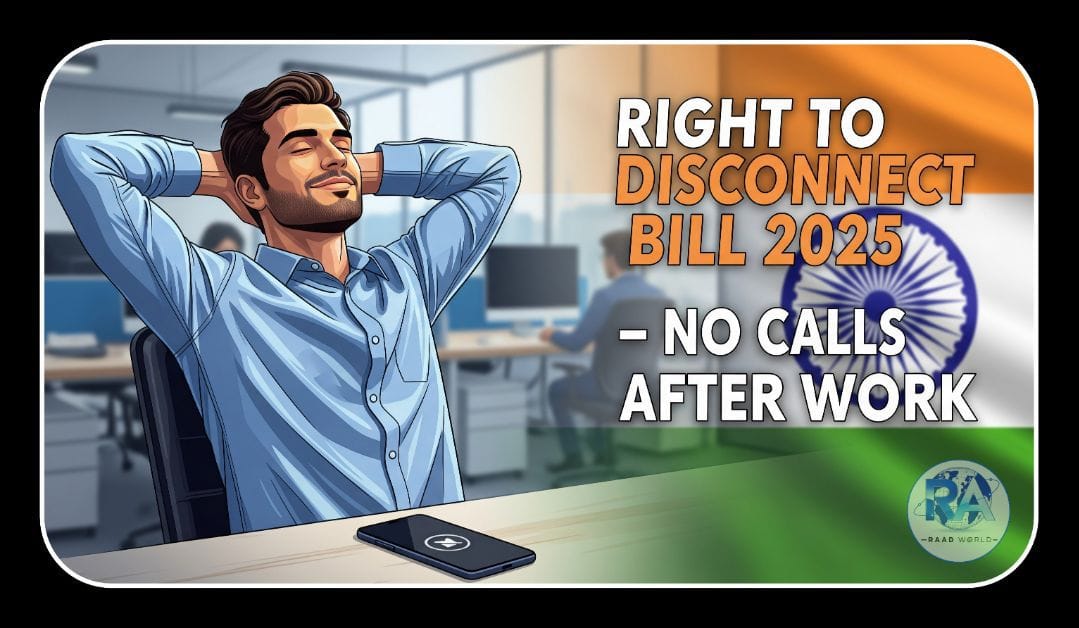
India is talking about a simple but powerful idea: after office hours, your time should be your own.
On 5–6 December 2025, Supriya Sule, Member of Parliament from the Nationalist Congress Party (Sharad Pawar), introduced a private member’s bill in the Lok Sabha called the “Right to Disconnect Bill, 2025.” The proposal says that employees should have the legal right to ignore work calls, emails and messages after their official working hours and on holidays.
1. What is the “Right to Disconnect”?
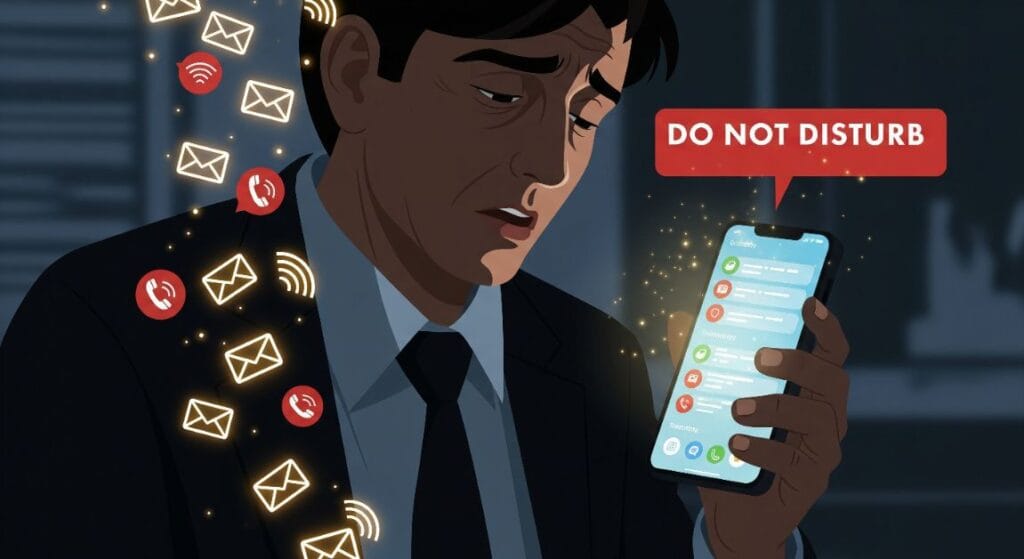
The “right to disconnect” is the idea that workers shoe to switch off from office work once their working day is over. No pressure to reply to emails at midnight, no fear of punishment for ignoring calls during family time. Some countries in Europe and Australia already have similar protections in law. India’s new Right to Disconnect Bill 2025 tries to bring this protection into Indian law.
2. Government update
An MP, Supriya Sule, has introduced a private member’s bill in the Lok Sabha asking for a law that gives employees the right to disconnect from work-related calls and emails after office hours and on holidays. It also suggests creating an employees’ welfare authority, setting rules for overtime, and imposing penalties on companies that do not follow these rules.
Important point: 👉 This is a proposal, not a final law yet. It has started a serious discussion, but your company is not yet legally forced to follow it.
3. Key features of the Right to Disconnect Bill 2025
According to media reports and the statement attached to the bill, these are the main points:
Right to ignore work communication after hours
Every employee would have the right to ignore:
- work-related phone calls
- emails
- messages on apps (like WhatsApp, Teams, Slack, etc.)
- This right applies after official working hours and on holidays.
If an employee chooses not to respond, the employer cannot punish, threaten or harass them for it.

Employees’Welfare Authority
The bill proposes an Employees’Welfare Authority (or similar body).
This authority would:
- frame detailed rules,
- monitor whether companies are following the law,
- handle complaints from employees.
Penalties for companies
If a company does not respect the right to disconnect, it can face a penalty up to 1% of the total remuneration of its employees. The idea is to make it costly for employers to ignore the rules.
Overtime and digital work
If an employee agrees to work beyond normal hours:
- that extra time should be treated as overtime,
- and paid at least at the same rate as their regular wage.
This is meant to stop the hidden, unpaid overtime that often happens through emails and phone calls at home.

Health, burnout and “digital detox”
The bill talks about:
- stress, anxiety, sleep problems and “info-obesity” caused by constant digital pressure;
- the need for counselling and awareness about healthy use of digital tools;
- even digital detox centres where people can disconnect and recharge.
How would this work if the bill becomes law?
If Parliament passes the bill without major changes, this is roughly how it would work in practice:
1. Law notified
The Right to Disconnect Act would be published in the Gazette and come into force on a certain date.
2. Authority set up
The central government would establish the Employees’ Welfare Authority and frame detailed rules and guidelines.
3.Companies define work hours & policies
Each company would:
- clearly define official working hours in contracts/HR policies;
- create a Right to Disconnect Policy (for example: no calls after 7 pm except emergencies);
- negotiate terms with employees or unions based on their industry needs.
4.Employees can say “no”
- After official hours, employees can simply not answer work calls or emails.
- They cannot be given poor appraisals, warnings, or threats for exercising this right.
5.Extra work = overtime
- If an employee chooses to work after hours (for a project, deadline, etc.), that time must be treated as overtime, and paid accordingly.
6. Complaints and penalties
- If an employer repeatedly disturbs staff after hours or punishes them for not responding, employees can complain to the authority.
- After enquiry, the authority can impose financial penalties (up to 1% of the company’s total wage bill) and give directions to the employer.
Is this bill already a law?
No, not yet. This is very important for readers to understand.
The Right to Disconnect Bill 2025 is a private member’s bill. That means it was introduced by an MP who is not a minister.
Private member’s bills almost always:
- get discussed, referred to committees, or lapsed,
- but very rarely become law in India.

Parliamentary procedure – what happens next?
| Step | Stage | Details |
|---|---|---|
| 1 | Introduction in Lok Sabha | Already done by Supriya Sule. |
| 2 | First Reading | Basic presentation of the bill. |
| 3 | Possible Reference to a Committee | A parliamentary committee may study the bill, seek expert views, and give recommendations. |
| 4 | Second Reading & Debate | MPs debate the bill clause by clause; amendments can be moved. |
| 5 | Third Reading & Voting in Lok Sabha | If a majority votes in favour, the bill passes the Lok Sabha. |
| 6 | Rajya Sabha | The same three-reading process happens in the Rajya Sabha. |
| 7 | President’s Assent | If both Houses pass the bill, it is sent to the President for assent. |
| 8 | Notification & Implementation | After assent, the government frames rules and notifies the date from which the law will apply. |
Until all these steps are completed, nothing changes legally for employees or companies.
Why is this bill important?
Even though it is only a proposal, the bill matters for several reasons:
- It officially recognises mental health and work-life balance as serious policy issues.
It puts pressure on companies and the government to think about:
- humane working hours,
- fair overtime pay,
- realistic expectations in an “always online” culture.
It starts a national conversation about boundaries:
- Is it okay to expect employees to be available 24×7?
- How much is productivity worth if it destroys people’s health?
What should employees and employers understand right now?
For employees
- There is no automatic legal right yet to ignore calls or emails after work.
Your protection still depends on:
- your employment contract,
- your company’s HR policies,
- existing labour laws (like Shops & Establishments Acts, overtime rules, etc.).
However, you can:
- track this bill in the news,
- raise the issue of right to disconnect with HR or unions,
- push for internal company policies even before the law comes.
For employers
- This bill is a warning sign that the old “24×7 availability”culture is being questioned.
Forward-looking companies can:
- set clear cut-off times for routine communication,
- limit late-night emails and calls,
- encourage managers to respect boundaries,
- design proper overtime and compensatory off systems.
Doing this early can improve employee morale, retention and brand image, even if the bill never becomes law.
Read This Article Also: RBI New Rules 2025 Is Pushing Banks Towards-.bank.in Domain
Conclusion: The Right to Disconnect Bill 2025 is a big symbolic step in India’s journey from “always on” to “balanced work-life”.
Supriya Sule’s proposal tells the country that rest, family time and mental health deserve legal protection just as much as productivity and profits. However, it is still a private member’s bill, and the path from proposal to actual law is long and uncertain.
For now, nothing has legally changed but the conversation has clearly started. Whether or not this exact bill passes, it is likely that in the coming years India will see stronger rules on working hours, overtime and digital boundaries.
About The Author