As the global football community prepares for the largest-ever FIFA World Cup in 2026, a strange silence hangs over the Indian subcontinent. With the tournament scheduled to begin across North America in just a matter of weeks.
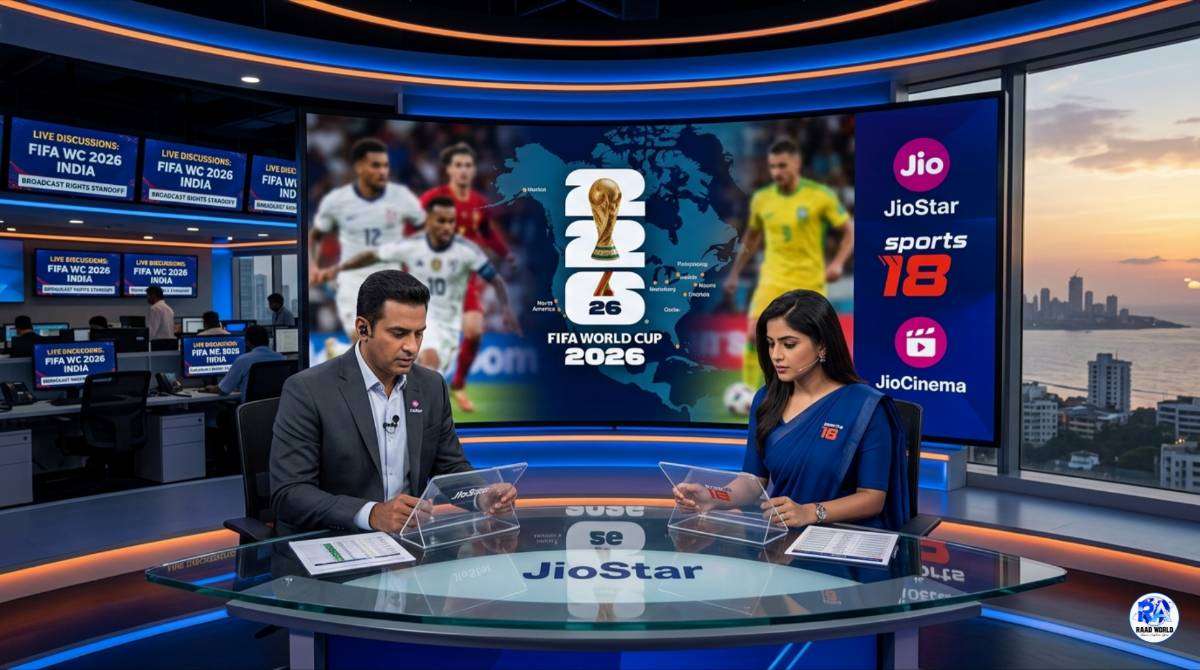
Indian football fans find themselves in an unprecedented situation there is currently no official broadcaster confirmed for the event. This standoff represents a fascinating intersection of sports diplomacy, corporate consolidation, and the brutal reality of time-zone economics.
The Valuation Gap and Market Consolidation
The primary hurdle in securing a deal has been the valuation of media rights. Historically, FIFA has viewed India as a high-growth market, expecting a significant premium for the 2026 and 2030 cycles. Initial reports suggested that FIFA was seeking a package deal worth nearly $100 million.
However, the Indian media landscape has shifted dramatically since the 2022 Qatar World Cup. The recent merger between Reliance’s Viacom18 and Disney’s Star India has created a powerhouse entity, JioStar, which now holds a near-monopoly on premium sports rights.
This consolidation has stripped FIFA of its traditional “bidding war” leverage. Without a hungry competitor like Sony Sports Network which has reportedly stepped back due to high entry costs JioStar is in a position to dictate terms.
Industry insiders suggest that while FIFA has lowered its expectations to approximately $35 million, the domestic broadcasters are holding firm at a lower threshold, citing the specific logistical challenges of this particular tournament cycle.
READ THIS: IPL 2026 Playoff Schedule: Why the Final Shifted to Ahmedabad
The “Western Time Zone” Penalty
The most significant barrier to a lucrative deal is the clock. Unlike the 2022 World Cup in Qatar, which offered India prime-time evening viewing, the 2026 edition is hosted by the United States, Canada, and Mexico. For the
Indian audience, this means the vast majority of the 104 matches will kick off between 12:30 AM and 7:00 AM IST. From a commercial standpoint, this is a nightmare for advertisers.
Broadcasters rely on high viewership numbers to sell ad slots at a premium. With nearly 90% of the tournament occurring while most of the Indian population is asleep, the “reach” of the tournament is projected to drop significantly compared to previous editions.
This makes it incredibly difficult for a network to justify a massive upfront rights fee when they cannot guarantee the high-volume TV ratings usually associated with a World Cup. The focus has therefore shifted almost entirely to digital streaming, where “on-demand” highlights and delayed viewing might recoup some of the investment.
Potential Solutions and Last-Minute Deals
Despite the current impasse, it is highly unlikely that India will face a total blackout. The most probable outcome remains a last-minute agreement with JioStar.
The infrastructure provided by platforms like JioCinema or the newly integrated JioHotstar is the only system capable of handling the massive concurrent traffic a World Cup generates in India. Furthermore, there is a regulatory aspect to consider.
The Indian government has previously categorized the FIFA World Cup as an event of national importance, which could lead to mandatory sharing with the state-owned broadcaster, Prasar Bharati (DD Sports).
READ THIS: National Creator Economy Bill 2026 Explained: Rules, Benefits & India Update
The Impact on the Indian Football Ecosystem
Beyond the immediate frustration of fans, the lack of a clear broadcast partner hurts the growth of the sport domestically. Consistent visibility of world-class football is essential for inspiring.
the next generation of Indian players and maintaining the momentum of the Indian Super League (ISL). A delay in marketing the tournament also means less “hype,” potentially leading to lower engagement once the games actually begin.
Conclusion
The broadcast saga of the FIFA World Cup 2026 serves as a reality check for the global sports market. It proves that even the world’s biggest sporting event is not immune to the laws of supply, demand, and geography.
While a deal will almost certainly be struck in the eleventh hour likely favoring a digital-first approach on a Reliance-backed platform the friction highlights the growing power of domestic media giants over international sports federations.
For the Indian fan, the message is clear keep your streaming apps updated and prepare for a month of very late nights and early mornings.
About The Author