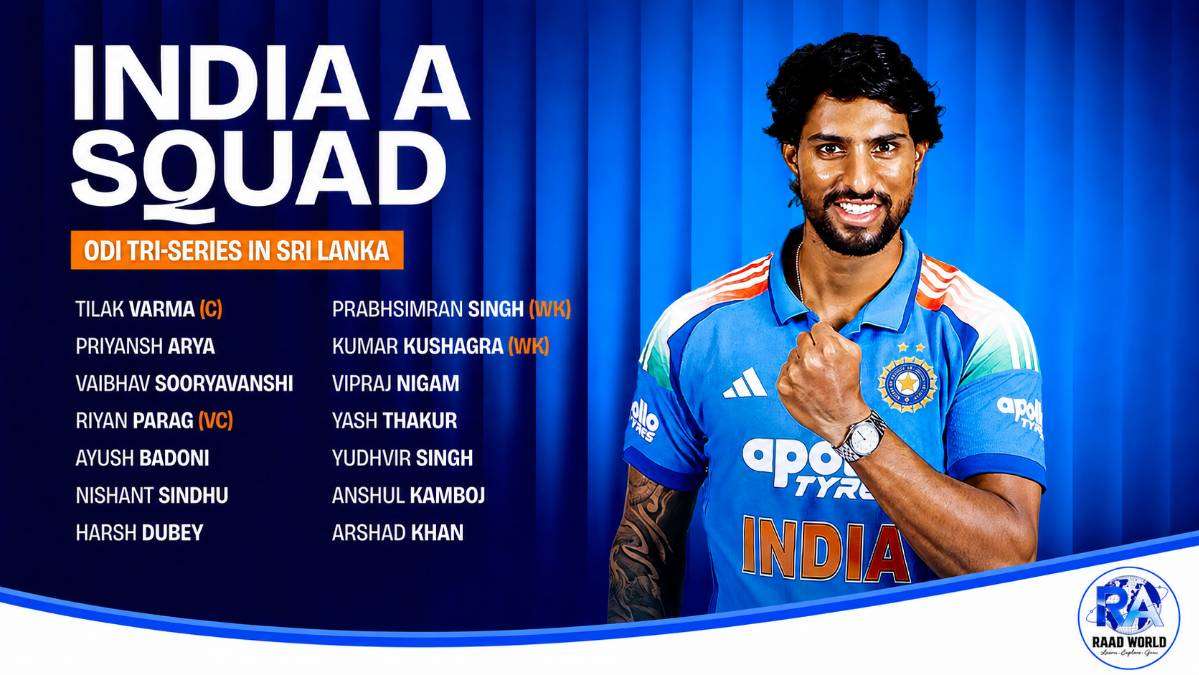
The announcement of the 15-member India A squad for the upcoming One Day International (ODI) Tri-Series in Sri Lanka marks a critical inflexion point in the Board of Control for Cricket in India’s (BCCI) developmental philosophy.
Historically, “A” tours served primarily as rehab clinics for out-of-form veterans or waiting rooms for older domestic heavyweights. However, the current selection reflects a distinct pivot toward ultra-youthful integration, aggressive intent, and transition planning.
By pitching a group of dynamic youngsters into the challenging spin-friendly environments of Dambulla against Sri Lanka A and Afghanistan A, selectors are evidently scanning the horizon for the next decade of white-ball cricket.
The Strategic Elevation of Tilak Varma and Riyan Parag
Handing the captaincy reins to Tilak Varma, with Riyan Parag as his deputy, is an eloquent statement on the future leadership core. Both individuals are no longer just domestic phenoms they possess vital international exposure and have anchored their respective Indian Premier League (IPL) franchises through high-pressure situations.
Varma brings a serene, calculated temperament to the leadership role, mirroring his approach to constructing middle-order innings. His ability to read match situations and communicate effectively under stress makes him an ideal candidate to guide a highly volatile, young batting lineup.
Conversely, Riyan Parag offers the essential counter-balance of raw emotion, tactical audacity, and a fiercely modern approach to the game. Parag’s recent evolutionary leap in domestic cricket, where he transformed from an enigmatic talent into an incredibly consistent match-winner, validates his promotion.
Beyond their roles with the bat, both Varma and Parag provide critical balance as handy off-spin options. In modern limited-overs cricket, top-order batters who can roll their arms over are worth their weight in gold. By positioning them at the helm, the selectors are investing heavily in a culturally aggressive and flexible tactical blueprint.
The Prodigy Metric: Vaibhav Sooryavanshi’s Historical Ascent
Among the list of names, none has triggered as much mainstream excitement and analytical intrigue as the inclusion of 15-year-old Vaibhav Sooryavanshi. The young batting prodigy has demolished the conventional age-group barriers of Indian cricket.
His inclusion is not merely a token nod to raw talent; it is a calculated gamble on a generational ceiling. Watching Sooryavanshi operate reveals a startling sense of spatial awareness and intuitive timing that usually takes a decade of professional exposure to develop.
His recent explosive performances against elite bowling lineups have proved that he possesses the fast twitch reflexes required to combat high pace, alongside a fearless approach to clearing boundaries. However, an ODI series in Sri Lanka presents a completely different matrix of complexity.
He will face slow, turning tracks where the ball grips, requiring sophisticated footwork and an elite sense of strike rotation. How the young southpaw handles the dry, abrasive wickets of Dambulla will tell us volumes about his technical adaptability and emotional maturity at the highest level.
READ THIS: IPL 2026 Playoff Schedule: Why the Final Shifted to Ahmedabad
Constructing the Engine Room: Power-Hitters and Anchor Men
The batting framework of this squad is designed around modern multi-dimensionality. In Priyansh Arya, India finds an opener capable of exploiting mandatory powerplays with clean, orthodox cricketing shots mixed with brutal aerial execution.
Arya’s domestic consistency has earned him this platform, and his partnership at the top of the order will dictate how effectively India sets up their innings.
Further down the order, the presence of multi-faceted players like Ayush Badoni, Nishant Sindhu, and Suryansh Shedge ensures that the lineup does not suffer from structural rigidity. Badoni has repeatedly illustrated his utility as an elite finisher who can manipulate fields with late cuts, sweeps, and innovative ramp shots.
Nishant Sindhu provides the vital left-handed variation in the middle order alongside his accurate left-arm orthodox spin, making him a fundamental tactical asset when defending totals on degrading pitches.
The Dual-Wicketkeeper Conundrum
Another fascinating sub-plot within this squad configuration is the inclusion of both Prabhsimran Singh and Kumar Kushagra as wicketkeeping options. Both represent entirely different philosophies of modern glovework and run-scoring:
Prabhsimran Singh: A high-octane, uninhibited dynamic striker who can open the batting or disrupt bowling plans during the middle overs with sheer velocity of scoring.
Kumar Kushagra: A technically sound middle-order accumulator who possesses excellent situational awareness, a heavy ground-stroke game, and is built for pacing deep chases.
This dual presence creates an intense internal competition, but it also gives the team management the flexibility to play both in the same XI depending on whether they require an explosive top-order catalyst or a stabilizing force in the lower-middle order.
Pace, Spin, and the Art of Defending in the Subcontinent
An India A tour to Sri Lanka is fundamentally an examination of bowling discipline. The fast-bowling contingent, spearheaded by Yash Thakur, Yudhvir Singh, Anshul Kamboj, and Arshad Khan, must find ways to remain effective without the luxury of green tops or excessive lateral movement.
Yash Thakur’s mastery over death-overs execution utilizing subtle variations in pace and wide yorkers will be vital. Meanwhile, the left-arm angle of Arshad Khan offers the necessary variety to disrupt the rhythm of opposition right-handers, creating awkward trajectories and essential footplay challenges.
However, the true destiny of the tournament lies in the hands of the spin department. Harsh Dubey and Vipraj Nigam bear the heavy responsibility of controlling the middle overs.
In the subcontinent, low, slow turners demand that spinners bowl with immaculate control over their lengths, using subtle variations in flight and speed rather than relying purely on surface assistance.
If Dubey and Nigam can choke the run flow and force errors, they will build an irresistible case for their inclusion in future senior national transitions.
READ THIS: FIFA World Cup 2026 India Broadcast: Where to Watch & Rights Update
Strategic Synthesis and Looking Ahead
Ultimately, this India A squad represents a calculated gamble on pure potential over experienced safety nets. By stripping away the comfort blankets, the BCCI has created an environment where young prospects must either sink or swim.
The Sri Lanka Tri-Series will serve as a ruthless filter, separating those who dominate merely on flat domestic tracks from those who possess the elite technical framework and psychological fortitude required to thrive on the international stage.
Conclusion
the composition of this India A squad signals a deliberate and visionary shift in how Indian cricket plans its generational successions. By entrusting the leadership to proven young anchors like Tilak Varma and Riyan Parag, and integrating raw, high-ceiling talents like the 15-year-old Vaibhav Sooryavanshi, the selectors have explicitly prioritized future readiness over short-term pragmatism.
This tournament is less about maintaining a status quo and more about throwing tomorrow’s stars into a high-stakes competitive crucible. The upcoming matches in Dambulla will test more than just physical skill they will test structural adaptability.
Facing the unpredictable spin webs of Sri Lanka A and Afghanistan A on slow, gripping wickets will demand tactical patience from the batters and immaculate discipline from the bowling unit.
Those who emerge successful from this trial by fire will not only secure silverware for India A, but will also put themselves at the very front of the line for senior national team call-ups as India builds its blueprint for the next cycle of global ICC tournaments.
About The Author