India’s digital payment system has become an important part of everyday life. Millions of people use the Unified Payments Interface (UPI) to send money, pay shopkeepers, recharge mobile phones and purchase products online.
Whenever someone makes a UPI payment, banks generally send transaction notifications through SMS, email or mobile applications. These alerts help customers check their payments and identify suspicious activities.
However, a new set of Reserve Bank of India (RBI) directions will change the way banks send SMS alerts for smaller electronic transactions from January 1, 2027.
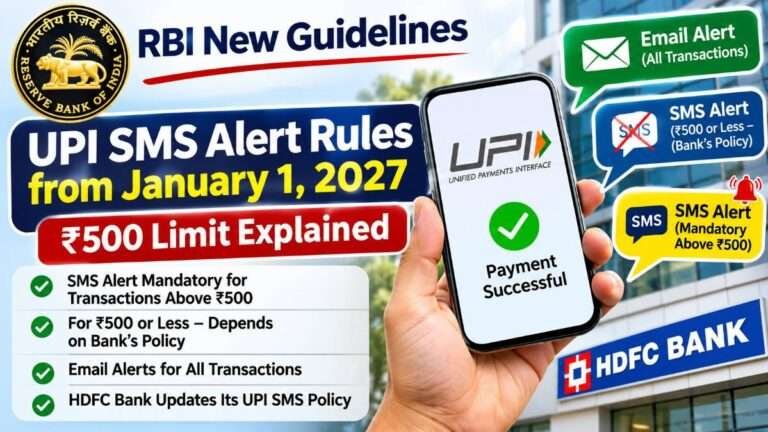
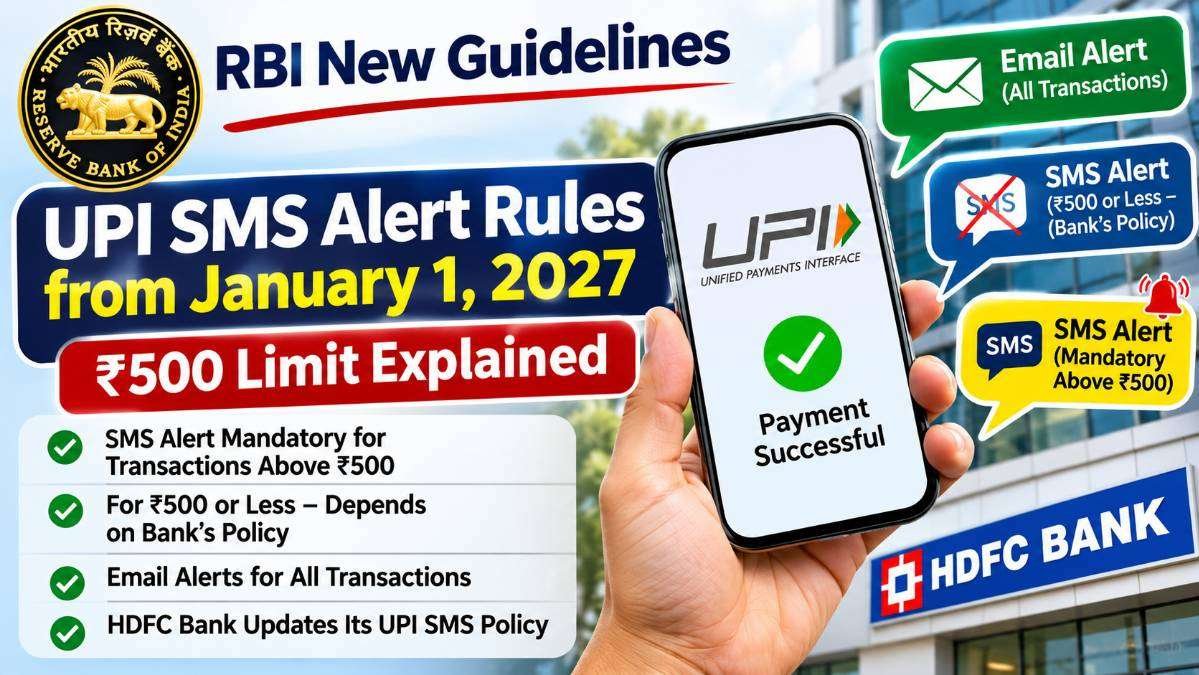
Under the revised directions, banks must send instant SMS alerts for covered electronic banking transactions above ₹500. For transactions of ₹500 or less, banks can decide whether to send SMS notifications according to their internal policies.
This update has also attracted attention because HDFC Bank has informed its customers about changes to its UPI SMS notification policy.
What Is the New RBI Rule?
The Reserve Bank of India has introduced revised directions concerning customer protection in unauthorised electronic banking transactions.
The new directions were issued on June 24, 2026, and will come into effect on January 1, 2027.
According to the revised instructions, banks must send instant SMS notifications whenever a covered electronic banking transaction exceeds ₹500.
For transactions worth ₹500 or less, banks have the option to decide whether they want to send SMS notifications according to their internal policies.
The RBI has also directed banks to send email notifications for covered electronic banking transactions whenever customers have provided their email addresses.
READ THIS: WhatsApp Scheduled Messages Feature: How It Works, Features and Availability
How Will the ₹500 SMS Alert Rule Work?
The new notification system can be understood through a few simple examples.
| Transaction Amount | SMS Notification Requirement |
|---|---|
| ₹100 | Depends on the bank’s policy |
| ₹200 | Depends on the bank’s policy |
| ₹500 | Depends on the bank’s policy |
| ₹501 | Mandatory |
| ₹1,000 | Mandatory |
| ₹5,000 | Mandatory |
For example, imagine that a customer pays ₹300 through UPI at a grocery shop.
The payment can be completed successfully even if the bank does not send an SMS notification. The customer can still check the transaction through the UPI application, email notification or bank statement.
However, when the customer makes a covered electronic transaction of ₹501, the bank must send an instant SMS alert under the applicable directions.
Customers should understand that the ₹500 limit concerns SMS notifications. It does not restrict the amount of money they can transfer through UPI.
Why Is HDFC Bank Changing Its UPI SMS Alerts?
HDFC Bank has informed customers about a change to its UPI SMS notification policy.
According to a customer communication reported by LiveMint on November 27, 2026, HDFC Bank will stop sending SMS alerts for UPI transactions of ₹500 or less from January 1, 2027.
However, the bank will continue sending email notifications for UPI transactions when customers have a valid registered email address.
SMS notifications will continue for UPI transactions above ₹500.
This decision is consistent with the flexibility provided under the revised RBI directions.
It is important to understand that this is HDFC Bank’s reported policy decision. It does not mean that every bank in India will follow exactly the same notification policy.
READ THIS: EPFO WhatsApp Services 2026: Check PF Balance & Download Passbook
Does the New Rule Apply Only to UPI Payments?
No. This is one of the most important points customers should understand.
The RBI directions refer to Electronic Banking Transactions (EBTs), which cover a wider range of electronic banking activities.
These include applicable electronic p ftayment transactions through different banking channels.
Therefore, the revised notification requirements are not limited to UPI applications such as Google Pay, PhonePe, Paytm or BHIM.
Customers should also remember that the detailed requirements depend on the applicable directions for their bank.
Will Google Pay, PhonePe and Paytm Stop Working?
No. There is no such restriction in the new RBI directions.
Google Pay, PhonePe, Paytm and BHIM can continue to be used for UPI payments.
- Send money to friends and family.
- Scan QR codes and make payments.
- Pay electricity and mobile bills.
- Recharge mobile phones.
- Make online purchases.
- Receive money from other UPI users.
The change is related to bank SMS notifications, not the functioning of UPI payment services.
What About Email Notifications?
Email notifications will become particularly important under the revised directions.
Banks must send email alerts for covered electronic banking transactions whenever customers have provided an email address.
For example, if a customer makes a UPI payment of ₹100, ₹300 or ₹500, the customer should receive an email notification if the email address is registered and provided to the bank.
Customers should make sure that their registered email address is correct and active.
They should also check their spam and junk folders if they cannot find transaction notifications in their inbox.
What Should Bank Customers Do Before January 1, 2027?
1. Check Your Registered Email Address
Make sure that your bank has your correct email address. Update it through the bank’s official mobile application, internet banking service or branch.
2. Enable Mobile Application Notifications
Keep notifications enabled for your UPI applications and banking applications.
3. Check Your Transaction History
Whenever you make a payment, check the transaction status through the application you used.
4. Monitor Your Bank Account
Regularly review your bank account statement to identify unfamiliar transactions.
5. Report Suspicious Transactions Immediately
If you notice an unauthorised payment, contact your bank immediately and report the incident through the official cybercrime reporting channels.
RBI’s New Customer Protection Measures Against Digital Payment Fraud
The revised RBI directions are not limited to transaction notifications. They also introduce important measures to improve customer protection against electronic banking fraud.
One important development is a compensation mechanism for eligible small-value fraudulent electronic banking transactions.
Under the specified conditions, eligible individual customers, including sole proprietors, may receive compensation equal to 85 per cent of their eligible net loss, subject to a maximum of ₹25,000.
The mechanism applies to eligible gross fraud losses of up to ₹50,000.
However, customers must satisfy the prescribed conditions. These include reporting the incident to the bank and lodging a complaint through the National Cyber Crime Reporting Portal or helpline 1930 within five calendar days.
The compensation is not automatic, and it does not apply to every digital payment fraud.
The revised directions also provide for:
- Round-the-clock channels for reporting fraudulent electronic transactions.
- Improved procedures for handling customer complaints.
- Faster examination of fraud-related complaints.
- Protection for eligible customers in specified unauthorised transaction situations.
These measures are intended to improve customer confidence in digital banking.
How to Report UPI or Digital Payment Fraud in India
If someone makes an unauthorised transaction from your bank account, take action immediately.
- Contact your bank through its official customer support number or banking application.
- Report the unauthorised transaction and request a complaint reference number.
- Call the National Cyber Crime Helpline at 1930.
- Visit the official National Cyber Crime Reporting Portal.
- Keep transaction details, screenshots and complaint records for future reference.
Never share your UPI PIN, OTP, password or banking details with anyone claiming to help you recover money.
Remember that reporting fraud quickly can help reduce the risk of further financial loss.
Frequently Asked Questions (FAQs)
1. When will the new RBI SMS alert directions start?
The revised directions will come into effect on January 1, 2027.
2. Will I receive an SMS for a ₹500 UPI payment?
It depends on your bank’s internal policy. The RBI does not make SMS alerts mandatory for transactions of ₹500 or less.
3. Will banks send SMS alerts for ₹501 transactions?
Yes. Instant SMS alerts are mandatory for covered electronic banking transactions above ₹500.
4. Will UPI payments stop working from January 2027?
No. UPI payment services will continue to operate. Only the bank notification requirements are changing.
5. Will Google Pay and PhonePe be affected?
The applications can continue to operate normally. However, the SMS notifications generated by your bank may change according to its policy.
6. Will I receive email notifications for small payments?
Banks must send email alerts for covered electronic banking transactions whenever the customer has provided an email address.
7. Is this rule applicable to every bank?
The RBI has issued separate amendment directions for seven categories of banks. Customers should check the directions applicable to their bank.
8. Can I complain if my bank does not send a mandatory SMS alert?
Yes. You can contact your bank and register a complaint if a required transaction alert is missing.
Conclusion
The new RBI directions coming into effect on January 1, 2027, introduce important changes to electronic banking transaction notifications in India.
Banks must send instant SMS alerts for covered electronic banking transactions above ₹500. For transactions of ₹500 or less, banks can decide whether to provide SMS notifications according to their internal policies.
HDFC Bank has already informed customers about its decision to stop SMS alerts for UPI payments of ₹500 or less while continuing email notifications.
Customers should not worry that UPI payments will stop working. Instead, they should ensure that their registered email addresses are updated, keep banking notifications enabled and regularly check their transaction history.
The revised RBI directions also introduce additional customer protection measures against digital payment fraud. Understanding these changes will help people use digital banking more safely and confidently.
Stay informed, stay alert and use digital payments safely.
About The Author