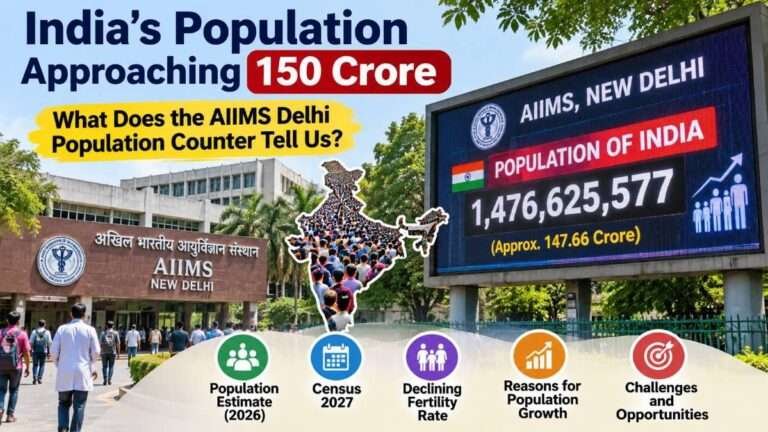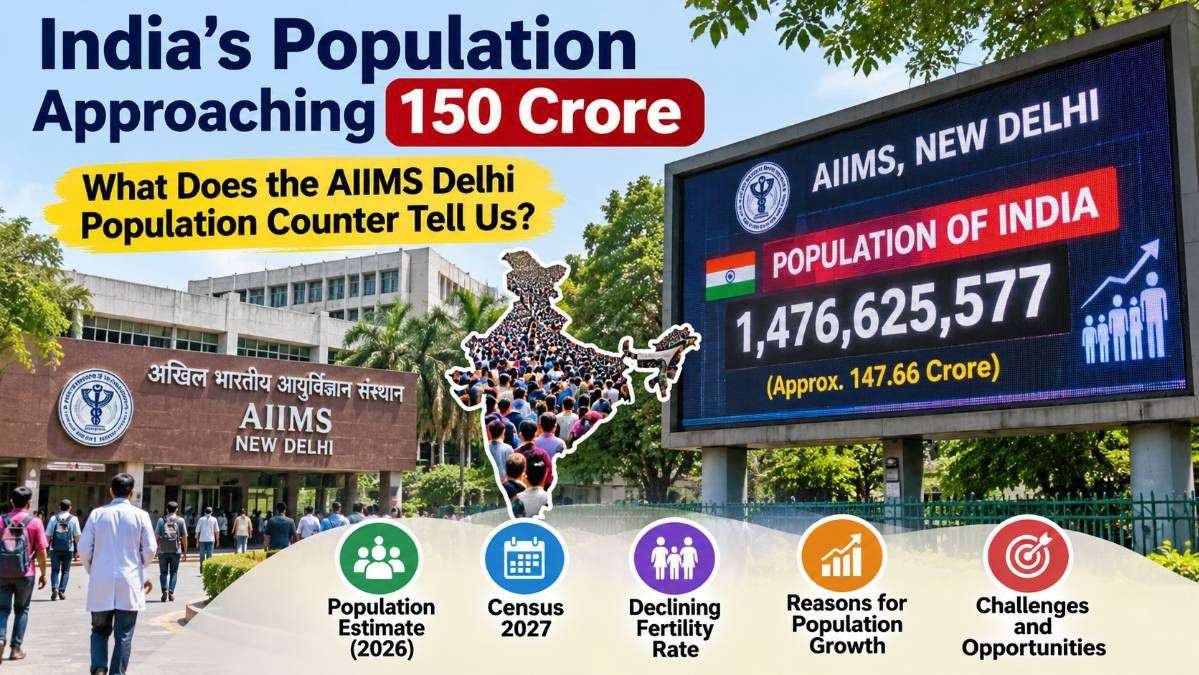
India is one of the most populated countries in the world. Its population has continued to grow over the years, attracting attention from researchers, governments and people around the world. Recently, a video showing a digital population counter at AIIMS Delhi has attracted public interest. The display shows a continuously changing number representing India’s estimated population.
But an important question comes to mind. Is the number displayed on the screen the exact population of India? How does the country calculate its population, and why is the population still increasing? Let us understand the facts in simple language.
India’s Population Is Getting Closer to 150 Crore
According to the United Nations Department of Economic and Social Affairs (UN DESA), India’s estimated population for 2026 is approximately 147.66 crore. This means the country’s population is getting closer to the 150 crore mark.
India became the world’s most populous country in 2023, overtaking China according to United Nations estimates. This development marked an important moment in India’s demographic history.
However, it is important to understand that population figures published by international organisations are estimates. They are calculated using demographic information, birth rates, death rates and other available data. They are not exact real-time counts of every person living in the country.
What Is the AIIMS Delhi Population Counter?
A video circulating online shows a digital population counter displayed on a billboard associated with the All India Institute of Medical Sciences (AIIMS), New Delhi. The display shows changing population figures, which have attracted attention from viewers.
Such displays are generally designed to communicate estimated population growth. A population counter can use statistical calculations to show how the population may change over time.
However, there is an important difference between a digital population estimate and an official population count. No publicly verified information has established the exact calculation method, data source or update frequency used by the particular AIIMS display shown in the video.
Therefore, viewers should not assume that the changing number represents an exact live count of every person in India.
Why Is India’s Population Increasing?
There are several reasons behind India’s population growth. Birth rates, death rates, life expectancy and migration all influence the total population of a country.
1. Birth Rate
When children are born, they add to the country’s total population. Even though the average number of children per woman has declined in India, millions of children continue to be born every year.
2. Better Healthcare Facilities
Improvements in medical facilities, vaccination programmes, hospitals and public health services have helped people live longer. Better healthcare also plays an important role in reducing preventable deaths.
3. Young Population
India has a large young population. Many people are entering their working and family-building years. This creates population momentum, which means the population can continue increasing even when the average number of children per woman becomes lower.
4. Increasing Life Expectancy
Better healthcare, improved living conditions and greater awareness of health have contributed to longer life expectancy. When people live longer, they remain part of the total population for more years.
India’s Fertility Rate Is Declining
One important development in India’s population story is the decline in the fertility rate.
According to the fifth National Family Health Survey (NFHS-5), conducted between 2019 and 2021, India’s Total Fertility Rate was 2.0 children per woman. This is below the commonly used replacement-level fertility benchmark of approximately 2.1.
Replacement-level fertility refers to the average number of children women need to have for one generation to replace itself over time, assuming other demographic conditions remain broadly stable.
The declining fertility rate shows that Indian families are having fewer children on average than in previous generations. However, the country’s large population and age structure mean that population growth does not stop immediately.
India’s Census 2027: An Important Development
India’s next population Census is planned for 2027. The Census is an important national exercise because it helps the government collect information about people, households and living conditions across the country.
The Census exercise is being organised by the Office of the Registrar General and Census Commissioner under the Ministry of Home Affairs.
One important development is the introduction of digital data collection. The Census process includes mobile applications for enumerators and a self-enumeration facility for eligible households.
Why Is the Census Important?
The Census provides important information that helps governments plan public services and development programmes.
- It helps estimate the population in different areas.
- It supports planning for schools and educational facilities.
- It helps governments understand healthcare requirements.
- It provides information for housing and infrastructure development.
- It supports employment, welfare and public policy planning.
- It helps researchers understand changes in society.
Official Census information is especially important because it provides a systematic picture of the country’s population rather than relying only on projections.
READ THIS: Reliance Retail Crosses 400 Million Customers, Operates 19,947 Stores
What Are the Challenges of a Growing Population?
A large population can create opportunities for economic development, but it also brings several responsibilities and challenges.
Employment Opportunities
India needs to create enough employment opportunities for its growing working-age population. Skill development, education, manufacturing and technology can play important roles in supporting job creation.
Education and Healthcare
More people require access to quality schools, colleges, hospitals and healthcare services. Governments need to improve these facilities to meet the needs of different communities.
Housing and Transportation
Growing cities require affordable housing, better roads, public transportation and proper urban planning. Without effective planning, population growth can increase traffic congestion and pressure on public infrastructure.
Food, Water and Natural Resources
A large population requires sufficient food, clean drinking water, electricity and other essential resources. Sustainable development and responsible resource management are important for the country’s future.
Population Growth Can Also Create New Opportunities
India’s large population is not only a challenge. It can also become an important strength when people receive proper education, training and employment opportunities.
A large working-age population can support economic growth, technological development, entrepreneurship and manufacturing. India’s expanding consumer market can also create opportunities for businesses and startups.
Investing in education, digital skills, healthcare and infrastructure will be important to make the best use of this demographic opportunity.
How Is a Digital Population Counter Calculated?
A digital population counter generally uses a statistical model rather than receiving information about every birth and death as it happens.
A simplified population calculation considers the following factors:
- The estimated population at the starting point.
- The number of births during a particular period.
- The number of deaths during that period.
- People moving into or out of the country.
In simple terms, population change can be understood through this formula:
New Population = Previous Population + Births – Deaths + Net Migration
A digital display can use estimated rates to update its number continuously. This makes the counter appear live, but the displayed figure remains an estimate unless it is supported by a verified real-time data system.
READ THIS: Jio Canva Offer 2026: Get Canva Pro Free for 12 Months
What Does India’s Population Future Look Like?
According to the United Nations World Population Prospects 2024, India’s population is expected to continue increasing for several decades before reaching its projected peak around the early 2060s.
However, future population figures are projections rather than guaranteed results. Actual population growth can change because of fertility rates, mortality, migration and other demographic developments.
India’s future will depend not only on how many people live in the country but also on their education, health, skills and access to opportunities.
Conclusion
India’s population approaching 150 crore is an important demographic development. The AIIMS Delhi population counter video has brought public attention to this subject and encouraged people to learn more about the country’s population growth.
However, a digital population counter should not be confused with an official Census or an exact live population measurement. United Nations estimates and projections provide useful information, while India’s Census provides an important source of official population data.
Population growth brings both opportunities and challenges. By investing in education, healthcare, employment, technology and sustainable infrastructure, India can work towards a stronger future for its people.
Understanding population statistics is important because they help us understand not only how many people live in a country but also what the country needs for its future development.
Official Sources and References
- United Nations – World Population Prospects 2024
- Census of India – Government of India
- Ministry of Health and Family Welfare
- National Family Health Survey (NFHS)
- AIIMS New Delhi – Official Website
About The Author