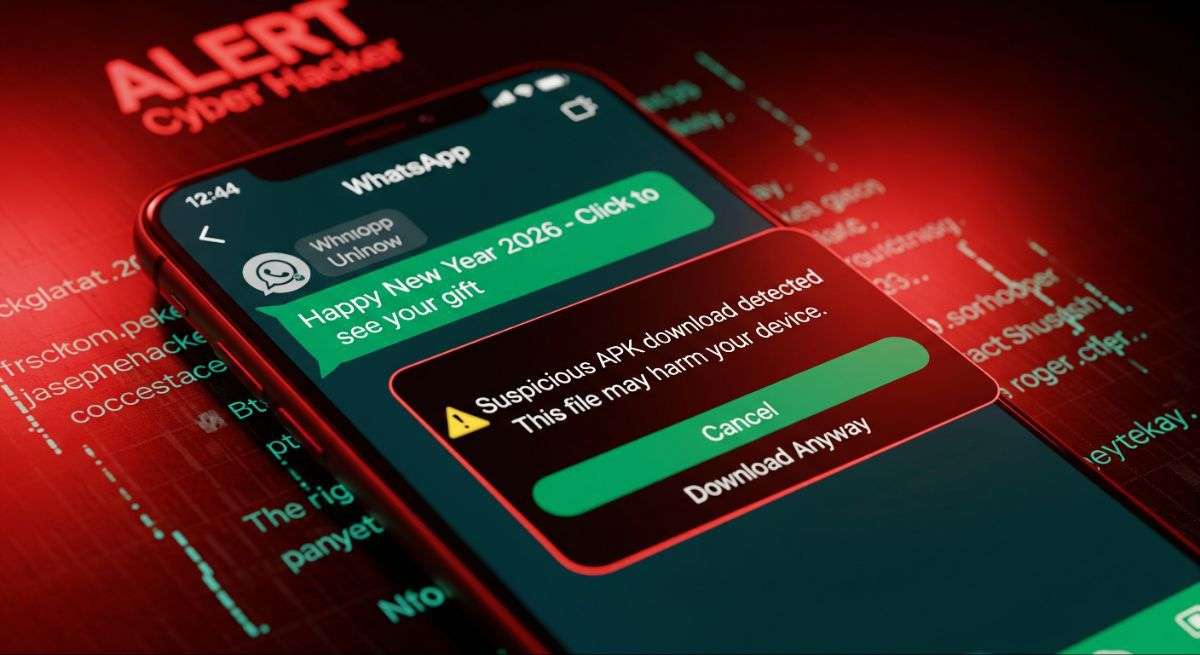
As India and other countries prepare to ring in 2026, cybercrime units and security experts have issued urgent alerts “Happy New Year” greetings, e-cards and supposed “gift” links circulating on WhatsApp can be traps. These messages often ask you to download an APK (Android app package) or click a shortened link once opened, they can install malware that steals OTPs, reads messages, records keystrokes and even drains bank accounts. Multiple state cyber bureaus and national outlets reported a sharp rise in these holiday-themed scams in December 2025.
How the scam usually starts
- The friendly message: You receive a WhatsApp message that looks like a harmless New Year wish“Happy New Year 2026 click to see your special greeting” or “You’ve received a New Year gift.” The sender might be an unknown number or worse, a contact whose account has been compromised, making the message look trustworthy.
- A landing page or attachment: The message links to a festive webpage or contains an attachment (PDF, image or an APK). The page shows animations or a preview and prompts you to “download the app to view the greeting.” That “app” is not on Google Play; it’s an APK hosted on an external server.
- User installs APK: On Android devices, installing an APK outside the Play Store requires the user to enable “unknown sources.” Scammers social-engineer victims into allowing this, often by claiming it’s necessary to view the greeting or claim the gift.
- Payload activation: The APK can be a trojan/RAT (remote access trojan) or overlay banking malware. Once active it can read notifications (including OTPs), capture keystrokes, access contacts and photos, and execute transactions sometimes within minutes.

Read This Article Also: Why Instagram Is Not Showing the Live Option Without 1,000 Followers
Why these holiday scams work so well
- Emotional timing: During festivals and year-end parties people are distracted, more willing to click celebratory links and less suspicious.
- Social proof: Links coming from a friend or a familiar group feel safe; attackers exploit compromised accounts to spread the malicious link reliably.
- Technical gap: Many Android users don’t know how APKs differ from Play Store apps and the risks of “unknown sources.”
Real-world warnings (who’s saying this)
State cyber bureaus, police cyber cells and multiple national news outlets issued alerts in December 2025 reminding users not to click unsolicited greeting links or install APKs because they can lead to full device takeover and bank fraud. If you receive a suspicious festive link, authorities recommend verifying the sender via a separate call or message and avoiding app installs from unknown sources.
Practical, step-by-step prevention (for everyone)
- Never install APKs from WhatsApp messages: If an app isn’t on Play Store (or the official vendor site), don’t install it. Period.
- Verify the sender out-of-band: Call or DM the person on another channel (not by replying to the suspicious WhatsApp message). Compromised accounts are common a quick voice check avoids social-engineering traps.
- Disable “Install unknown apps.”: On Android, keep the permission for unknown installs turned off globally and only enable it temporarily for trusted sources and never for a link from WhatsApp.
- Don’t share OTPs or UPI PINs: Legitimate apps or banks never ask you to share OTPs or PINs via chat. If prompted, assume fraud.
- Keep device and apps updated: Security patches close many exploitation paths. Use Play Protect and official app stores.
- Use a bank app lock and two-factor methods that don’t rely on SMS when possible: FIDO or app-based 2FA is safer than SMS OTPs that can be intercepted.
If you clicked the link or installed an APK Immediate Actions
- Disconnect from the internet: Turn off Wi-Fi and mobile data to stop active exfiltration.
- Do not enter bank passwords or OTPs: If the device is compromised, any credentials typed may be captured.
- Run a trusted antivirus scan: (from Play Store) or use a reputable malware-removal app.
- Change critical passwords from a separate, clean device: Start with banking, email and social logins.
- Inform your bank immediately: and freeze accounts or payment instruments if you see unauthorized transactions. Report fraud to your bank’s fraud desk and local cyber police.
How to Report WhatsApp New Year Scams on the Official Indian Cyber Crime Website
If you receive a fake “Happy New Year 2026” WhatsApp message, suspicious APK link, or if money/data is stolen, immediately report it on the official Government of India cyber crime portal:
https://www.cybercrime.gov.in
This is the national cyber crime reporting portal managed by the Ministry of Home Affairs (MHA), Government of India. Complaints submitted here are automatically forwarded to the concerned State Cyber Police Cell, ensuring official legal action.
Step-by-Step: How to Submit a Complaint:
- Visit cybercrime.gov.in
- Click on “Report Cyber Crime”
- Select “Report Other Cyber Crime” (for WhatsApp scams, APK frauds, fake links)
- Login using your mobile number & OTP
- Fill details:
Scam type: WhatsApp / APK / Online Fraud
Phone number or link used by scammer
Date & time of incident
Short explanation of what happened - Upload evidence (screenshots, APK file name, transaction proof if any)
- Submit the complaint and note the Acknowledgement Number

Benefits of Reporting on the Official Cyber Crime Portal
- Legal recognition – Your complaint is officially registered under Indian cyber laws
- Fast action – Routed to local cyber police automatically
- Bank coordination – Helps banks freeze suspicious transactions quickly
- Prevents further victims – Reported links and numbers can be blocked nationwide
- Proof for future use – Useful for insurance, bank disputes, or legal cases
Even if no money is lost, reporting scam links helps authorities track criminal networks.
Important Safety Note
If money is already debited:
- Call your bank immediately
- Block UPI / debit card
- Report within 24 hours for higher recovery chances
- Then submit complaint on cybercrime.gov.in
Read This Article Also: Truecaller Introduces Voicemail Feature: What It Means for Indian Users
Conclusion: WhatsApp New Year scams may look harmless, but one APK click can compromise your phone, bank account, and personal data. Do not ignore suspicious messages report them officially. Early reporting saves not just you, but thousands of others.
About The Author