UPI Charges for Large Merchants Has the Government Introduced MDR? Latest Official Update

India Unified Payments Interface (UPI) has transformed the way people make digital payments. From buying groceries to paying utility bills, millions of users rely on UPI every day because it is fast, secure, and convenient.
Recently, reports claiming that the Finance Ministry has taken the first step towards introducing UPI charges for large merchants have gone viral on social media. This has created confusion among consumers and businesses, with many wondering whether UPI payments will no longer remain free.
The reality is more nuanced. While the Government of India has proposed changes to the law that could allow merchant charges in the future, no new UPI charges have been implemented at this time. Understanding the difference between a legal proposal and an actual policy is essential to avoid misinformation.
What Has Changed?
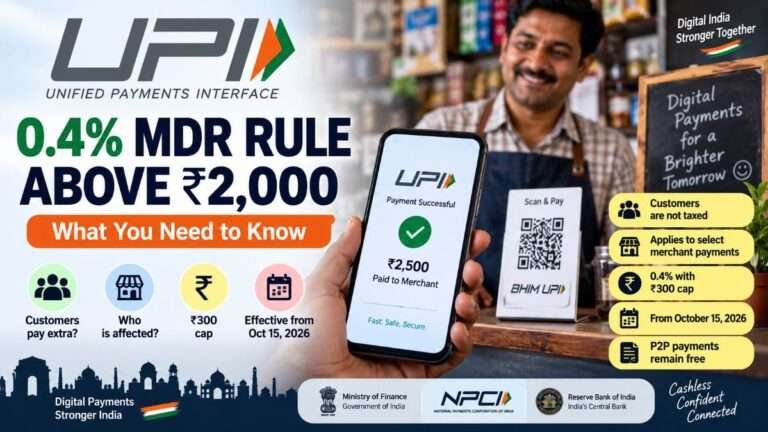
On 4 August 2026, the Government introduced amendments to the Payment and Settlement Systems Act in Parliament. The proposed amendments aim to create a legal framework that would allow the government to introduce Merchant Discount Rate (MDR) on certain digital payment transactions, including UPI, if required in the future.
It is important to note that this amendment does not automatically impose any new charges. Instead, it gives the government the legal authority to notify such charges later through official rules or notifications if it decides to do so.
What Is Merchant Discount Rate (MDR)?
Merchant Discount Rate, commonly known as MDR, is a transaction fee paid by merchants whenever they accept digital payments. This fee is generally shared among banks, payment service providers, payment aggregators, and other participants involved in processing digital transactions.
Unlike customer charges, MDR is collected from businesses accepting payments. Consumers do not directly pay this fee while making transactions.
In India, standard UPI merchant transactions have remained free from MDR for several years, encouraging rapid adoption of digital payments across the country.
READ THIS: WhatsApp Web Voice & Video Calling Encrypted Browser Calls
Who Could Be Affected?
According to discussions surrounding the proposal, the government is primarily considering merchant charges for large businesses rather than small shopkeepers or ordinary consumers.
Reports indicate that one of the options under consideration is applying MDR only to merchants with an annual turnover above a specified threshold and for higher-value UPI transactions.
Some reports have mentioned possible transaction thresholds and MDR rates, but these figures remain proposals and have not been officially approved.
As of now, no official notification has confirmed the final eligibility criteria, transaction limits, or the percentage of any future merchant charge.
Will UPI Users Have to Pay?
The simple answer is no.
There is currently no government notification stating that individual users will be charged for sending money or making payments through UPI. People can continue using UPI for everyday transactions as they do today.
The discussions relate only to merchant charges. Even if a merchant charge is introduced in the future, it would not automatically mean that customers will have to pay transaction fees while using UPI applications.
Why Is the Government Considering This Move?
India’s digital payment ecosystem has expanded at an extraordinary pace over the past few years. UPI processes billions of transactions every month and has become one of the world’s largest real-time payment systems.
Maintaining such a large payment infrastructure requires continuous investment in technology, cybersecurity, fraud prevention, customer support, compliance, and system upgrades.
Since standard UPI merchant transactions currently do not generate MDR revenue, banks and payment service providers have argued that sustaining this rapidly growing ecosystem has become increasingly expensive. The proposed legal framework is intended to provide flexibility for developing a sustainable funding model if required in the future.
Why Are Only Large Merchants Being Discussed?
The government’s reported approach focuses on protecting small businesses while exploring charges only for larger commercial establishments.
Small merchants have benefited significantly from zero-cost UPI acceptance, allowing them to adopt digital payments without additional expenses. Policymakers appear to be considering whether larger businesses, which process substantial digital payment volumes, could contribute towards maintaining the payment infrastructure.
However, these discussions remain part of the policy-making process and should not be interpreted as an approved decision.
What Happens Before Any Charges Can Be Introduced?
Several important steps must take place before any merchant charges become effective.
- The proposed amendments must complete the parliamentary process.
- The government must issue detailed implementation rules.
- Official notifications must specify the applicable merchants, transaction limits, MDR rates, and implementation date.
- Payment service providers and banks would then update their systems based on the official guidelines.
Until these steps are completed, the existing UPI payment system continues without any change.
READ THIS: Google Selfie Video Account Recovery New Security Feature
Why Should People Be Careful About Viral Social Media Posts?
Social media posts often present policy proposals as if they are already in effect. This can easily create unnecessary confusion among the public.
Whenever news relates to financial regulations, taxes, banking, or digital payments, people should rely on official government notifications and trusted institutions rather than unverified viral posts. Reading only headlines without understanding the complete context can spread misinformation quickly.
Conclusion
The recent proposal regarding UPI merchant charges does not mean that UPI has become chargeable today. The Government has only introduced legislative amendments that could legally allow Merchant Discount Rate on certain merchant transactions in the future if it decides to implement such a policy.
At present, there are no charges for ordinary UPI users, and no final decision has been announced regarding merchant fees. The proposal is still part of the legislative and policy process, and any future implementation would require official notifications specifying the applicable rules.
For consumers, daily UPI transactions continue to operate as usual. Businesses and users should avoid relying on misleading social media claims and instead follow official government announcements for accurate and updated information.
About The Author