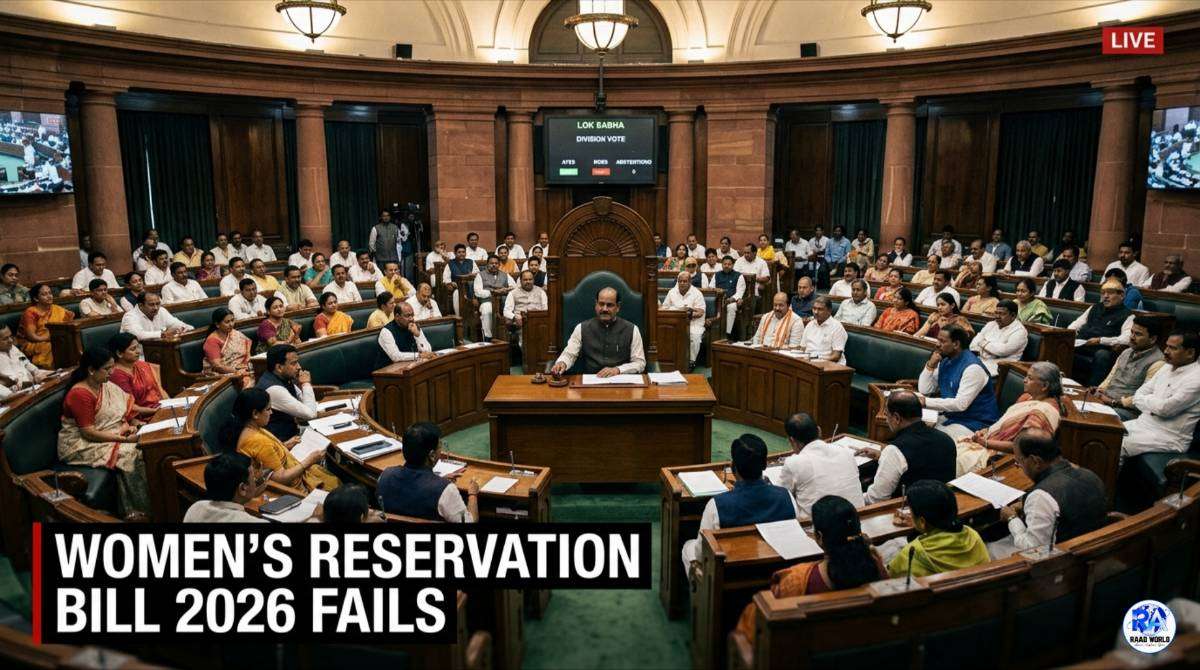
The Constitution (One Hundred and Thirty-First Amendment) Bill, 2026, related to the implementation framework of women’s reservation in legislatures, failed to secure passage in the Lok Sabha on April 17, 2026.
The development has generated nationwide attention, particularly because it is linked to the broader implementation of women’s political representation in India.
Official Legislative Context
The Government of India had earlier enacted the Constitution (One Hundred and Twenty-Eighth Amendment) Act, 2023, widely known as the Nari Shakti Vandan Adhiniyam. This law provides for 33 percent reservation for women in the Lok Sabha and State Legislative Assemblies. However, its implementation is subject to the completion of two key processes:
- Decennial Census
- Delimitation of constituencies
The Constitution (131st Amendment) Bill, 2026, was introduced to address structural and procedural aspects linked to the imiplementation timeline, including provisions related to delimitation and expansion of parliamentary seats.
Outcome in Lok Sabha
On April 17, 2026, the bill was taken up for voting in the Lok Sabha. As a constitutional amendment, it required a two-thirds majority of members present and voting, along with a majority of the total membership of the House.
According to official parliamentary proceedings and verified reports:
- The bill did not secure the required two-thirds majority
- It was consequently not passed in the Lok Sabha
As a result, the proposed amendment failed at the lower house stage and will not proceed further in its current form.
READ THIS: RBI New Rule: 1 Hour Delay for UPI Payments Above ₹10,000
Key Issues Behind the Failure
1. Linkage with Delimitation
A central point of contention was the bill’s linkage with delimitation, which involves redrawing parliamentary and assembly constituencies based on updated population data. Several political parties expressed concern that combining women’s reservation with delimitation could alter electoral balances and create regional disparities.
2. Requirement of Special Majority
Constitutional amendments in India require a special majority. Despite support for women’s reservation in principle, the bill did not receive sufficient cross-party backing to meet the constitutional threshold.
3. Political Divergence on Implementation Mechanism
While there is broad agreement across parties on increasing women’s representation, differences emerged regarding the method and timing of implementation. Opposition parties emphasized the need to delink reservation from delimitation conditions.
Clarification on Women’s Reservation Law
It is important to distinguish between the 2023 law and the 2026 amendment attempt:
The 2023 constitutional amendment establishing women’s reservation remains valid The 2026 bill was an additional legislative attempt to modify or accelerate implementation mechanisms The failure of the 2026 bill does not Soul or nullify the 2023 law
Therefore, women’s reservation in legislatures continues to remain part of the constitutional framework, but its implementation is pending the completion of census and delimitation processes.
READ THIS: Why Article 370 Was Removed from Indian Constitution: Official Reasons
Current Status and Implications
As of April 17, 2026, the implementation of 33 percent reservation for women in the Lok Sabha and State Assemblies remains delayed. The failure of the amendment bill indicates that further political consensus will be required to address procedural challenges.
The issue is expected to remain a significant part of legislative and electoral discourse, especially in the context of future census operations and constituency restructuring.
Conclusion
The Constitution (131st Amendment) Bill, 2026, failed in the Lok Sabha on April 17, 2026, due to the inability to secure the constitutionally mandated special majority.
While this marks a setback for immediate procedural changes, the foundational legal framework for women’s reservation established in 2023 remains intact. The path to implementation now depends on administrative processes and renewed political agreement.
About The Author