SWARAJ DWEEP: In a breathtaking display of national pride and technical precision, the Andaman and Nicobar administration has officially etched its name into the global record books.
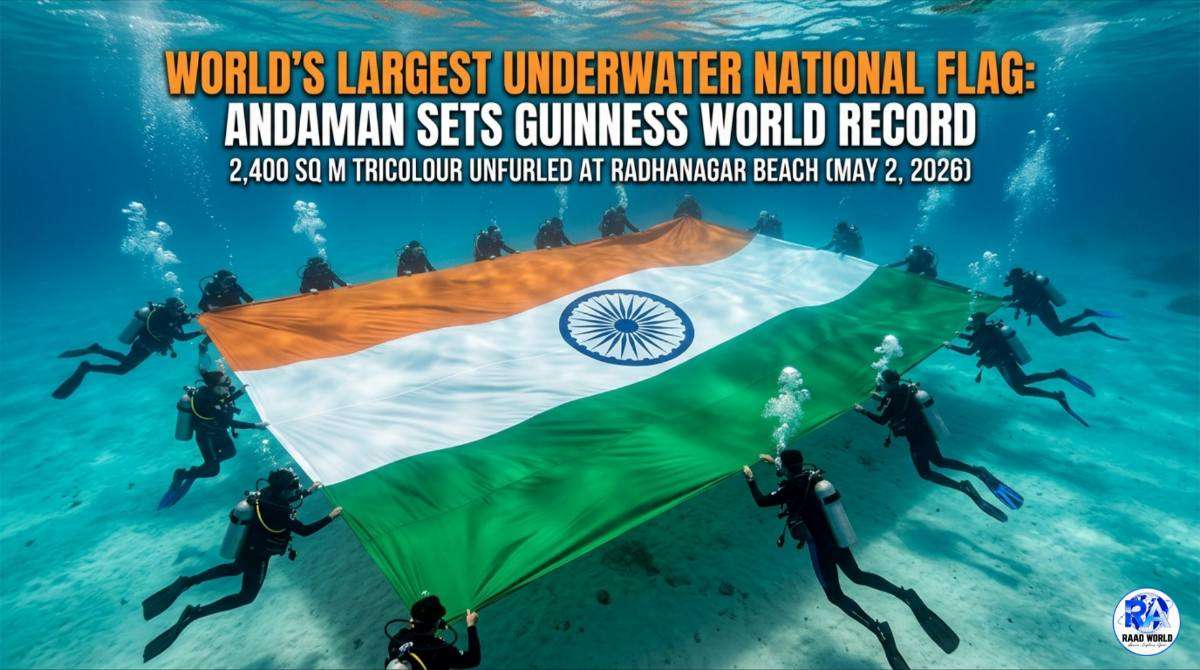
On Saturday, May 2, 2026, the turquoise waters of Radhanagar Beach became the stage for a historic milestone as India unfurled the world’s largest underwater national flag, successfully claiming a new Guinness World Record.
A Monumental Feat Beneath the Surface
The record-breaking Indian Tricolour, measuring a staggering 60 metres by 40 metres, covered a total area of 2,400 square metres. To put this into perspective, the flag’s surface area is nearly equivalent to half a football field, all submerged beneath the rhythmic waves of the Bay of Bengal.
The sheer scale of the fabric required an unprecedented level of coordination to ensure it remained flat and visible for the official adjudication.
READ THIS: Why Article 370 Was Removed from Indian Constitution: Official Reasons
The operation was not merely a ceremonial gesture but a complex maritime exercise. It involved a dedicated team of over 200 divers, including elite personnel from the Indian Navy, the Indian Coast Guard, the Andaman and Nicobar Police, and the Department of Environment and Forests.
These divers worked in unison against underwater currents to secure the massive fabric, ensuring the Ashoka Chakra remained perfectly centered and the vibrant saffron, white, and green hues were clearly visible from the surface.
Video Credits: Andaman & Nicobar Administration, Indian Navy, Coast Guard & A&N Police.
The Moment of Victory
At exactly 10:35 AM, the effort was officially validated. Rishi Nath, an official adjudicator from Guinness World Records, was present on-site to verify the dimensions and the successful deployment of the flag.
Following the rigorous inspection, the official certificate was presented to the Lieutenant Governor of Andaman and Nicobar, Admiral (Retd.) D.K. Joshi, who had himself joined the diving teams to oversee the final stages of the attempt.
“This is a moment of immense pride for every Indian,” stated a spokesperson for the administration. “Setting this record in the pristine waters of Swaraj Dweep is a testament to our islands’ potential and the incredible skill of our diving community.
It sends a message to the world that India’s maritime capabilities and spirit of adventure are second to none.”
READ THIS: Government of India Cell Broadcast Alert System Test: What Citizens Must Know
Strategic Vision: More Than Just a Record
While the Guinness World Record is a significant achievement, the motivations behind the event run deeper than a certificate. The Andaman and Nicobar administration has long sought to position the archipelago as the premier global hub for scuba diving and adventure tourism.
By choosing Radhanagar Beach already frequently voted among the best beaches in Asia the event highlights the clarity of the water and the sophisticated diving infrastructure available in the region.
Furthermore, the event served as a platform for environmental advocacy. Officials emphasized that the operation was conducted with strict adherence to marine safety protocols to ensure no damage was done to the local coral reefs or aquatic life.
The goal was to promote “Blue Tourism,” encouraging travelers to explore the ocean’s depths while respecting the fragile ecosystem of the Bay of Bengal.
Looking Ahead: The Twin Record Attempt
The celebrations did not stop on Saturday. The administration has revealed that this flag unfurling is only the first half of a “Twin Record” initiative. Today, Sunday, May 3, 2026, teams are returning to the water at the Lighthouse dive site.
Their next objective is to set a second Guinness World Record for the ‘Tallest Human Stack Underwater.’ This follow-up attempt aims to further showcase the physical prowess and teamwork of the local diving professionals.
As the news of this achievement spreads, local tourism operators are already reporting a surge in interest from international diving enthusiasts. For the people of the Andaman and Nicobar Islands, the sight of the Tricolour swaying gracefully under the sea is a memory that will be cherished for generations, marking a new chapter in India’s maritime history.
Conclusion
The successful unfurling of the world’s largest underwater national flag is far more than a entry in a record book; it is a definitive statement of India’s growing maritime ambition and its commitment to sustainable development.
By blending patriotism with environmental consciousness, the Andaman and Nicobar administration has effectively highlighted the region’s world-class diving infrastructure and its unique marine biodiversity.
This achievement serves as a catalyst for “Blue Economy” initiatives, signaling to global investors and adventure seekers that the archipelago is ready to lead in high-end, eco-friendly marine tourism.
As the islands move forward with more daring underwater feats, like the human stack attempt, they reinforce a new identity one that honors national heritage while embracing the adventurous spirit of the 21st century.
The Tricolour waving beneath the waves at Radhanagar Beach now stands as a symbol of unity, technical excellence, and the boundless potential of India oceanic frontiers.
About The Author