The 2026 Indian Premier League season has marked a definitive departure from the traditional building phases of T20 cricket. We have entered an era where “anchoring” an innings is no longer seen as a safety net, but rather as a statistical liability.
This season, the focus has shifted entirely toward maximizing the powerplay and minimizing the “dead time” between boundaries. For the first time in the history of the league.
we are seeing established legends like Virat Kohli and Rohit Sharma overhaul their decade-long playing styles to match the aggressive pace of younger contemporaries like Priyansh Arya and Abhishek Sharma.
The Powerplay Paradigm: Virat Kohli’s Statistical Transformation
Perhaps the most shocking data point of the 2026 season is the reduction of dot-ball percentages among opening batsmen. Historically, an opener was expected to settle in for the first five to ten balls. However, current official data suggests that the “settling period” has been abolished.
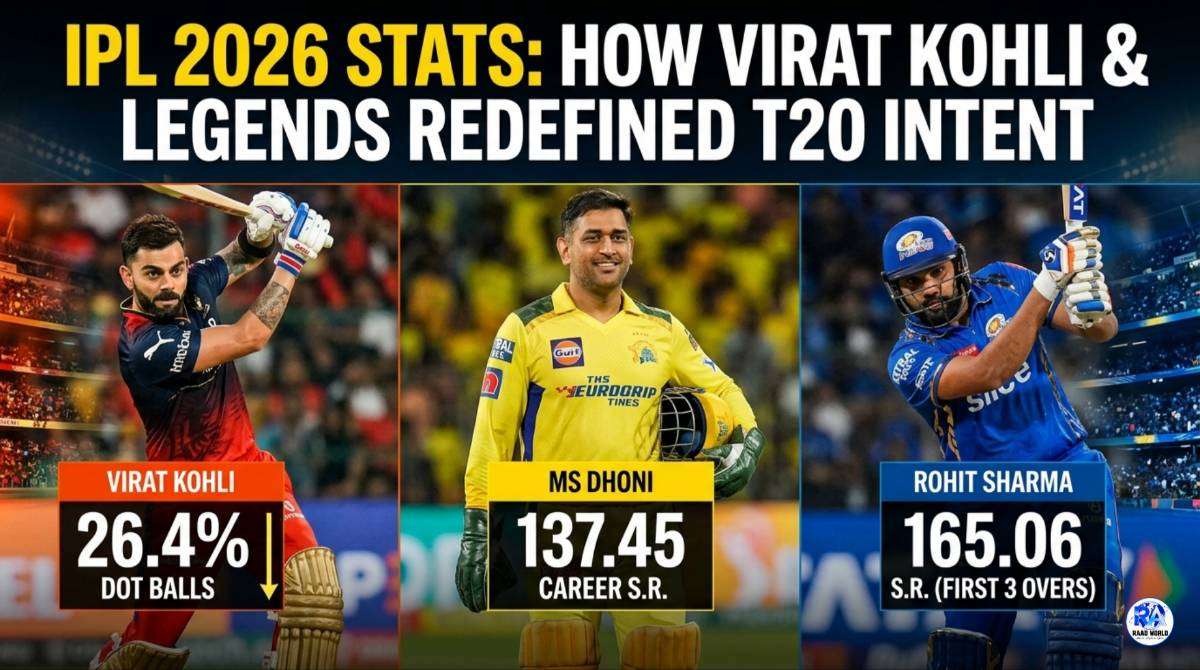
Virat Kohli, often criticized in previous years for a slower middle-overs strike rate, has emerged as the most efficient powerplay aggressor in 2026. As of May 2026, Kohli boasts a powerplay dot-ball percentage of just 26.4%. This is a historic low for a player who has faced more than 100 deliveries in the first six overs.
READ THIS: Bhuvneshwar Kumar 200 IPL Wickets: Truth Behind Viral Record Claim
To put this into perspective, even aggressive youngsters like Yashasvi Jaiswal are currently recording a dot-ball rate of 46.7%. The data indicates that Kohli has traded his high-percentage ground shots for lofted intent, hitting a boundary or taking a single nearly 74% of the time he is at the crease during the powerplay.
The Legend Metrics: MS Dhoni and Rohit Sharma
While Kohli has dominated the opening metrics, MS Dhoni continues to redefine the role of the lower-order finisher. Despite being in the twilight of his career, Dhoni’s presence for Chennai Super Kings remains a tactical masterclass.
In 2026, Dhoni’s role has been compressed into high-impact “cameos.” While he faces fewer deliveries, his ability to manipulate field placements in the final two overs remains unmatched. However, official tracking does show a vulnerability against high-quality wrist spin, where his dot-ball percentage rises significantly during the middle overs if he is forced to come in early.
READ THIS: IPL 2026 Orange Cap Leaderboard: Kohli Leads Top Run Scorers
Rohit Sharma, on the other hand, has mirrored Kohli’s aggression. After relinquishing full-time captaincy duties in previous seasons, Rohit has played with a “nothing-to-lose” mentality. His strike rate in the first three overs of the innings has touched 165.06 this season.
Unlike his earlier career where he would wait for the short ball to pull, Rohit is now dancing down the track to opening bowlers, effectively forcing them to change their lengths and disrupting their rhythm before they can settle.
The All-Time Greats: AB no de Villiers and the Benchmark of Efficiency
When discussing dot balls and efficiency, the shadow of AB de Villiers always looms large. Even as a retired legend, his career statistics serve as the yardstick for the 2026 season. De Villiers remains the fastest player to reach the 5,000-run milestone in terms of balls faced, requiring only 3,288 deliveries.
READ THIS: KL Rahul 152 in IPL 2026: First Indian to Score 150+ Runs in History
This is significantly more efficient than the 3,691 balls required by MS Dhoni or the 3,620+ required by Virat Kohli. The 2026 season is the first time we are seeing players consistently hit the “ABD levels” of strike rotation, where the gap between boundaries is filled with active ones and twos rather than defensive dot balls.
The Rise of the New Guard: Priyansh Arya and Sooryavanshi
The 2026 season has not just been about the legends; it has been about the arrival of the “Intent Merchants.” Players like Priyansh Arya have set the league on fire with a strike rate exceeding 250. Arya’s dot-ball percentage of 28.8% is second only to Kohli, but his boundary-to-ball ratio is actually higher.
This suggests a new blueprint for the modern T20 opener: if the ball is not a boundary, it must be a run. The concept of “respecting the good ball” is being replaced by “punishing the slightly-off ball.”
Young Vaibhav Sooryavanshi has also made waves, specifically in his ability to clear the ropes. With 37 sixes as of early May, he leads the league in maximums.
This level of power hitting from a young age demonstrates that the next generation is being coached for raw power and immediate impact, rather than the technical longevity associated with the older legends of the game.
Bowling Dynamics: The Battle Against the Dot Ball
While batsmen are trying to eliminate dot balls, bowlers are desperately trying to manufacture them. Bhuvneshwar Kumar remains the gold standard in this department. Holding the all-time record for most dot balls in IPL history (1,865), his performance in 2026 has been a clinic in defensive bowling.
READ THIS: Virat Kohli Creates History: First Player to Reach 9000 Runs in IPL 2026
In a season where 260+ scores are becoming common, Bhuvneshwar’s ability to bowl “dry” overs overs with 4 or more dots has made him the most valuable asset in the RCB bowling lineup.
The data shows a clear divide: the best bowlers (Bhuvi, Narine, and Archer) are those who can maintain an economy rate under 8.00 in a season where the league average has ballooned to 9.50. The value of a dot ball has never been higher for a bowler, as each one adds immense pressure to a batting side that is now mentally programmed to score off every single delivery.
Strategic Conclusions: The Future of T20 Cricket
As we analyze the 2026 season, it is clear that the game has fundamentally changed. The statistics provided in recent leaderboards confirm that the “Anchor” role is dying. Success in the modern IPL is now measured by the ability to minimize “empty” deliveries.
Virat Kohli’s shift from a 40% dot-ball opener to a 26% intent-driven aggressor is the most significant tactical shift of the decade. Furthermore, the 2026 season highlights that longevity in the IPL now requires constant evolution.
Legends like Dhoni and Rohit have stayed relevant by identifying their specific niches Dhoni as the surgical finisher and Rohit as the chaotic opener. For the younger generation, the bar has been set incredibly high. They are expected to maintain strike rates of 180+ while keeping their dot-ball percentages below 30%.
In conclusion, the IPL 2026 season will be remembered as the year the “Dot Ball” became the ultimate enemy of the batsman and the greatest weapon of the bowler.
The statistical gap between the legends and the newcomers is closing, not because the legends are slowing down, but because the entire league has accelerated to a pace that was once thought impossible.
Whether this level of aggression is sustainable over a long career remains to be seen, but for now, it has made for the most explosive and high-scoring season in the history of professional cricket.
Official Data Summary (May 2026):
- Lowest Powerplay Dot %: Virat Kohli (26.4%)
- Highest Career Dot Balls (Bowler): Bhuvneshwar Kumar (1,865)
- Fastest to 5,000 Runs (Balls): AB de Villiers (3,288)
- Season Strike Rate Leader: Priyansh Arya (250.44)
About The Author