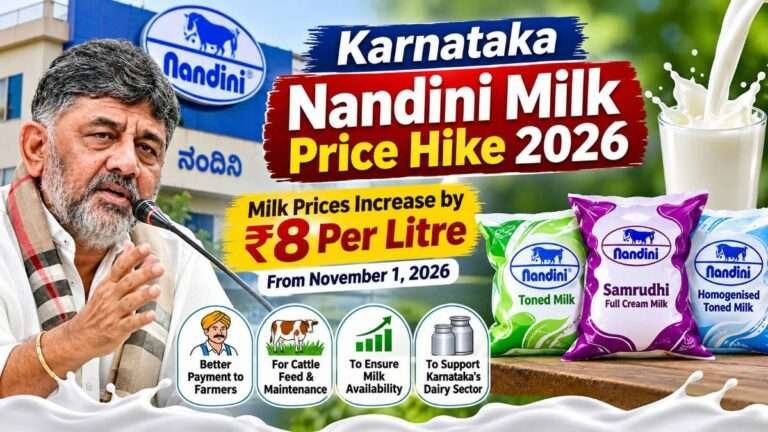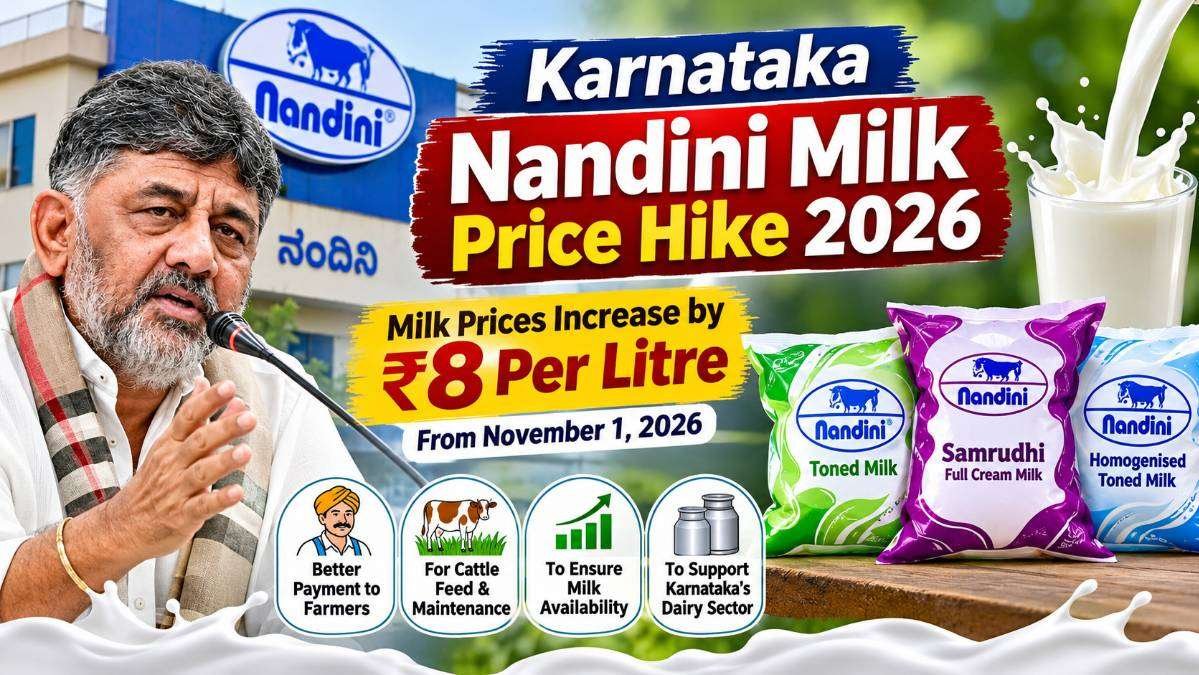
People across Karnataka are now paying more for Nandini milk following a fresh price revision announced by the state government. The Karnataka Cabinet approved an increase of ₹8 per litre in the basic milk procurement price, with the revised rates coming into effect on November 1, 2026.
The decision was announced on October 29, 2026. According to the government, the main purpose of the revision is to provide better financial support to dairy farmers, manage increasing milk production costs and maintain a regular supply of milk across the state.
Deputy Chief Minister D.K. Shivakumar explained that farmers were facing difficulties because of increasing cattle feed expenses and lower milk availability. The government believes that better payments will encourage farmers to continue dairy farming.
Why Did Karnataka Increase Nandini Milk Prices?
Milk production involves several expenses for dairy farmers. They need to spend money on cattle feed, green fodder, veterinary care, labour and transportation. When these expenses increase, farmers may find it difficult to continue supplying milk at the existing procurement price.
The Karnataka government explained that farmers needed better financial support to manage these expenses. It also highlighted the difference between milk procurement prices in Karnataka and neighbouring states.
According to Deputy Chief Minister D.K. Shivakumar, some farmers were moving their milk to neighbouring states because they could receive better prices there. The government was concerned that this could affect milk availability in Karnataka.
Therefore, the price revision was introduced to improve farmers’ earnings and support the state’s dairy sector.
How Will the Additional ₹8 Be Distributed?
The additional ₹8 per litre is divided into two parts. Out of this amount, ₹7 will go towards increasing the payment to dairy farmers, while the remaining ₹1 will be given to milk cooperative unions.
- ₹7 per litre: Additional payment to dairy farmers.
- ₹1 per litre: Allocation to milk cooperative unions.
- Total increase: ₹8 per litre.
Before the revision, the basic milk procurement price was ₹35 per litre. Following the increase, it has become ₹42 per litre. The existing Karnataka government incentive of ₹5 per litre continues separately, taking the total amount received by farmers to ₹47 per litre, subject to applicable conditions.
READ THIS: Samosa Prices Around the World: India vs Other Countries
How Much More Money Will Dairy Farmers Receive?
The increase is expected to provide additional income to farmers who regularly supply milk to cooperative societies.
For example, consider a farmer who supplies 10 litres of milk every day. With an additional ₹7 per litre, the farmer can receive ₹70 more each day.
Over 30 days, this amounts to an additional ₹2,100.
This is only an example. The actual additional income depends on the quantity and quality of milk supplied and the applicable procurement conditions.
The government expects the revision to improve the financial position of dairy farmers and encourage them to continue milk production.
What Did D.K. Shivakumar Say About the Price Increase?
Deputy Chief Minister D.K. Shivakumar defended the decision by explaining the difficulties faced by dairy farmers.
He said that milk prices in neighbouring states were higher and that some Karnataka farmers were moving their milk to those markets. He also pointed out that milk availability was declining.
According to his explanation, farmers need enough money to purchase good-quality cattle fodder and maintain their animals. Without proper financial support, milk production could decline further.
The government says that improving the income of farmers is important for protecting Karnataka’s dairy industry and maintaining milk availability for consumers.
Will All Nandini Milk Packets Become ₹8 More Expensive?
No. Consumers should understand that the retail price increase is not exactly the same for every Nandini milk product.
Nandini sells different varieties of milk, including toned milk, homogenised milk, special toned milk and full cream milk. These products have different fat contents and retail prices.
Reports about the November revision indicate that the price increase varies according to the product category. Some varieties have seen an increase of more than ₹8.
Therefore, customers should check the latest price printed on the milk packet before purchasing it. The revised retail price may differ depending on the product and milk union.
READ THIS: EPFO WhatsApp Services 2026: Check PF Balance & Download Passbook
Nandini Curd Prices Also Increased
Along with the milk price revision, Nandini curd prices have also increased from November 1, 2026.
Reports indicate that the price of a 500-gram curd packet increased from ₹28 to ₹34, while the reported price of a one-kilogram or one-litre pouch increased from ₹54 to ₹68.
Curd prices are determined separately through the relevant milk federation and cooperative pricing arrangements. Therefore, the curd price increase should not be confused with the Cabinet’s basic ₹8 milk procurement price decision.
How Will the Price Hike Affect Common People?
The revised Nandini prices will increase monthly household expenses for families that regularly purchase milk.
For example, if a family purchases one litre of milk every day and the price increases by ₹8 per litre, its additional monthly expense will be ₹240, assuming 30 days of consumption.
Families purchasing larger quantities will have to spend more.
The increase may also affect tea shops, hotels, restaurants, bakeries and sweet shops because milk is an important ingredient in many food products. Businesses may review their prices depending on their operating expenses.
READ THIS: DMart Beats Blinkit & Zepto Combined in FY26 Revenue
Why Is Milk Procurement Important for Karnataka?
Karnataka has a large dairy farming community, and milk production provides an important source of income for many rural families.
The Karnataka Milk Federation, commonly known as KMF, operates through a network of milk unions and cooperative societies. Nandini is its well-known dairy brand.
Farmers supply milk to cooperative societies, which collect and process it before distributing dairy products to consumers.
When farmers receive better procurement prices, they may be in a stronger position to manage cattle maintenance and production expenses. This is important for maintaining the state’s dairy supply chain.
Conclusion
The Karnataka Nandini milk price hike, effective from November 1, 2026, is an important development for both dairy farmers and consumers. The Karnataka Cabinet approved an additional ₹8 per litre in the basic milk procurement price, with ₹7 allocated towards farmers’ payments and ₹1 towards milk cooperative unions.
The government says the decision will help farmers manage rising production expenses, improve their income and support milk availability across Karnataka.
However, the revised prices will also increase expenses for households and businesses that depend on milk and curd. Consumers should check the latest printed prices on Nandini packets to understand the exact cost of their preferred products.
Ultimately, the success of this decision will depend on whether it provides meaningful financial support to dairy farmers while maintaining an affordable and reliable milk supply for consumers.
About The Author