India’s retail industry is witnessing one of its biggest transformations as traditional supermarket chains compete with fast-growing quick commerce companies.
While Blinkit and Zepto have rapidly expanded across major cities with thousands of dark stores promising deliveries in minutes, DMart continues to demonstrate the strength of its low-cost supermarket model.
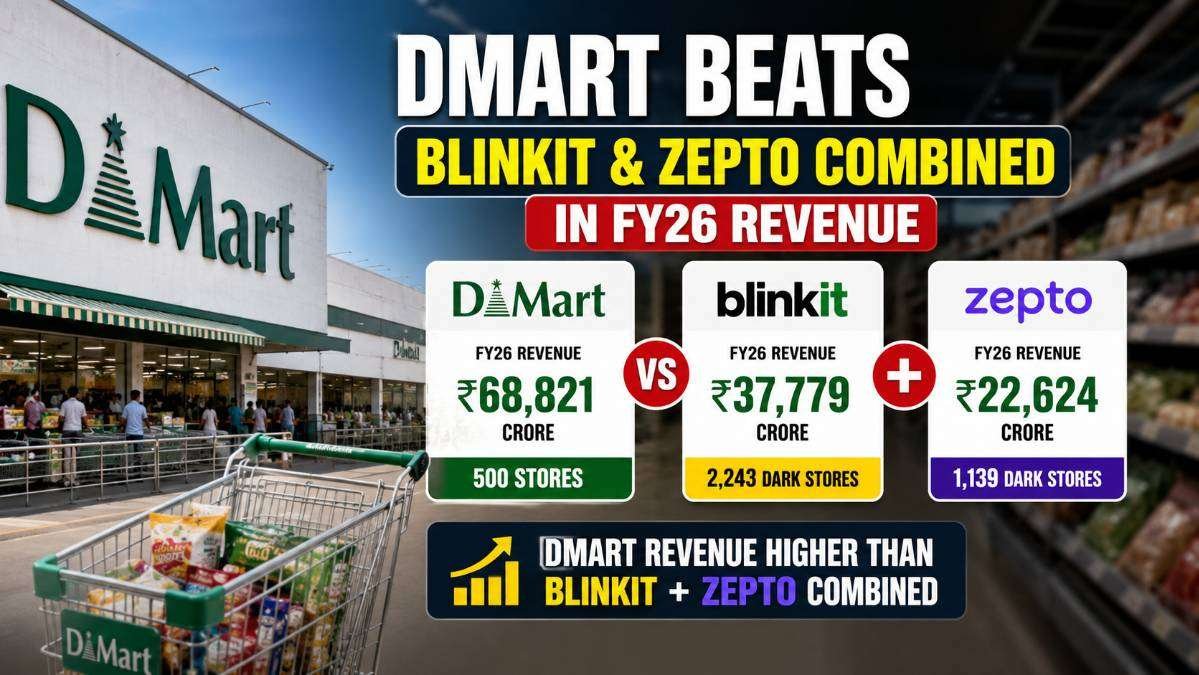
According to the latest FY26 financial disclosures, DMart generated ₹68,821 crore in revenue during the financial year. In comparison, Blinkit reported revenue of ₹37,779 crore, while Zepto recorded ₹22,624 crore.Together, Blinkit and Zepto generated ₹60,403 crore, meaning DMart still outperformed both companies combined by approximately ₹8,418 crore.
The figures have attracted widespread attention because they compare India’s largest value retail chain with two of the country’s fastest-growing quick commerce platforms. Although the comparison highlights revenue, it is important to understand that each company operates under a very different business model.
FY26 Revenue Comparison
| Company | FY26 Revenue | Store Network |
|---|---|---|
| DMart | ₹68,821 crore | 500 stores |
| Blinkit | ₹37,779 crore | 2,243 dark stores |
| Zepto | ₹22,624 crore | 1,139 dark stores |
| Blinkit + Zepto | ₹60,403 crore | 3,382 locations |
These figures show that DMart generated more revenue despite operating significantly fewer physical locations than Blinkit and Zepto combined.
Understanding the Different Business Models
Although these companies compete for grocery shoppers, their business strategies are fundamentally different.
DMart’s Value Retail Strategy
DMart follows a traditional supermarket model focused on offering quality products at competitive prices. Customers usually visit stores to purchase groceries, personal care items, kitchen essentials, clothing, home products, and other daily necessities in a single shopping trip.
The company is known for maintaining efficient inventory management, owning many of its retail properties, and keeping operational costs under control. These strategies have helped DMart remain consistently profitable while expanding gradually across India.
READ THIS: RBI Polymer ₹10 & ₹20 Notes Approved Government Clears Field Trials, Paper Currency to Continue
Blinkit’s Quick Commerce Model
Blinkit focuses on delivering products within 10 to 20 minutes through a network of dark stores. These facilities are designed exclusively for online orders rather than customer visits.
The platform has expanded rapidly by offering instant delivery of groceries, medicines, electronics, beauty products, and household essentials. Convenience remains Blinkit’s biggest competitive advantage.
Zepto’s Rapid Expansion
Zepto has become one of India’s fastest-growing startups by aggressively expanding its dark store network and entering multiple metropolitan markets. Like Blinkit, Zepto emphasizes ultra-fast delivery while investing heavily in logistics, technology, and customer acquisition.
Why DMart Continues to Lead
One of the biggest reasons behind DMart’s impressive revenue performance is its ability to generate higher sales from each store.
Unlike quick commerce companies that fulfill smaller orders several times a day, supermarket customers generally purchase larger quantities during each visit. This results in a higher average order value.
DMart also benefits from:
- Efficient supply chain management
- Lower operating expenses
- Strong relationships with suppliers
- Competitive pricing strategy
- High customer loyalty
- Private-label product offerings
- Carefully planned expansion
These strengths have allowed the retailer to maintain stable growth even as consumer shopping habits continue to evolve.
Quick Commerce Is Growing at an Extraordinary Pace
While DMart currently leads in revenue, the rapid growth of India’s quick commerce sector cannot be ignored.
Blinkit and Zepto have transformed customer expectations by making grocery shopping almost instantaneous. Consumers increasingly rely on these platforms for urgent purchases, especially in metropolitan areas where convenience often outweighs price.
Industry analysts expect India’s quick commerce market to continue expanding over the next several years as internet penetration improves, smartphone adoption increases, and urban lifestyles become more time-sensitive.
Both Blinkit and Zepto continue investing heavily in expanding their dark store networks, improving delivery speeds, and increasing product selection.
READ THIS: Google Selfie Video Account Recovery New Security Feature
Revenue Does Not Mean Profit
One important point often overlooked in social media comparisons is that revenue and profit are entirely different financial metrics.
Revenue represents the total income generated through business operations before deducting expenses. Profit, on the other hand, reflects the amount a company earns after accounting for operating costs, salaries, logistics, marketing, rent, taxes, and other expenditures.
DMart has built a reputation for consistent profitability through disciplined financial management.
Blinkit has made significant progress toward profitability, achieving positive adjusted EBITDA in recent quarters. However, it continues investing heavily in network expansion.
Zepto is also prioritizing long-term growth over immediate profitability, as it competes aggressively in India’s evolving quick commerce market.
What This Means for Consumers
The competition between supermarkets and quick commerce companies is ultimately benefiting consumers.
Traditional retailers are improving their digital offerings, while quick commerce companies continue expanding product categories and delivery capabilities.
Consumers now enjoy greater convenience, competitive pricing, wider product availability, and faster delivery options than ever before.
READ THIS: Bank of Baroda Cybersecurity Incident Explained What We Know About the Reported Data Leak
Will Quick Commerce Eventually Surpass DMart?
The answer remains uncertain.
Quick commerce companies continue to report exceptional growth, but maintaining profitability while expanding rapidly remains a significant challenge.
Meanwhile, DMart continues following its disciplined expansion strategy, opening stores selectively and focusing on operational efficiency instead of aggressive growth.
Both business models serve different customer needs, suggesting they may continue to coexist rather than directly replace one another.
Conclusion
DMart’s FY26 revenue of ₹68,821 crore demonstrates the continued strength of India’s organized retail sector. Despite operating only 500 stores, the company generated higher revenue than Blinkit and Zepto combined, whose combined FY26 revenue stood at ₹60,403 crore.
However, this comparison should not be viewed as a winner-versus-loser story. DMart, Blinkit, and Zepto operate different business models with distinct growth strategies and customer expectations.
As India’s retail landscape continues evolving, traditional supermarkets and quick commerce platforms are expected to play complementary roles. DMart remains a leader in value retail, while Blinkit and Zepto continue redefining convenience through ultra-fast delivery. The coming years will determine how these competing strategies shape the future of Indian retail.
About The Author