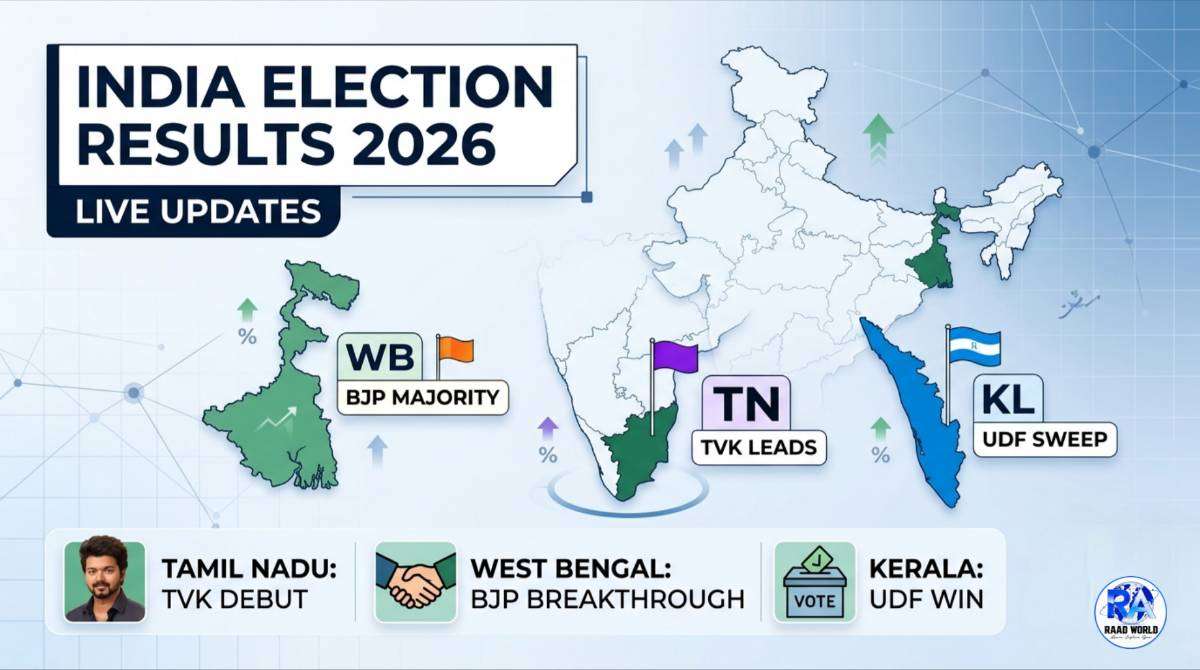
May 4, 2026, will be remembered as a watershed moment in Indian politics. As the counting of votes for five major Assembly elections concludes, the results reveal a massive transformation in the political map of India.
From the rise of a new superstar-led force in the South to a historic breakthrough in the East, the mandate reflects a clear desire for change among the electorate.
Tamil Nadu: The ‘Thalapathy’ Storm Disrupts the Status Quo
In a result that has stunned seasoned political analysts, actor-turned-politician Vijay’s Tamilaga Vettri Kazhagam (TVK) has delivered a blockbuster debut. Challenging the decades-old DMK-AIADMK duopoly, the TVK is leading in over 100 seats, nearing the majority mark of 118.
The ruling DMK, led by M.K. Stalin, has faced a severe blow, slipping to third place in several urban strongholds. Even the Chief Minister found himself trailing in his bastion, Kolathur, against a TVK candidate.
READ THIS: Raghav Chadha Joins BJP: Official Reasons, AAP Exit Explained & Political Impact 2026
The surge is being attributed to a “Gen-Z wave” and a massive shift in urban voters who have rallied behind Vijay’s vision of a fresh alternative.
West Bengal: BJP Secures a Historic Breakthrough
For the first time in history, the Bharatiya Janata Party (BJP) is poised to form a government in West Bengal. Crossing the halfway mark of 147 seats, the party is leading in over 190 constituencies.
Mamata Banerjee’s Trinamool Congress (TMC), which has governed the state for 15 years, appears to have lost its grip on key regions, including its traditional strongholds in the Presidency division.
READ THIS: Why Article 370 Was Removed from Indian Constitution Official Reasons
The election was marked by intense legal and political battles, specifically over the voter roll clean-up that removed nearly 11% of the electorate. This shift marks the most significant political transition in Bengal since the fall of the Left Front in 2011.
Kerala: The Alternating Power Cycle Returns
In God’s Own Country, the streak of the LDF has come to an end. The Congress-led United Democratic Front (UDF) has reclaimed the state with a thumping majority, crossing the 100-seat mark.
Chief Minister Pinarayi Vijayan’s bid for a “hat-trick” was thwarted by a strong anti-incumbency sentiment, with 13 of his cabinet ministers trailing in their respective seats. The UDF victory signals Kerala’s return to its traditional pattern of rotating power every five years.
Assam and Puducherry: Incumbents Hold the Line
While change was the theme in the South and East, stability reigned in the Northeast. In Assam, the BJP-led NDA is set to retain power for a third consecutive term, with Chief Minister Himanta Biswa Sarma leading by a massive margin in Jalukbari. The opposition INDIA bloc failed to make a significant dent in the NDA’s rural and urban vote base.
In the Union Territory of Puducherry, the All India NR Congress (AINRC) led by N. Rangasamy continues its dominance, securing 9 seats early on and heading toward a comfortable majority alongside its allies.
READ THIS: World Largest Underwater National Flag: Andaman & Nicobar Sets Guinness World Record
Summary of Early Leads (May 4, 2026)
| State/UT | Total Seats | Leading Party/Alliance | Approximate Leads/Wins |
|---|---|---|---|
| Tamil Nadu | 234 | TVK (Vijay) | 107+ |
| West Bengal | 294 | BJP | 190+ |
| Kerala | 140 | UDF (Congress+) | 102+ |
| Assam | 126 | NDA (BJP+) | 81+ |
| Puducherry | 30 | AINRC+ | 11+ |
Conclusion
The 2026 Assembly Election results underscore a rejection of traditional “family-led” politics and a move toward aspirational, performance-based governance.
Whether it is the historic entry of the BJP into the Bengal secretariat or the dramatic disruption by Vijay in Tamil Nadu, the Indian voter has sent a clear message: no bastion is impregnable. As the final tallies are confirmed tonight, these states will begin a new chapter of administration that could reshape the national political narrative heading into the next general elections.
About The Author