Karnataka High Court on School Bus Safety Schools Responsible for Children Until Safe Drop
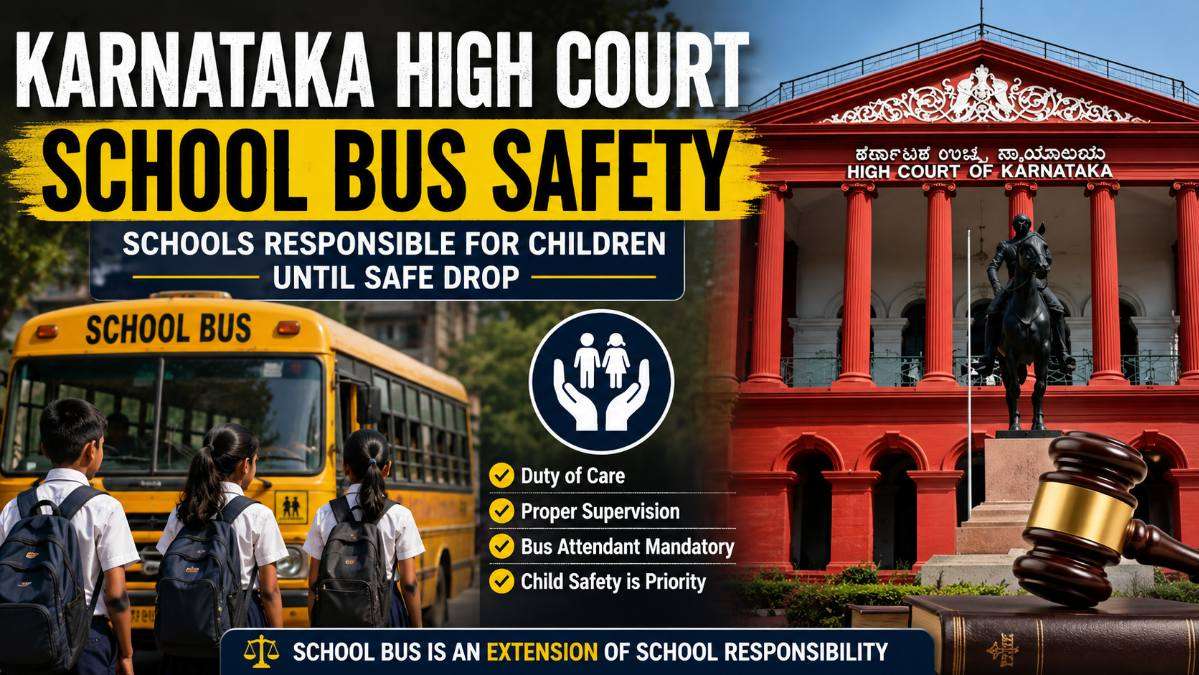
The safety of children travelling in school buses has once again become an important subject of public discussion after a significant observation by the Karnataka High Court.
The Court has underlined that the responsibility of a school does not necessarily end when a child leaves the classroom or steps outside the school campus. When an educational institution provides transportation to students, it also has a duty to ensure reasonable safety and supervision during the journey.
The observation came while the Karnataka High Court was considering a criminal petition connected with an incident involving a school student who allegedly suffered a serious eye injury while travelling in a school bus. The case has attracted attention because the Court discussed the wider responsibility of educational institutions towards children using school transportation.
The case was heard in Criminal Petition No. 13718 of 2025. The matter involved Divyajyothi School Management and the State of Karnataka. The order was delivered on June 23, 2026.
While considering the petition, the High Court examined allegations concerning student safety, supervision inside a school bus and the legal responsibilities connected with transportation provided by an educational institution.
READ THIS: Children Aadhaar Biometric Update Free Until September 30, 2026 Parents Must Know
What Happened in the School Bus?
According to the facts recorded in the case, the incident involved a fourth-standard student who was travelling home in a school bus on August 1, 2025. During the journey, some children inside the bus allegedly used a coloured spray or a similar celebratory item.
The substance reportedly entered the child’s eye and caused a serious injury. The injury was not treated as a minor or temporary problem. The material placed before the Court indicated that the child had suffered significant damage to the eye.
The case records also referred to an assessment of permanent disability. The seriousness of the injury led to questions about the supervision available inside the school bus at the time of the incident.
One of the important allegations was that there was no attendant inside the bus to properly supervise the students. Questions were also raised regarding the functioning of the CCTV system.
These circumstances became relevant because school buses carry children of different ages, and younger students may not always fully understand the possible consequences of their actions.
READ THIS: India Removes Chinese Battery Apps Over E-Rickshaw Remote Shutdown Concerns
School Bus Is Connected to the School’s Duty of Care
A key aspect of the High Court’s observation was the relationship between a school and the transportation service provided to students. The Court indicated that a school bus cannot simply be treated as an ordinary private vehicle when it is being used as part of the school’s student transportation system.
In legal and practical terms, the school bus can be considered an extension of the educational institution’s responsibility. When parents send their children to school and use the transportation arranged by the institution, there is a reasonable expectation that proper safety measures and supervision will be maintained.
This means that the responsibility of school authorities cannot automatically end at the school gate. If a child boards a school bus arranged or operated as part of the institution’s transportation facility, the child’s journey remains connected with the school’s duty of care.
The Court’s observations have been widely understood to mean that a school must take reasonable steps to protect students until they are safely transported to their designated destination. However, it is important to understand the legal context carefully.
The Court was dealing with allegations of negligence and a request to quash criminal proceedings. It was not delivering a final criminal conviction against the school management at this stage.
Why Supervision Inside School Buses Is Important
School buses are different from ordinary public transportation because the passengers are primarily children. A bus may carry very young students who require continuous supervision. Even an action that appears playful can quickly become dangerous when children are travelling in a moving vehicle.
An attendant or responsible supervising person can play an important role in maintaining discipline and identifying unsafe behaviour. If children are throwing objects, using sprays, fighting, standing while the bus is moving or engaging in any activity that could cause injury, immediate intervention may prevent a serious accident.
The presence of a bus attendant is particularly important when younger students are travelling. A driver has the primary responsibility of safely operating the vehicle and watching the road. Expecting the driver to continuously monitor every child inside the bus can create additional safety risks. This is why supervision arrangements are an important part of school transportation safety.
The Karnataka High Court also referred to the regulatory framework concerning transportation facilities provided by educational institutions.
The Court discussed requirements connected with attendants and the supervision of children during school bus journeys. The observations emphasised that child safety in school transportation should not be treated as an optional service or a matter of convenience.
Schools Cannot Ignore Transportation Safety
The case sends an important message to educational institutions that provide transportation facilities. Schools need to regularly review their school bus safety systems instead of merely completing formal documentation.
Having written safety rules is not enough if those rules are not followed in daily operations. Schools should verify whether attendants are actually present in buses, whether CCTV cameras are functioning where such systems are installed, and whether students are properly supervised throughout the journey.
School managements may also need to train drivers and attendants to respond to emergencies. Staff members should know what to do when a child suffers an injury, becomes unconscious or requires immediate medical attention. Quick communication with parents and emergency medical services can make a major difference in serious situations.
Regular checks of the bus interior are equally important. Potentially dangerous objects or substances should not be allowed inside school buses without proper control. Students should also be educated about safe behaviour during travel. Simple instructions regarding standing, fighting, throwing objects and carrying unsafe items can help prevent avoidable incidents.
What Does the Court Order Actually Mean?
Several social media posts have summarised the case by saying that once a child boards a school bus, the school is responsible until the child safely reaches the parents. The general idea reflects the broader safety principle discussed in the case, but the legal position should be explained accurately.
The Karnataka High Court did not finally declare the school management criminally guilty in the order. The management had approached the Court seeking to quash the criminal proceedings connected with the incident. The High Court declined to interfere at that stage and allowed the investigation to continue.
Therefore, it would be incorrect to claim that the Court had already delivered a final conviction for criminal negligence. The investigation and the legal process must determine the final responsibility based on evidence.
At the same time, the Court made important observations regarding the duty of educational institutions when they transport children. The order makes it clear that student transportation safety is a serious responsibility and allegations involving a lack of supervision cannot always be dismissed without a proper investigation.
What Parents Should Know About School Bus Safety
Parents can also play an active role in understanding the transportation arrangements provided by their child’s school. They can ask whether the bus has a trained attendant, how younger children are supervised and what emergency procedures are followed.
Parents may also check whether the school has a clear system for reporting incidents that occur inside buses. Children should be encouraged to inform parents or teachers if they experience bullying, unsafe behaviour or any other problem during the journey.
It is equally important for parents to teach children basic bus safety. Students should understand that a school bus is not a playground. Activities that involve throwing objects, using sprays or disturbing the driver can put everyone in danger.
A Reminder for Educational Institutions
The Karnataka High Court case is a reminder that schools are entrusted with the safety of children for a significant part of the day. This responsibility becomes even more important when the institution provides transportation.
Educational institutions should conduct periodic safety audits of school buses. The availability of attendants, emergency contact information, first-aid facilities and vehicle safety systems should be reviewed regularly. If CCTV cameras are installed, schools should ensure that they remain functional and are properly maintained.
Schools should also establish accountability. If an attendant is absent, the bus should not simply continue its normal route without considering the safety implications. Management authorities must have a system to identify such gaps and take corrective action.
Conclusion
The Karnataka High Court’s observations in the school bus injury case highlight an important principle: the safety of children using school transportation cannot be treated casually.
When a school provides a bus facility, it carries a responsibility to take reasonable steps to supervise and protect the students travelling in that vehicle.
The Court has not given a final criminal conviction against the school management in this particular matter. Instead, it refused to quash the proceedings and allowed the investigation to continue.
The final legal responsibility will depend on the evidence and the outcome of the judicial process. However, the broader message is clear. School buses are closely connected with the duty of care owed by educational institutions to their students.
Proper attendants, effective supervision, working safety systems and clear emergency procedures are essential. For schools, parents and transport staff, the case serves as a strong reminder that a child’s safety must remain the highest priority from the beginning of the school journey until the child reaches the designated destination safely.
About The Author