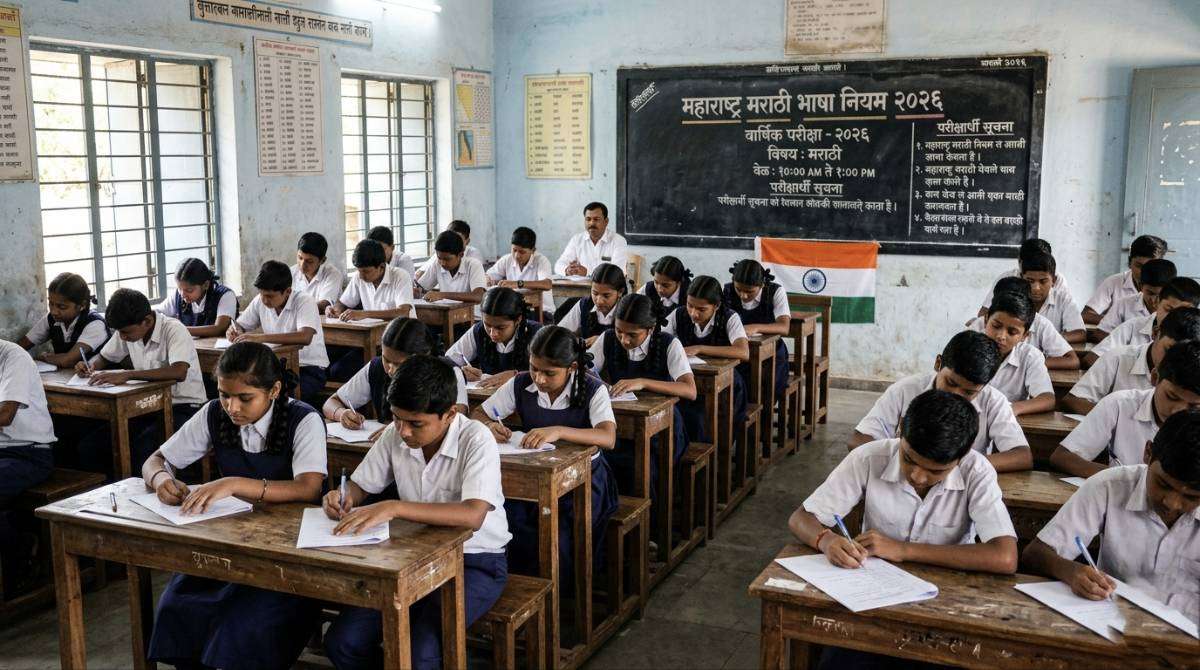
The Government of Maharashtra has formally reinforced the implementation of the Maharashtra Compulsory Teaching and Learning of Marathi Language in Schools Act, 2020.
This update has recently gained attention after several reports highlighted stricter enforcement measures across schools in the state. The decision aims to ensure that every student studying in Maharashtra gains basic proficiency in the Marathi language, which is the official language of the state.
When Did This Update Come?
Although the law was originally passed in 2020, the latest enforcement push and clarity on penalties came into focus in April 2026. During this period, the state government issued renewed instructions to educational.
authorities and school managements, emphasizing strict compliance with the provisions of the Act. This step followed multiple reviews and complaints regarding non-implementation in certain institutions.
READ THIS: Eduverse 2026 Begins in Bengaluru: Karnataka Biggest Education Expo for CET & NEET Aspirants
What Does the Law Say?
According to the official Act and subsequent government communications, Marathi has been made a mandatory subject from Class 1 to Class 10 in all schools across Maharashtra. This rule applies to all education boards operating within the state, including:
- State Board (SSC)
- CBSE
- ICSE
- International boards
The objective is not to replace other languages but to ensure that students acquire foundational knowledge of Marathi as part of their curriculum. Schools are required to include Marathi either as a compulsory subject or as part of a structured language program approved by the state authorities.
Penalty for Non-Compliance
One of the most important aspects of the recent update is the introduction of strict penalties for schools that fail to comply with the rule. As per official government directions.
Schools that do not implement Marathi teaching can face a fine of up to ₹1 lakh. Repeated violations may lead to further action, including withdrawal of school recognition.
The penalty provision is designed to ensure uniform implementation and prevent institutions from bypassing the requirement. Education authorities have been instructed to carry out inspections and monitor compliance regularly.
READ THIS: AI Introduced in School Education in India 2026 CBSE AI Curriculum Explained
Implementation and Monitoring
The School Education Department has directed local education officers to oversee the implementation of this rule. Schools are expected to update their curriculum, appoint qualified Marathi language teachers if required, and maintain proper academic records. Authorities may conduct inspections to verify whether the subject is being taught effectively.
Additionally, schools are expected to inform parents and students about the inclusion of Marathi in the curriculum to ensure transparency and smooth adaptation.
What This Means for Students
For students, the rule ensures exposure to the regional language, which can be beneficial for cultural understanding and local communication.
The government has clarified that the aim is educational inclusion rather than academic burden. Schools may adopt flexible teaching methods to help non-Marathi-speaking students learn the language comfortably.
READ THIS: CBSE 3-Language Policy 2026 Explained: What Changes from Existing Hindi-English System
Clarification on Financial Claims
It is important to note that official government documents and announcements related to this update only mention compliance requirements and penalties for institutions.
There is no provision in any official notification regarding financial benefits, scholarships, or monthly payments linked to this rule. Any such claims circulating on social media are not part of the official policy framework.
Conclusion
The Maharashtra government’s latest action is focused on strengthening the implementation of an existing law rather than introducing a new scheme. By making Marathi compulsory from Class 1 to 10 and enforcing penalties for non-compliance.
the state aims to promote linguistic inclusion while maintaining academic standards. Schools are expected to follow the guidelines strictly, while students benefit from learning the state’s official language in a structured manner.
About The Author