A reported customer data exposure involving the State Bank of India has raised fresh concerns about the safety of personal information in the country’s banking sector. The bank is investigating records discovered on the dark web after receiving alerts from cybersecurity sources.
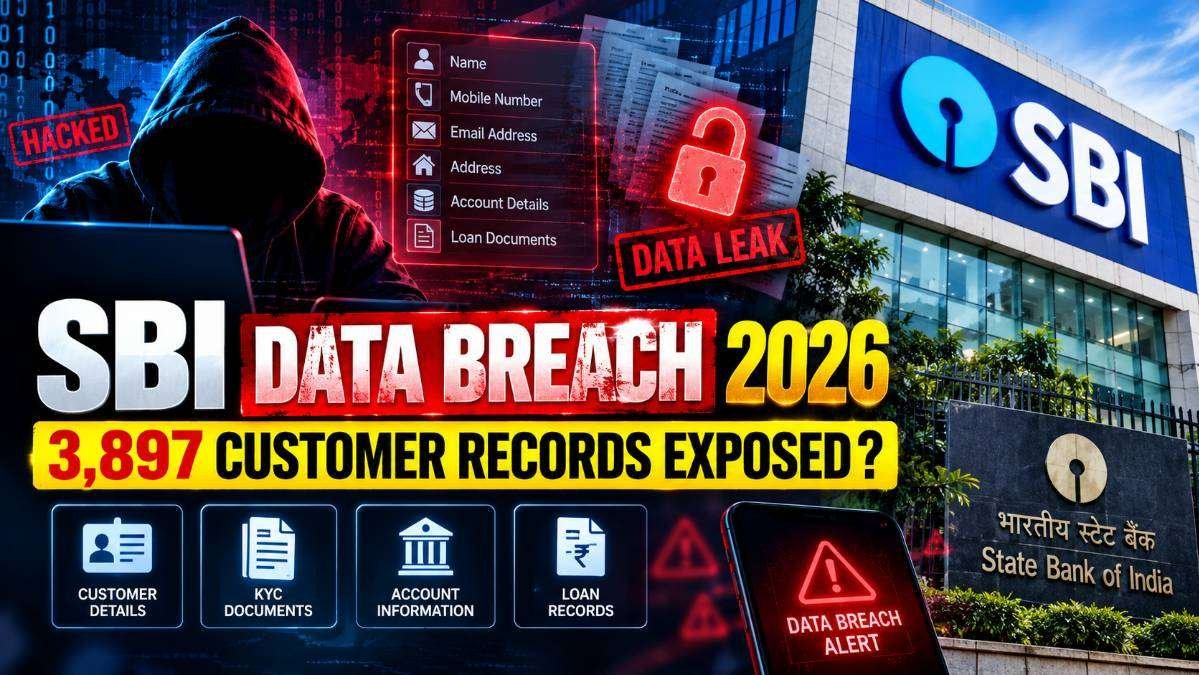
Initial reports refer to approximately 375,000 records in the dataset, with 3,897 customer records identified as containing personally identifiable information. The investigation is expected to establish the source of the data, the extent of the exposure, and the steps needed to prevent further risks.
What Happened in the SBI Data Breach Case?
On October 21, 2026, reports based on information attributed to the State Bank of India described a potential data exposure involving customer records found on the dark web. The incident drew attention after an alleged hacker group named Siriusim was reported to have claimed access to a much larger collection of banking-related information.
The initial allegation, which circulated on October 20, referred to approximately 3.75 lakh records and 2,722 PDF documents. The files were claimed to contain customer information, loan applications, account-opening documents, and other supporting paperwork.
Subsequent reporting described a preliminary review of approximately 375,000 records, of which 3,897 reportedly contained personally identifiable information. These figures refer to different aspects of the reported dataset and should not be interpreted as proof that 375,000 bank accounts were hacked.
The distinction matters because the number of records in a dataset does not necessarily equal the number of affected customers or compromised bank accounts.
Sources: Reuters report and The Economic Times report.
What Information May Have Been Exposed?
Reports about the incident indicate that the records identified during the preliminary review may contain personally identifiable information. Such information can help identify an individual and may become a target for online fraud if it falls into the wrong hands.
The information described in the reports includes:
- Customer names and registered mobile numbers.
- Dates of birth and email addresses.
- Residential addresses and gender information.
- Customer identification details and branch-related identifiers.
- Loan-related records and application information.
- Account-opening documents and other supporting paperwork mentioned in the original allegation.
The available reports do not establish that every category of information was present in the confirmed subset of 3,897 records. The precise contents and origin of the wider dataset remain important questions for the investigation.
Has the SBI Data Breach Been Confirmed?
Reports published on October 21 describe a customer data exposure reported by SBI, while the larger claim involving 3.75 lakh records first circulated as an allegation attributed to a threat actor. The two developments need to be understood in the context of the ongoing investigation.
A dataset appearing on the dark web does not automatically establish how the information was obtained. Investigators must determine whether the records are authentic, whether they originated from SBI or another source, and whether unauthorised access to the bank’s systems occurred.
It is also important to distinguish the exposure of customer information from the compromise of banking credentials or payment systems. Public reporting has not established that every customer in the larger dataset had a compromised account, nor does the reported exposure by itself prove that money was stolen.
Customers should follow verified updates from SBI rather than relying on unconfirmed social media posts or messages that exaggerate the incident.
How Did SBI Respond to the Incident?
According to reports published on October 21, the bank received alerts concerning the suspected exposure and began examining the information. The reporting refers to alerts from its threat intelligence service provider, the Defence Cyber Agency, and the Indian Computer Emergency Response Team.
SBI reportedly initiated its incident response procedures and engaged an independent cybersecurity agency to investigate the incident. The investigation is intended to establish the source of the data, determine the extent of the exposure, and identify any further action required.
The bank has also been reported as saying that the incident is not expected to have a material impact on its core banking operations, financial performance, or business continuity.
This assessment concerns the expected operational and financial impact. It should not be interpreted as meaning that the exposure of personal information is unimportant or that every potential privacy risk has already been resolved.
Why Is a Banking Data Leak a Serious Concern?
Banking documents can contain information that criminals may use to make fraudulent communications appear genuine. Even when payment credentials are not exposed, personal details can make it easier for scammers to gain a victim’s confidence.
Targeted phishing messages
Criminals may send text messages or emails that appear to come from a bank. By including a person’s name or other genuine details, they may try to persuade the recipient to click a suspicious link or disclose confidential information.
Fraudulent calls pretending to be from SBI
A caller may claim that an account has been flagged for suspicious activity or that a customer’s identification documents need to be updated. Personal information can make such calls sound convincing, even when the caller has no connection to the bank.
Identity misuse
If genuine identity documents or supporting records are exposed, criminals may attempt to misuse them in fraudulent applications or impersonation schemes. Whether this has happened in the present case has not been established.
Greater risk of follow-up scams
People worried about a reported data leak may themselves become targets of follow-up scams. Fraudsters might claim that they can secure an account, remove leaked information, or recover money in exchange for a payment or confidential banking details.
What Should SBI Customers Do Now?
Customers do not need to panic simply because a data exposure has been reported. However, taking a few practical precautions can reduce the risk of fraud.
- Check account activity: Review recent transactions and contact SBI immediately if you notice a transaction you did not authorise.
- Never disclose an OTP or PIN: Do not share one-time passwords, ATM PINs, card verification values, internet banking passwords, or other confidential credentials with callers or through links.
- Be careful with KYC messages: Do not click links in unexpected messages threatening to suspend your account. Verify the information through SBI’s official website or customer service.
- Avoid unknown applications: Never install remote-access or screen-sharing applications because an unknown caller claims they are required to resolve a banking issue.
- Use official banking channels: Type the bank’s official website address yourself or use its verified mobile application rather than following unfamiliar links.
- Report suspected fraud promptly: Contact the bank and report suspected financial cybercrime through India’s official reporting channels.
SBI’s official cybersecurity guidance is available at the State Bank of India’s cybersecurity page.
How to Report SBI-Related Cyber Fraud in India
Anyone who suspects that they have been targeted by a banking scam should contact their bank through a verified channel. If money has been lost to cyber fraud, reporting it quickly can help the relevant authorities take timely action.
- National cybercrime helpline: 1930.
- Online reporting: National Cyber Crime Reporting Portal.
- SBI phishing reports: report.phishing@sbi.co.in.
- SBI cybersecurity guidance: Official SBI website.
Do not send passwords, PINs, or one-time passwords in an email or disclose them to someone claiming to investigate the incident.
What Does This Incident Mean for Digital Banking Security?
The reported exposure highlights a challenge faced by financial institutions as more customer information is stored and processed digitally. Protecting a bank requires more than securing login pages and payment systems. It also involves controlling access to documents, monitoring unusual activity, protecting information handled by service providers, and responding quickly when suspicious data appears online.
Investigations into incidents of this kind should establish how the information became accessible, whether any security controls failed, and what corrective measures are necessary. Clear communication with affected customers is also important when verified information becomes available.
For customers, the lesson is equally practical: personal information deserves protection, and no caller or message should be trusted simply because it contains genuine details. Independent verification remains one of the most effective ways to avoid banking scams.
Conclusion
The SBI data exposure reported in October 2026 has raised important questions about the protection of customer information. Reports describe approximately 375,000 records in a dataset found on the dark web, with 3,897 customer records reportedly identified as containing personally identifiable information. The bank’s investigation is expected to clarify the origin of the records and the full extent of the exposure.
At this stage, it would be inaccurate to claim that 3.75 lakh SBI bank accounts were all hacked or that money was stolen from those accounts. The number of records in a dataset is not the same as the number of confirmed compromised bank accounts. The findings should be interpreted carefully as further verified information becomes available.
SBI customers should remain alert, monitor their transactions, and avoid sharing confidential banking credentials. Anyone who notices suspicious activity should contact the bank immediately and report suspected cyber fraud through the appropriate official channels.
Ultimately, the incident is a reminder that customer data protection and public awareness are both essential to digital banking security. Accurate information, a transparent investigation, and sensible precautions can help protect customers while the facts continue to emerge.
About The Author