Internet Services Reportedly Suspended in Parts of Central Delhi During CJP March What Official Sources Confirm
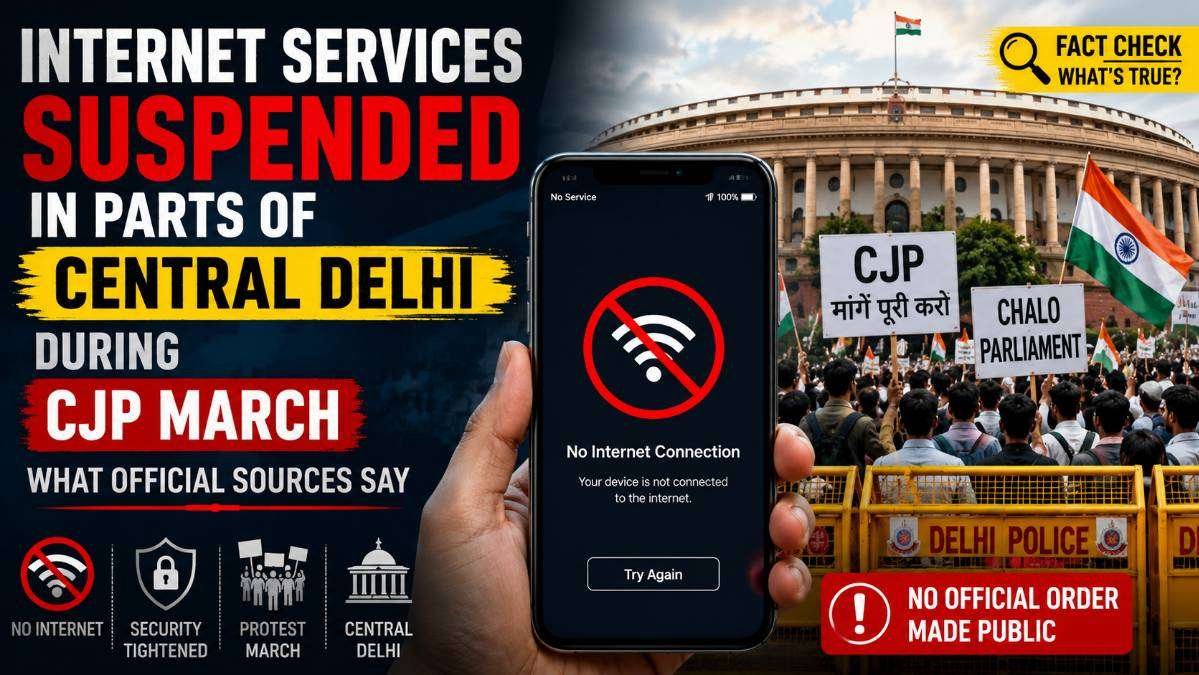
Security measures in India’s capital often become stricter whenever large public demonstrations, political gatherings, or protest marches are planned near important government buildings. Recently, reports claiming that internet services were suspended in Central Delhi during the CJP (Chalo Parliament) march gained widespread attention on social media.
Images showing smartphones without internet connectivity and headlines suggesting a complete shutdown quickly spread across various platforms, leading many people to question whether the information was accurate.
While several news organizations reported temporary mobile internet disruptions in parts of Central Delhi, the official picture is more nuanced. Understanding what actually happened requires examining verified reports, official statements, and the available public information rather than relying solely on viral social media posts.
During the CJP march, Delhi Police implemented extensive security arrangements around central government institutions, Parliament, and other sensitive locations.
Authorities deployed additional police personnel, installed barricades, regulated traffic movement, and issued advisories asking commuters to avoid certain routes. Similar arrangements have been made in the past whenever authorities anticipate large gatherings that could affect public order or security.
One of the most discussed issues during the protest was the availability of mobile internet services. Several participants and journalists reported difficulties accessing mobile data in parts of Central Delhi.
Multiple news organizations also carried reports stating that mobile internet services appeared to have been disrupted temporarily in some locations where security arrangements were the strictest. These reports quickly led to claims that the government had imposed a complete internet shutdown across Central Delhi.
However, available official information does not fully support the broader claim of a blanket internet shutdown across the entire Central Delhi region. At the time of reporting, neither Delhi Police nor the Ministry of Home Affairs publicly released a detailed suspension order confirming that all internet services had been officially shut down across the entire district.
This distinction is important because internet shutdowns in India are governed by specific legal procedures that generally require formal authorization under established rules.
The Internet Freedom Foundation (IFF), a digital rights organization that monitors internet restrictions across India, stated that mobile internet appeared to have been suspended in parts of Central Delhi during the protest.
However, the organization also noted that no public suspension order had been made available. The absence of a publicly accessible order has raised questions among digital rights advocates regarding transparency and public communication whenever internet restrictions are imposed.
Experts explain that temporary communication restrictions are sometimes used by authorities during high-security events to reduce the possibility of misinformation spreading rapidly, coordinate crowd management, and address potential security concerns. Authorities argue that such measures may help maintain public safety in exceptional situations.
At the same time, civil liberties organizations emphasize that any restriction on internet access should remain lawful, proportionate, transparent, and limited to only those situations where it is absolutely necessary.
READ THIS: Airtel Unlimited 5G Hotspot Policy Explained Can You Share Unlimited 5G Data via Hotspot?
It is also important to distinguish between complete internet shutdowns and temporary network disruptions. Mobile users may experience service interruptions because of network congestion, technical issues, overloaded cellular towers, or localized administrative measures. Without an official order clearly defining the scope of restrictions, it becomes difficult to determine whether users experienced a formal suspension or another type of network disruption.
Several commuters reported that messaging applications, mobile browsers, and social media platforms were inaccessible for a limited period in certain parts of Central Delhi.
Meanwhile, internet connectivity reportedly continued functioning normally in many other areas of the National Capital Region (NCR). This indicates that any disruption was not necessarily citywide but may have been geographically limited.
Traffic restrictions also played a significant role during the protest. Delhi Traffic Police issued advisories requesting commuters to avoid specific roads near Parliament and surrounding government buildings.
Some Metro stations experienced temporary entry or exit restrictions depending on security requirements. Such preventive measures are commonly implemented during high-profile political demonstrations or important government events.
The rapid spread of social media graphics claiming “Internet Services Suspended in Central Delhi” demonstrates how easily headlines can oversimplify complex situations.
Many viral images do not include the date, source, official notification, or supporting documentation. As a result, readers may mistakenly believe that an entire city has lost internet access even when disruptions affect only selected areas or specific mobile services.
READ THIS: Google Account Email Change Feature How to Change Your Gmail Address
Before accepting similar claims, users should verify whether official government notifications have been published. Reliable information usually comes from government departments, police advisories, recognized news agencies, or official press releases.
Fact-checking organizations also play an important role in examining whether viral claims accurately represent official actions. India has witnessed several internet suspensions over the years in response to law-and-order situations.
Each instance has generated discussions regarding the balance between national security, public safety, transparency, and citizens’ digital rights. Courts have also emphasized that internet restrictions cannot continue indefinitely and should satisfy legal standards of necessity and proportionality.
For journalists, students, researchers, and ordinary citizens, distinguishing between verified facts and social media speculation has become increasingly important.
Images designed for social media engagement often present simplified narratives that may omit important legal or factual context. Reading complete reports from credible sources provides a more accurate understanding of evolving situations.
Conclusion
Based on the information available from reliable news organizations and public-interest groups, there is credible evidence that many users experienced temporary mobile internet disruptions in parts of Central Delhi during the CJP march while heightened security measures were in place.
However, no publicly released government order confirming a blanket internet shutdown across all of Central Delhi was available at the time of reporting. Therefore, describing the situation as a complete citywide internet suspension would not accurately reflect the publicly available evidence.
Readers should rely on official government notifications, Delhi Police advisories, and established news organizations before sharing or believing viral claims about internet shutdowns. Responsible verification helps reduce misinformation and ensures that public discussions remain based on confirmed facts rather than incomplete or misleading social media posts.
About The Author