India is preparing for a historic Independence Day celebration on 15 August 2026, with the national ceremony at the Red Fort set to include a special tribute to one of the country’s most important patriotic songs.
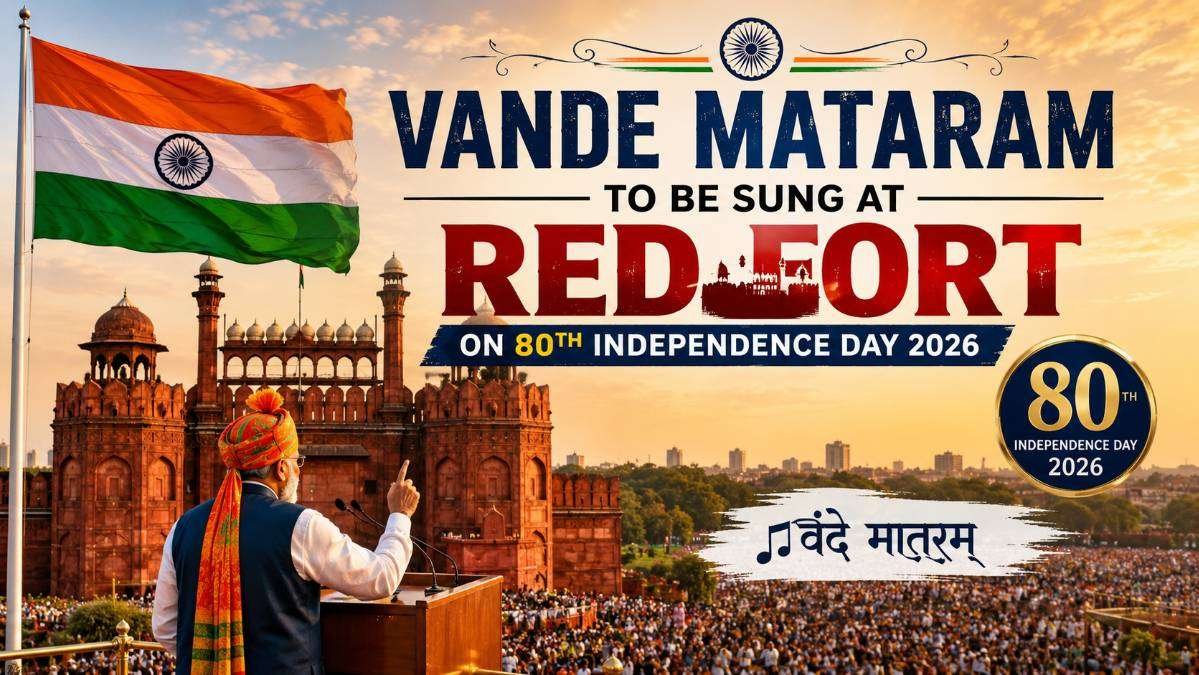
According to an official announcement from the Government of India, Vande Mataram will be sung from the ramparts of the historic Red Fort for the first time as part of the Independence Day ceremony.
The announcement is significant because 2026 also falls within the year-long national commemoration marking 150 years of Vande Mataram. The special presentation at the Red Fort is expected to add a historic and cultural dimension to the 80th Independence Day celebrations.
India to Celebrate Its 80th Independence Day
India will observe its 80th Independence Day on 15 August 2026. The main national celebration will take place at the Red Fort in New Delhi, where the Prime Minister traditionally addresses the nation after the hoisting of the National Flag.
The Government of India has planned several special programmes around this year’s celebration. Along with the traditional Independence Day ceremony, the programme will highlight the historical importance of Vande Mataram and the contribution of young Indians towards the country’s future.
The official theme associated with the broader celebration also highlights the role of India’s youth in building a developed India by 2047. This connects the country’s freedom struggle and historical achievements with the aspirations of the younger generation.
READ THIS: Russia India Direct Railway Route What Is Really Proposed?
Vande Mataram to Be Sung From the Red Fort Ramparts
The most notable announcement is the planned singing of Vande Mataram from the ramparts of the Red Fort during the Independence Day ceremony.
The wording of the Government announcement is important. The claim is not that Vande Mataram has never been performed at the Red Fort before. Instead, the announcement specifically describes the 2026 Independence Day performance as the first time Vande Mataram will be sung from the ramparts of the Red Fort as part of this ceremony.
This distinction is important because Vande Mataram-related programmes have been held at the Red Fort and other important national locations in the past. Therefore, social media posts should not interpret the announcement as meaning that the song has never been heard at the Red Fort.
Why 2026 Is Important for Vande Mataram
The special Independence Day programme comes during a nationwide commemoration of 150 years of Vande Mataram.
The Government of India launched a year-long commemoration beginning on 7 November 2025 and continuing until 7 November 2026. The programme was created to recognise the historical and cultural significance of the song and its contribution to India’s freedom movement.
As part of the commemoration, government institutions, educational organisations and other bodies have organised mass singing programmes, cultural activities, exhibitions and other events connected with Vande Mataram.
A Song With a Long Historical Legacy
Vande Mataram was written by Bankim Chandra Chattopadhyay and became closely associated with India’s freedom movement. The song expressed a powerful sense of devotion to the motherland and became an important symbol of India’s national awakening during the colonial period.
According to Government of India material, the song first appeared in the literary journal Bangadarshan and was later associated with Bankim Chandra Chattopadhyay’s novel Anandamath. Over time, Vande Mataram became deeply connected with India’s struggle for independence.
Its historical importance continued after independence. On 24 January 1950, the Constituent Assembly recognised the special status of Vande Mataram and stated that the song, because of its historic role in India’s freedom struggle, would be honoured equally with Jana Gana Mana.
Vande Mataram Is the National Song, Not the National Anthem
Another important point needs to be clarified because social media posts sometimes confuse the two national symbols.
Jana Gana Mana is India’s National Anthem, while Vande Mataram is India’s National Song.
Vande Mataram does not replace Jana Gana Mana as the National Anthem. The two have different official designations, although Vande Mataram has been accorded equal honour because of its historic contribution to India’s freedom struggle.
This distinction should be maintained when reporting about the 2026 Independence Day programme. Calling Vande Mataram the National Anthem would be factually incorrect.
150 Years of Vande Mataram Being Celebrated Nationwide
The 150-year commemoration is not limited to one ceremony in Delhi. The Government has organised a nationwide programme involving citizens from different sections of society.
When the commemoration was launched in November 2025, mass singing of the full version of Vande Mataram was organised at public places across the country. Students, government employees, elected representatives, professionals and members of the public participated in various programmes.
The Government has also used cultural programmes and musical performances to introduce younger generations to the history and significance of the song.
Special Programmes Planned Around Independence Day
The 2026 Independence Day celebrations are expected to include several elements beyond the main flag-hoisting ceremony.
One of the planned activities involves a large formation of NCC cadets and My Bharat volunteers representing the words “Vande Mataram” in front of the Red Fort. The programme is designed to visually connect India’s youth with the 150-year legacy of the National Song.
Military bands and other uniformed organisations are also participating in Vande Mataram-related performances at locations across the country as part of the Independence Day celebrations.
These programmes demonstrate that the 2026 commemoration is being planned as a nationwide celebration rather than an event restricted to the national capital.
Focus on India’s Youth and Viksit Bharat
Youth participation is another major element of the 2026 Independence Day programme.
The Government has invited young achievers and beneficiaries of different national initiatives to participate in the celebrations. Students who have performed exceptionally in international academic competitions are also among those being recognised.
The focus on young Indians reflects the broader idea that the country’s next phase of development will depend heavily on its youth. The Independence Day programme therefore connects the legacy of the freedom movement with India’s long-term development vision.
READ THIS: Kargil Vijay Diwas 2026 History, Significance & Operation Vijay
What the Red Fort Announcement Really Means
The viral claim about Vande Mataram needs to be presented carefully.
The official announcement supports the central claim that Vande Mataram will be sung from the ramparts of the Red Fort for the first time during the Independence Day ceremony in 2026. However, it would be misleading to say that Vande Mataram has never previously been performed at the Red Fort in any form.
The significance lies in its planned place within the official Independence Day ceremony at the historic ramparts. The announcement comes at a particularly symbolic moment because the country is simultaneously observing the 80th Independence Day and the 150-year commemoration of Vande Mataram.
Conclusion
The planned singing of Vande Mataram from the Red Fort ramparts on 15 August 2026 is set to become one of the notable moments of India’s 80th Independence Day celebrations. The event carries additional significance because 2026 is part of the nationwide commemoration marking 150 years of Vande Mataram.
For readers seeing viral posts about the announcement, the most accurate interpretation is simple: the Government has announced that Vande Mataram will be sung from the ramparts of the Red Fort for the first time during the Independence Day ceremony. This does not mean the song has never been performed at the Red Fort before.
Vande Mataram’s place in India’s history goes far beyond a single ceremony. From its association with the freedom movement to its recognition as the National Song, it has remained an important part of India’s national heritage.
The 2026 Independence Day celebration will therefore bring together history, patriotism, youth participation and the country’s vision for the future in one of India’s most important national ceremonies.
About The Author