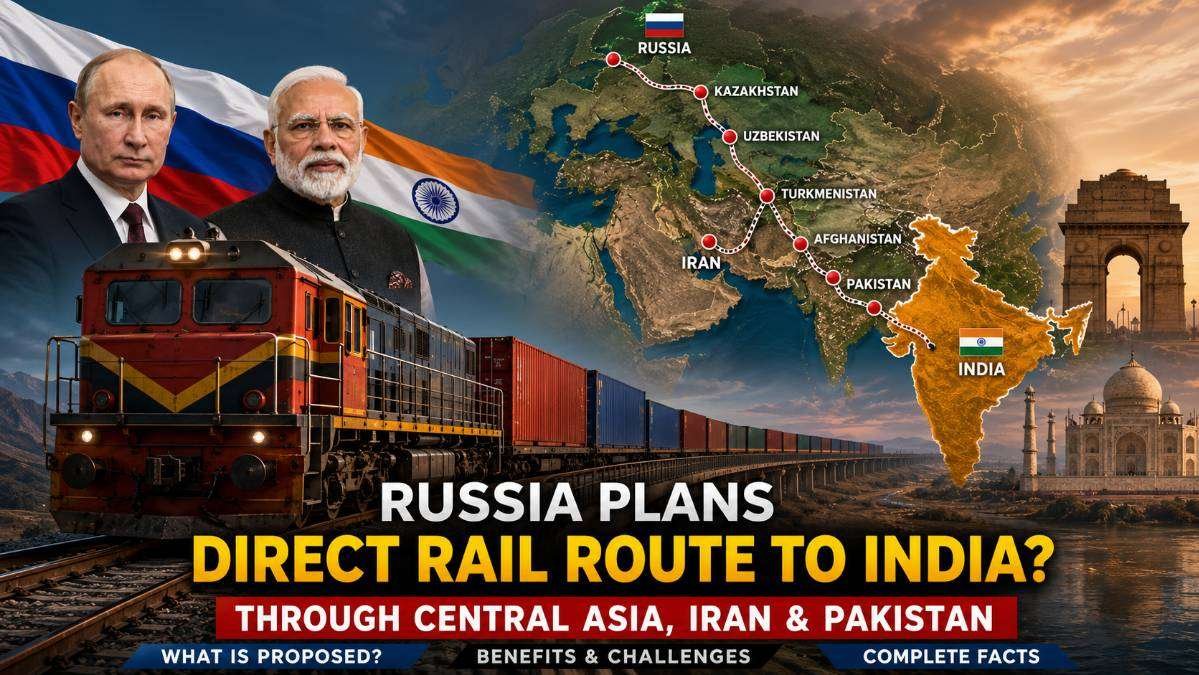
A new proposal from Russia has attracted attention after Russian Deputy Prime Minister Marat Khusnullin said Moscow should explore a railway route that could provide access to the Indian Ocean and eventually connect with India.
The statement has triggered headlines suggesting that Russia is planning a direct railway line to India. However, the available evidence shows that the proposal is still at the exploration stage and should not be described as an approved railway construction project.
According to Russia’s state news agency TASS, Khusnullin said on August 6, 2026, that Russia should explore a rail connection to the Indian Ocean as an alternative to routes exposed to risks around the Bosphorus and Strait of Hormuz.
He mentioned possible routes through Turkmenistan, Iran, Afghanistan and Pakistan and said that options providing access to India could be considered.
Russia Has Proposed Exploring a New Route to India
The most important point is the wording of the Russian proposal. Moscow has not announced that construction of a new direct railway from Russia to India has started. Instead, the Russian Deputy Prime Minister said that such a connection should be explored.
This means that the idea is currently about examining possible transportation routes and their feasibility. There is no publicly announced final railway alignment, construction schedule, project completion date or confirmed budget for a new Russia–India direct railway.
Therefore, the viral claim that “Russia is building a direct railway straight to India” goes beyond what has officially been announced.
What Route Could Russia Consider?
The route discussed by Khusnullin could involve several countries in Central and South Asia. The countries specifically mentioned in the Russian statement include Turkmenistan, Iran, Afghanistan and Pakistan, with the broader objective of obtaining access to India and the Indian Ocean. 1
A simplified representation of one possible corridor would be:
Russia → Central Asia → Turkmenistan → Iran → Afghanistan → Pakistan → India
However, this should not be treated as an officially approved railway map. The exact alignment would depend on future discussions between the countries involved, infrastructure availability, security conditions, financing, customs arrangements and technical feasibility.
READ THIS: Jio Airtel Vi Recharge Price Hike 2026 -15% Tariff Hike
Why Does Russia Want Another Route?
One of the main reasons behind the proposal is the need to diversify international transport routes.
Russia’s Deputy Prime Minister referred specifically to risks associated with the Bosphorus and Strait of Hormuz. These waterways are strategically important for international trade, and geopolitical tensions can affect the reliability of maritime transportation.
A land-based railway or multimodal corridor could give Russia another option for moving goods toward South Asia and the Indian Ocean. Such a route could potentially support freight transportation and strengthen trade links with India and other Asian markets.
India and Russia Already Have the INSTC
The new proposal should also be understood in the context of the existing International North-South Transport Corridor (INSTC).
India’s Ministry of Ports, Shipping and Waterways has described the INSTC as a multimodal transportation route connecting the Indian Ocean and Persian Gulf to the Caspian Sea through Iran and onward toward northern Europe and Russia.
The Indian government has explained that the corridor can involve different modes of transport. One example includes movement from Mumbai to Chabahar in Iran by sea, onward movement inside Iran, transportation across the Caspian Sea and then movement through Russia’s railway network. 2
This distinction is important. The INSTC is not simply one continuous railway line from India to Russia. It is a multimodal network combining sea, road and rail transportation.
India and Russia Are Already Strengthening Transport Connectivity
India and Russia have been working for years to improve transport and logistics connections.
The joint outcomes of the 23rd India-Russia Annual Summit in December 2025 included an agreement to deepen cooperation in building stable and efficient transport corridors.
The two sides focused on improving logistics links and infrastructure capacity supporting the INSTC, the Chennai–Vladivostok Eastern Maritime Corridor and the Northern Sea Route. The countries also noted ongoing cooperation between their railways, including mutually beneficial technology exchange. 3
Prime Minister Narendra Modi also said during the summit that India and Russia would move forward with renewed energy on the INSTC, Northern Sea Route and Chennai–Vladivostok corridors. 4
This shows that the new railway proposal is part of a much wider effort to expand India-Russia connectivity rather than an entirely separate development.
Why Central Asia Is Important
Central Asia could play an important role in any future land-based connectivity project between Russia and India.
India has been working to strengthen transport and economic links with Kazakhstan, Kyrgyzstan, Tajikistan, Turkmenistan and Uzbekistan.
At the fourth India-Central Asia Dialogue held in New Delhi in June 2025, the participating countries emphasized the importance of greater use of the INSTC to improve connectivity between India and Central Asia.
India also reiterated its support for Turkmenistan and Uzbekistan joining the INSTC, while the participants appreciated Kazakhstan’s initiative to develop the eastern branch of the corridor. 5
This existing cooperation provides an important background for understanding why Central Asian routes could become significant in future India-Russia trade.
Turkmenistan Could Become an Important Link
Turkmenistan is particularly relevant because of its location between Central Asia and Iran.
According to India’s Ministry of External Affairs, Turkmenistan joined the INSTC in July 2023. The ministry also stated that cargo movement through the eastern branch of the INSTC via Turkmenistan and Kazakhstan was gaining momentum.
India and Turkmenistan are also members of the Ashgabat Agreement, an international transport and transit framework involving countries including Iran, Turkmenistan and Uzbekistan. 6
These existing arrangements could potentially support future regional connectivity, although they do not automatically establish a new Russia-to-India railway.
What Role Could Iran Play?
Iran is another major component of the regional connectivity network.
India has been developing its relationship with Iran around Chabahar Port, which is strategically important for India’s access to Afghanistan and Central Asia.
Chabahar is also closely connected with India’s broader plans for the INSTC. The Indian government has described the port as an important transit centre for the region and highlighted its potential to connect India with Central Asian and Eurasian markets. 7
Consequently, Iran could become an important transit country for different future India-Russia transport arrangements.
Pakistan and Afghanistan Create Major Challenges
The possibility of a route passing through Afghanistan and Pakistan introduces significant complications.
A railway connecting Russia with India through these countries would require cooperation between several governments. Agreements would be necessary for transit rights, customs procedures, border crossings, security, railway operations, infrastructure investment and freight regulations.
The political and security situation along the proposed route would also have to be carefully considered.
For this reason, the route mentioned in the Russian proposal should be viewed as a possible connectivity option rather than a confirmed railway alignment.
READ THIS: Google Selfie Video Account Recovery New Security Feature
Why a Direct Train Is Not Yet Confirmed
There is currently no confirmed announcement of a regular direct passenger train connecting Russia and India as a result of this proposal.
There is also no announced public timetable, ticketing system, completion date or confirmed construction programme for a new Russia–India direct railway based on the August 2026 statement.
Another technical consideration is that railway systems across different countries can use different gauges, infrastructure standards and operating systems. A long-distance international freight corridor may therefore require transshipment, gauge-change facilities or a combination of rail, road and maritime transportation.
This is one reason multimodal corridors such as the INSTC remain important.
Potential Benefits for India
If a reliable new transport corridor eventually becomes feasible, India could gain several potential advantages.
Better Access to Russian Markets
Improved transportation could make it easier for Indian companies to move goods toward Russia and other Eurasian markets.
Stronger Central Asian Connectivity
A better-connected network could also support India’s economic engagement with Central Asian countries, particularly in areas such as energy, agriculture, pharmaceuticals, information technology and trade.
More Transport Options
Additional routes could reduce dependence on individual maritime corridors and give exporters and importers more logistical choices.
Greater Eurasian Connectivity
A successful corridor could strengthen India’s position within wider Eurasian trade networks and complement existing initiatives such as the INSTC and other India-Russia connectivity projects.
Potential Benefits for Russia
Russia could also benefit from stronger land and multimodal access to South Asian markets.
A functioning corridor could provide additional options for Russian exporters, strengthen commercial links with India and improve connections with Central Asian economies.
It could also complement Russia’s existing efforts to develop alternative transport corridors toward Asia.
How the New Proposal Differs From the Viral Claim
The viral image describes the development as a direct railway route “straight to India.” That presentation makes the proposal appear much more advanced than the information currently available.
The Russian statement is better understood as a proposal to explore a possible railway connection to the Indian Ocean and routes providing access to India.
Therefore, readers should not assume that the exact route shown in social media graphics has been approved by Russia, India or all the countries through which it could potentially pass.
READ THIS: WhatsApp Status Caption Edit Feature How to Edit Status Captions Without Deleting the Status
What Is Confirmed So Far?
- Russia has proposed exploring a railway route toward the Indian Ocean. This was stated by Russian Deputy Prime Minister Marat Khusnullin. 8
- Possible routes through Turkmenistan, Iran, Afghanistan and Pakistan were mentioned. 9
- India and Russia already cooperate on the INSTC and other transport corridors. 10
- India is working with Central Asian countries to improve use of the INSTC. 11
- Turkmenistan joined the INSTC in 2023. 12
- There is no confirmed announcement that construction of a new direct Russia–India railway has begun.
- No direct Russia–India passenger train has been announced as part of this proposal.
Conclusion
Russia’s latest proposal has the potential to become an important development in Eurasian transportation, but it should be reported carefully. Russian Deputy Prime Minister Marat Khusnullin has called for exploring a railway connection to the Indian Ocean and identified possible routes through Central and South Asia, including Turkmenistan, Iran, Afghanistan and Pakistan. 13
However, this does not mean that Russia has already started constructing a direct railway to India. The exact route, financing, construction arrangements, transit agreements and implementation schedule have not been publicly established for such a new direct railway.
India already has a significant connectivity framework through the INSTC, while cooperation with Russia and Central Asian countries continues to develop. The new Russian proposal could therefore become another element in a broader Eurasian transport network if the participating countries determine that the route is technically, financially and geopolitically feasible.
For now, the most accurate description is that Russia is exploring a possible railway and transport connection toward the Indian Ocean and India not that a direct Russia-to-India railway is already under construction.
About The Author