UPI has become one of the most widely used payment methods in India. From buying groceries at a local shop to paying bills, booking tickets and transferring money to friends, millions of people use UPI every day.
Recently, a social media post claiming that the Indian Government will impose a 0.4 percent tax on all UPI payments above ₹2,000 has attracted significant attention.
The claim has caused confusion among UPI users, particularly because the post suggests that customers will have to pay extra money whenever they make a large UPI payment.
However, the actual rule is different. The new charge is related to the Merchant Discount Rate, commonly known as MDR, for certain merchant transactions. It should not be confused with a direct tax on customers or a charge on every UPI transfer.
What Is the New UPI 0.4 Percent Rule?
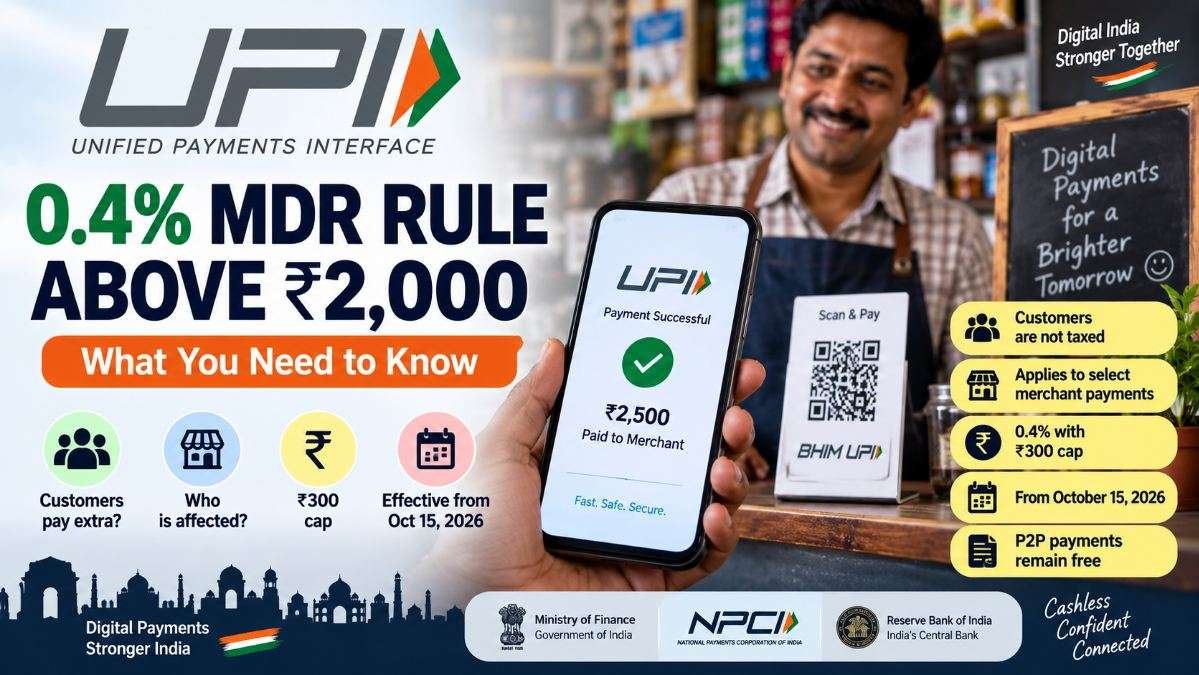
Under the new framework announced by the National Payments Corporation of India, a 0.4 percent Merchant Discount Rate will apply to certain Person-to-Merchant, or P2M, UPI transactions above ₹2,000.
The new framework is scheduled to take effect from October 15, 2026. The important point is that this is a merchant-side payment processing charge and not a blanket 0.4 percent tax imposed on UPI users.
The exact treatment can depend on the type of merchant and transaction category. Therefore, saying that every UPI payment above ₹2,000 will automatically attract a 0.4 percent charge is not accurate.
READ THIS: How to Permanently Delete UPI AutoPay & Stop Unwanted Recurring Payments (NPCI Update) 2026
The 0.4 Percent Charge a Tax on UPI Users?
No. The 0.4 percent Merchant Discount Rate should not be described as a direct UPI tax on customers.
MDR is a charge associated with processing a merchant payment. It operates within the payment ecosystem involving the merchant, acquiring bank, payment service providers and other participating entities.
This distinction is important because several social media posts have used words such as “UPI tax” or “Government tax,” which can give users the wrong impression.
Will Customers Have to Pay 0.4 Percent Extra?
Customers are not supposed to pay an additional 0.4 percent simply because they use UPI for a qualifying purchase.
For example, suppose you purchase a product worth ₹10,000 from a merchant and pay through UPI. The 0.4 percent calculation would be ₹40. However, this does not mean that the customer should automatically be asked to pay ₹10,040.
The MDR is intended to be handled within the merchant payment ecosystem, and merchants are not permitted to pass the MDR directly to customers as an additional UPI charge.
READ THIS: PhonePe Biometric UPI Payments Pay via Fingerprint or Face ID up to ₹5,000
What Does MDR Mean?
Merchant Discount Rate is a fee associated with processing a digital payment accepted by a merchant.
When a customer makes a digital payment, several entities can be involved in processing that transaction. MDR helps support the payment infrastructure and the various services involved in accepting and processing digital payments.
It is therefore different from a tax such as Goods and Services Tax or income tax.
What Happens to Person-to-Person UPI Payments?
The new MDR framework for merchant transactions should not be confused with ordinary person-to-person UPI transfers.
If you send ₹5,000 to a friend, transfer ₹20,000 to a family member, or send money to another person’s bank account for a personal transaction, the new merchant MDR rule does not turn that payment into a 0.4 percent customer charge.
Person-to-person UPI payments continue to remain free under the announced framework.
How Much Would 0.4 Percent Be?
Although customers are not supposed to pay this amount as an additional UPI fee, it is useful to understand the mathematics behind the MDR.
| Transaction Amount | 0.4 Percent Calculation |
|---|---|
| ₹2,500 | ₹10 |
| ₹5,000 | ₹20 |
| ₹10,000 | ₹40 |
| ₹25,000 | ₹100 |
| ₹50,000 | ₹200 |
| ₹75,000 | ₹300 |
| ₹1,00,000 | ₹300 maximum under the reported cap |
The calculation above shows the MDR amount, not an additional amount that customers should automatically pay to merchants.
There a Maximum MDR Amount?
Yes. Under the reported framework, the standard 0.4 percent MDR is subject to a maximum of ₹300 for transactions of ₹75,000 and above.
This means the viral claim that a ₹1 lakh UPI payment would necessarily result in ₹400 of MDR is not correct. The reported maximum for such a transaction is ₹300.
Are All Merchants Covered by the Rule?
No. The framework does not mean that every merchant in India will automatically face the same charge on every UPI transaction above ₹2,000.
There are specific categories and conditions under the new framework. Small merchants covered under the applicable small-merchant framework continue to receive special treatment, subject to the conditions prescribed for that category.
This is another reason why the statement “all UPI payments above ₹2,000 will be charged 0.4 percent” is an oversimplification.
Are There Special Categories With Different Charges?
Yes. Certain categories of transactions have been reported to have a different MDR structure.
For some sectors, including categories such as railways, telecommunications, insurance and fuel, a flat ₹5 MDR is applicable for qualifying transactions above ₹2,000 under the reported framework rather than the standard 0.4 percent rate.
This shows that the new system is not a single charge applied identically to every merchant and every transaction.
READ THIS: PhonePe Wallet Inactivity Fee 2026: ₹100 Charge for Inactive Wallets Explained
Why Is MDR Being Introduced?
UPI has grown rapidly and now handles an enormous number of digital transactions across India. Maintaining this infrastructure requires investment in technology, security, fraud prevention, network capacity and other payment-related systems.
The introduction of a limited MDR framework is connected with creating a sustainable model for certain merchant transactions while continuing to keep UPI convenient for consumers.
The Government has previously emphasized the importance of keeping UPI affordable and accessible to users while supporting the long-term sustainability of the digital payment ecosystem.
What About the Viral Claim That “Customers Will Pay ₹400 Extra”?
This is one of the most misleading parts of the viral message.
The post calculates 0.4 percent of ₹1,00,000 and arrives at ₹400. While the mathematical calculation itself is correct, it does not mean that a customer making a ₹1 lakh UPI payment will have ₹400 added to the bill.
First, the MDR is not a customer tax. Second, the reported framework places a ₹300 cap on the standard MDR for transactions of ₹75,000 and above. Third, merchants are not permitted to simply add the MDR as a separate UPI charge to the customer’s bill.
When Will the New Rule Start?
The new MDR framework for qualifying merchant UPI transactions is scheduled to come into effect on October 15, 2026.
Therefore, users should be careful with social media posts that make it appear that every UPI transaction above ₹2,000 is already being charged 0.4 percent.
What UPI Users Should Know
- UPI is not being converted into a blanket 0.4 percent tax for customers.
- The new MDR framework mainly concerns qualifying merchant transactions.
- The reported threshold for the standard MDR is above ₹2,000.
- The standard MDR is reported at 0.4 percent, subject to applicable conditions.
- The standard MDR has a reported maximum of ₹300 for transactions of ₹75,000 and above.
- Person-to-person UPI transfers remain free under the framework.
- Merchants cannot simply add the MDR as an extra UPI charge to customers.
- Some merchant categories have different MDR arrangements.
- The new framework is scheduled to start on October 15, 2026.
What Should Merchants Know?
Merchants should understand which category they fall under and how their acquiring bank or payment service provider will implement the new MDR structure.
They should also avoid misleading customers by describing MDR as a Government tax or by adding an unauthorized UPI surcharge to the customer’s bill.
Businesses that accept large-value UPI payments may need to review their payment arrangements and understand the applicable rules before the new framework takes effect.
UPI Will Still Be an Important Digital Payment Option
The introduction of MDR for certain merchant transactions does not mean that UPI is becoming a paid service for ordinary users.
For consumers, the key distinction is between a payment made to another person and a payment made to a merchant. The new MDR framework is focused on qualifying merchant transactions, while person-to-person transfers remain free.
Conclusion
The viral claim about a “0.4 percent UPI tax” does not accurately explain the new rule. A new Merchant Discount Rate framework is being introduced for certain merchant UPI transactions above ₹2,000, with the standard rate reported at 0.4 percent and a ₹300 cap for transactions of ₹75,000 and above.
However, this should not be interpreted as a direct tax on UPI users. Customers are not supposed to pay an additional 0.4 percent simply for using UPI, and person-to-person UPI transfers remain free.
As the new framework comes into effect from October 15, 2026, merchants and customers should rely on official information from the National Payments Corporation of India, the Reserve Bank of India and the Government of India rather than viral social media posts.
Official Sources
National Payments Corporation of India (NPCI): Official information and circulars relating to UPI and payment systems.
Government of India, Press Information Bureau: Official clarifications regarding UPI charges and the digital payment ecosystem.
Reserve Bank of India: Official regulatory information relating to payment systems and digital payments.
About The Author