RBI Polymer ₹10 & ₹20 Notes Explained Official Update on Plastic Currency Trial in India
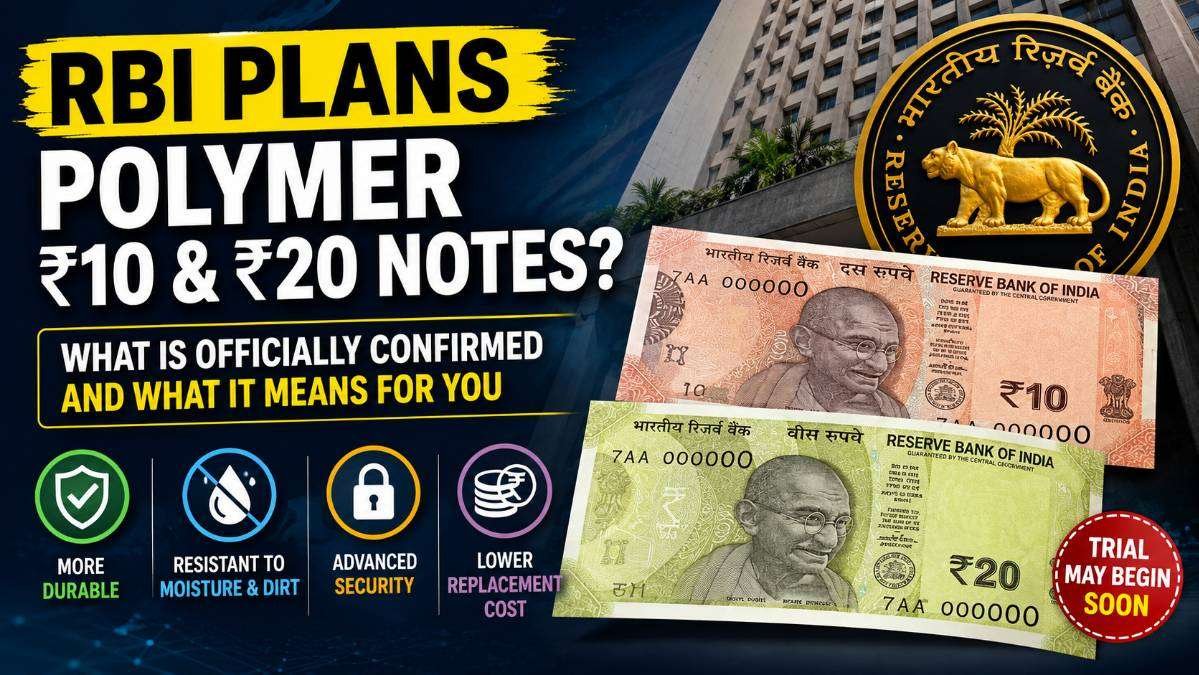
The Reserve Bank of India (RBI) is once again exploring the possibility of introducing polymer-based currency notes in the country. In recent days, several social media posts have claimed that the RBI will soon launch plastic ₹10 and ₹20 notes and that these notes could become available across India from 2027.
While these claims have attracted widespread attention, it is important to separate official information from speculation. Based on statements from the RBI and reports citing official developments, the central bank is indeed examining the use of polymer banknotes.
However, there has been no official announcement confirming a nationwide launch date or the withdrawal of existing paper currency. Here’s everything you need to know.
RBI Confirms Proposal Is Under Consideration
The most important official update came from RBI Governor Sanjay Malhotra during the Monetary Policy press conference held in June 2026. Responding to questions regarding polymer currency, the Governor stated that the proposal is currently under consideration and that the RBI is evaluating both the advantages and challenges before making a final decision.
This statement makes it clear that the project has not yet reached the implementation stage. Instead, it is still part of the RBI’s evaluation process, and no official launch timeline has been announced.
READ THIS: INDmoney Launches Free Income Tax Filing for AY 2026-27 Everything Investors Need to Know
Why Is RBI Considering Polymer Notes?
Polymer banknotes are made from a special plastic substrate instead of the traditional cotton-based paper used in Indian currency. Many countries, including Australia, Canada, New Zealand, the United Kingdom, Singapore and several others, have already adopted polymer notes because of their durability and enhanced security.
India’s ₹10 and ₹20 notes circulate heavily in daily transactions. Due to frequent handling, these denominations become dirty, torn and damaged much faster than higher-value notes. Replacing worn-out notes every year also increases printing and distribution costs.
By introducing polymer notes, the RBI hopes to improve the lifespan of lower denomination currency while reducing replacement expenses over time.
Benefits of Polymer Currency Notes
Polymer notes offer several practical advantages compared to conventional paper notes.
- They last significantly longer than paper notes.
- They are resistant to moisture, dust and dirt.
- They are more difficult to tear accidentally.
- Advanced security features make counterfeiting much harder.
- The overall cost of replacing damaged notes decreases over time despite higher initial production costs.
- They remain cleaner during circulation, making them more suitable for everyday transactions.
Because of these advantages, several central banks around the world have successfully shifted to polymer-based currency.
Why ₹10 and ₹20 Notes May Be Chosen First
Reports based on official procurement activities indicate that the RBI is likely to begin with ₹10 and ₹20 denominations if a pilot project moves forward.
These notes experience the highest circulation among lower denominations and usually require replacement much sooner than higher-value notes. Testing polymer technology on these denominations allows the RBI to study durability, public acceptance and operational challenges before considering wider adoption.
However, this remains part of the proposed pilot process and should not be interpreted as a confirmed rollout.
Has RBI Announced a Nationwide Launch in 2027?
No.
This is one of the biggest misconceptions currently circulating online. While several media reports suggest that polymer notes could eventually be introduced from 2027 if the pilot is successful, the RBI itself has not issued any official notification confirming this timeline.
Until an official circular, press release or notification is published by the Reserve Bank of India, any specific launch date should be treated as an estimate rather than a confirmed fact.
READ THIS: BSNL ₹1.34 Lakh Satellite Phone Price, Features and Full Details
Will Existing Paper Notes Become Invalid?
There is absolutely no official announcement stating that current ₹10 and ₹20 paper notes will become invalid.
Even if polymer notes are introduced in the future, both paper and polymer notes are expected to circulate together during the transition period. This approach has also been followed by several other countries that introduced polymer currency gradually instead of replacing all paper notes immediately.
Therefore, people should not worry about exchanging their existing currency or rushing to banks based on social media claims.
Preparatory Work Has Started
Recent reports indicate that RBI’s currency printing system has invited global suppliers to participate in the procurement process for polymer substrate containing advanced security features. This shows that preparatory work is progressing.
However, procurement activities alone do not mean that polymer notes have been approved for circulation. Before any new currency reaches the public, it must pass several stages including testing, production planning, security verification and regulatory approval.
Public Should Rely Only on Official Announcements
Currency-related news spreads rapidly on social media, especially when it concerns new banknotes. Unfortunately, incomplete or exaggerated information often creates unnecessary confusion.
Whenever there are major changes to Indian currency, the Reserve Bank of India publishes official notifications through its website, press releases and verified communication channels. Citizens should always verify such claims through official RBI announcements rather than relying solely on viral social media posts.
READ THIS: RBI Reveals Hidden ₹500 Note Feature How to Check the Latent Image
What Happens Next?
If the RBI decides to move ahead, the next stage would likely involve a controlled pilot project using ₹10 and ₹20 polymer notes in selected regions. The performance of these notes would then be evaluated under real-world conditions.
Based on the results, the RBI may decide whether to expand polymer currency to other denominations in the future. Since currency design and production involve extensive planning and security measures, the entire process may take considerable time before nationwide implementation.
Conclusion
The Reserve Bank of India has officially confirmed that the proposal to introduce polymer currency notes is under consideration. Preparatory work, including procurement activities for polymer substrates, indicates that the project is progressing. However, there is currently no official confirmation that polymer ₹10 and ₹20 notes will be launched across India in 2027, nor has the RBI announced the withdrawal of existing paper currency.
At present, citizens can continue using all existing ₹10 and ₹20 paper notes without any concern. Any future introduction of polymer currency will be officially communicated by the RBI through formal notifications. Until then, claims regarding confirmed launch dates or replacement of current notes should be viewed cautiously and verified through official sources.
About The Author