Afghanistan 6.2 Magnitude Earthquake: Delhi-NCR Tremors Explained with Official Facts
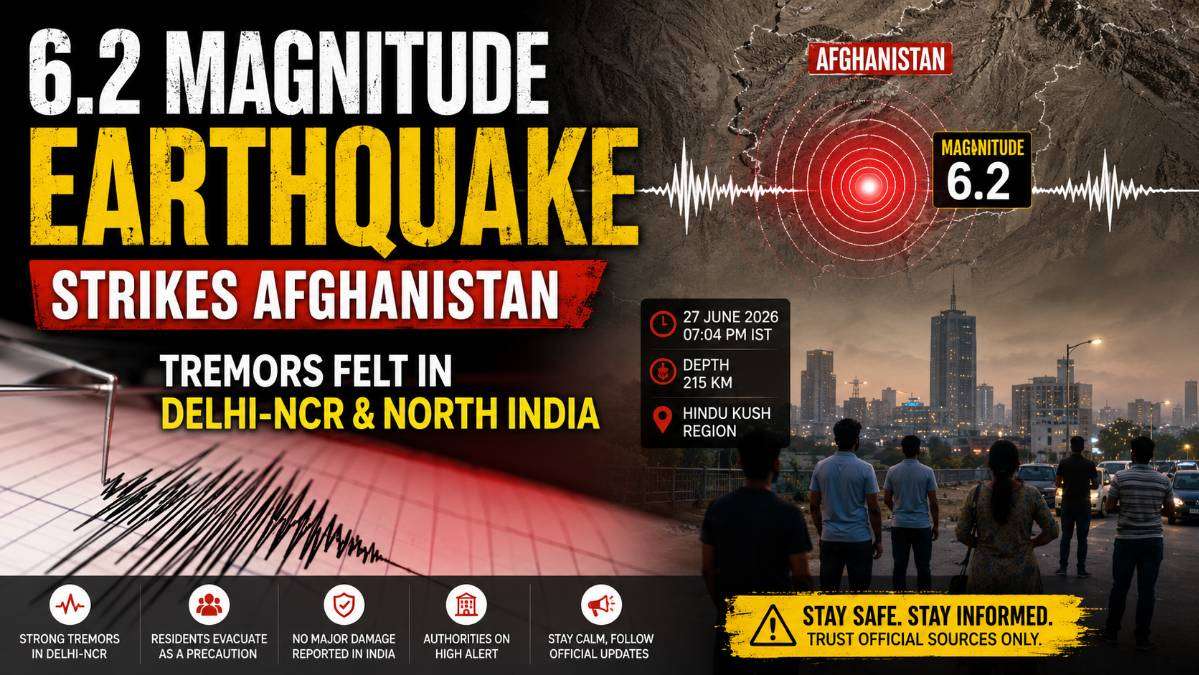
A strong earthquake measuring 6.2 on the Richter scale struck the Hindu Kush region of Afghanistan on the evening of June 27, 2026. The earthquake was confirmed by India’s National Centre for Seismology (NCS), while international monitoring agencies also detected the seismic event.
Although the epicentre was located inside Afghanistan, tremors were widely felt across northern India, including Delhi-NCR, Jammu and Kashmir, Punjab, Haryana, Himachal Pradesh, and several nearby regions.
The earthquake created temporary panic among residents, with many people leaving buildings as a precaution. Fortunately, there were no immediate reports of significant damage or casualties in India. Authorities continued monitoring the situation while urging people to remain calm and rely only on official information.
Official Details of the Earthquake
According to the National Centre for Seismology (NCS), the earthquake occurred at approximately 7:04 PM IST. The earthquake originated in Afghanistan’s Hindu Kush region at a depth of about 215 kilometres.
A deep-focus earthquake generally causes shaking across a wider geographical area than shallow earthquakes, which explains why tremors were experienced hundreds of kilometres away in northern India.
International earthquake monitoring agencies, including the United States Geological Survey (USGS) and the European-Mediterranean Seismological Centre (EMSC), also detected the seismic activity and confirmed the earthquake in the Afghanistan region.
Why Were Tremors Felt in Delhi-NCR?
Many people were surprised that an earthquake centred in Afghanistan could be felt in Delhi-NCR. The reason lies in both the earthquake’s magnitude and its depth.
Deep earthquakes release seismic waves that can travel long distances through the Earth’s interior. While deep earthquakes often produce less surface destruction near the epicentre than shallow earthquakes, they can still be felt over a much larger area.
Delhi-NCR is also located within a seismically active zone influenced by the Himalayan tectonic system. Because of this geological setting, residents occasionally experience tremors from earthquakes occurring in neighbouring countries such as Afghanistan, Pakistan, and Nepal.
READ THIS: Tamil Nadu 1 Gram Gold Ring Scheme for Newborns: Official Rules, Eligibility & Complete Details
Impact Across Northern India
Residents in several northern Indian cities reported light to moderate shaking. Office buildings, apartments, shopping centres, and residential complexes experienced noticeable tremors for a short period.
As a precaution, many people evacuated buildings and gathered in open spaces until the shaking stopped. Emergency services remained on alert, but no widespread structural damage was immediately reported.
Government agencies continued to monitor the situation throughout the evening while collecting information from state disaster management authorities.
Situation in Afghanistan
The earthquake originated in Afghanistan’s mountainous Hindu Kush region, an area known for frequent seismic activity. The region lies where the Indian and Eurasian tectonic plates interact, making earthquakes relatively common.
Initial official assessments indicated that authorities were evaluating the affected areas. At the time of reporting, there were no confirmed reports of major casualties directly linked to this particular 6.2 magnitude earthquake. Damage assessments continued as emergency teams gathered information from remote mountainous districts.
READ THIS: BIS-Certified Helmet Rules in India 2026 Official MoRTH & BIS Guidelines
False Information Shared Online
Following the earthquake, several social media posts and edited graphics circulated online claiming that the earthquake had caused hundreds of deaths in unrelated countries or linking it with old disaster photographs.
One widely shared image incorrectly claimed that more than 900 people had died in Venezuela because of the same earthquake. This information was not supported by official government agencies or internationally recognised news organisations. The claim mixed separate earthquake events and created confusion.
Fact-checking shows that people should avoid relying on viral social media graphics without verification. Official government agencies and trusted news organisations remain the best sources of emergency information.
What Should You Do During an Earthquake?
Earthquakes often occur without warning, making preparedness essential. Safety experts recommend following these steps:
- Stay calm and avoid panic.
- Drop to the ground, take cover under sturdy furniture, and hold on until the shaking stops.
- Stay away from windows, mirrors, and heavy objects that may fall.
- If outdoors, move to an open area away from buildings, trees, and power lines.
- Do not use elevators during or immediately after an earthquake.
- Follow instructions issued by local authorities and disaster management agencies.
- Keep an emergency kit with drinking water, medicines, flashlight, and important documents.
Importance of Official Sources
During natural disasters, misinformation spreads rapidly. Citizens should always verify information through official agencies such as:
- National Centre for Seismology (NCS)
- National Disaster Management Authority (NDMA)
- India Meteorological Department (IMD)
- United States Geological Survey (USGS)
- European-Mediterranean Seismological Centre (EMSC)
These organisations provide scientifically verified information about earthquake magnitude, epicentre, depth, aftershocks, and safety guidance.
Conclusion
The 6.2 magnitude earthquake that struck Afghanistan on June 27, 2026, was a significant seismic event that produced noticeable tremors across Delhi-NCR and several parts of northern India.
Thanks to its deep focus, the earthquake was felt over a wide region despite its epicentre being hundreds of kilometres away. Fortunately, no major damage or casualties were immediately reported in India.
The event also highlighted the importance of depending on verified information rather than unconfirmed social media posts. During emergencies, official scientific agencies and trusted news organisations provide the most reliable updates.
Staying informed, remaining prepared, and following earthquake safety guidelines are the best ways to protect ourselves and our communities during future seismic events.
About The Author