Dr. Bhimrao Ramji Ambedkar occupies a unique place in India’s constitutional and social history. He is widely remembered as the Chairman of the Drafting Committee of the Constitution of India, but his contribution extended far beyond constitution-making.
As the first Law Minister of independent India, Dr. Ambedkar worked towards introducing legal reforms that would provide equal rights and justice to millions of Indians, particularly women and marginalized communities.
One of the most significant reforms associated with Dr. Ambedkar was the Hindu Code Bill. The proposed legislation sought to modernize Hindu personal laws by introducing legal rights that had previously been denied to many women.
Although the Bill faced strong political and social opposition during its initial stages, it became one of the defining issues of Ambedkar’s tenure as Law Minister.
This article is based entirely on information available in official government publications, archival records and historical documents. It explains the historical background, the objectives of the Hindu Code Bill and Dr. Ambedkar’s role in advocating legal reforms for women.
Dr. B.R. Ambedkar as Independent India’s First Law Minister
After India gained independence on 15 August 1947, Prime Minister Jawaharlal Nehru formed the country’s first Cabinet. Dr. B.R. Ambedkar was appointed as the first Law Minister of independent India. His appointment reflected his exceptional legal knowledge, constitutional expertise and lifelong commitment to social justice.
At the same time, Dr. Ambedkar served as the Chairman of the Drafting Committee responsible for preparing the Constitution of India. His leadership played an essential role in shaping democratic institutions, guaranteeing fundamental rights and ensuring equality before the law.
The official biography published by the Government of India’s Dr. Ambedkar Foundation highlights his contribution as Law Minister and explains that his efforts were directed towards creating laws that would promote equality and social reform.
The Need for Reform in Hindu Personal Laws
During the years immediately after Independence, many aspects of Hindu personal law were governed by customs and traditional legal practices that varied across different regions of India. These laws affected issues such as marriage, divorce, inheritance, adoption and property rights.
Women often faced significant legal disadvantages under the existing system. In many situations, daughters and widows did not enjoy equal inheritance rights. Divorce provisions were extremely limited, and legal protection for women within family law remained inadequate.
Recognising these inequalities, the Government of India began considering comprehensive reforms that would modernize Hindu personal laws and bring them closer to the constitutional principles of equality and justice.
What Was the Hindu Code Bill?
The Hindu Code Bill was a comprehensive proposal intended to reform Hindu personal law. Rather than focusing on a single issue, it attempted to create a modern legal framework covering several important areas of family law.
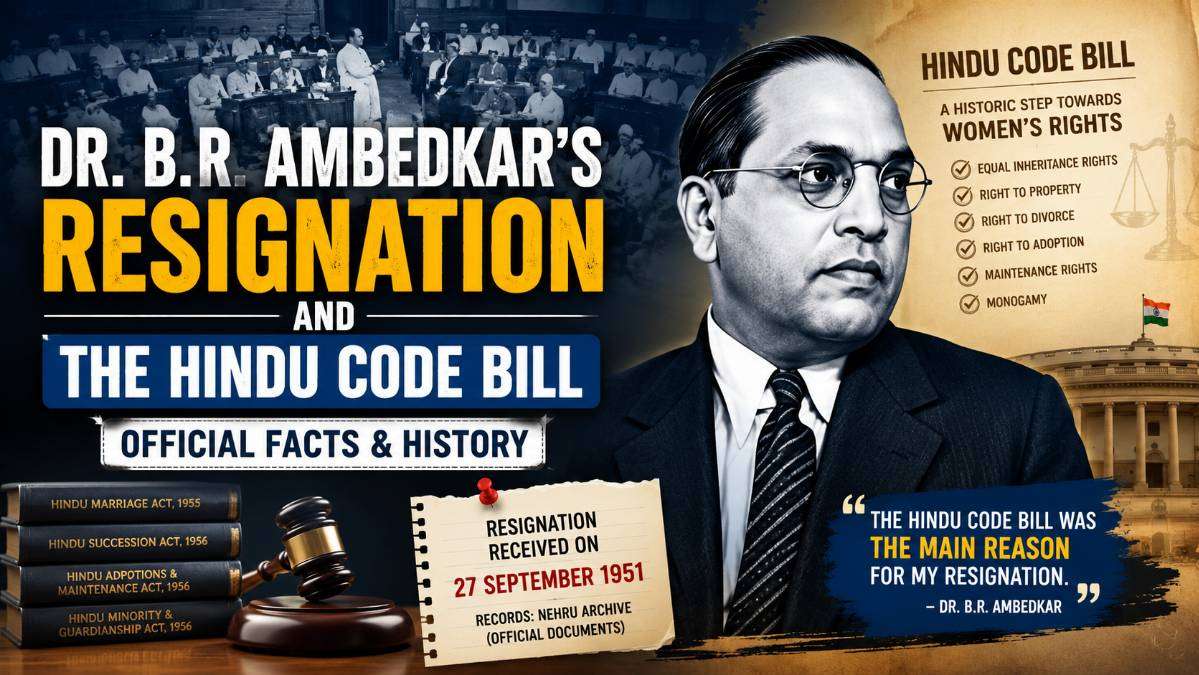
According to official government publications and historical records, the Bill proposed reforms relating to:
- Property and inheritance rights for women.
- Equal legal recognition for daughters in matters of succession.
- Rights relating to marriage.
- Legal provisions governing divorce.
- Rules relating to adoption.
- Maintenance and family responsibilities.
- Promotion of monogamy under Hindu law.
These proposals represented one of the most ambitious legal reform programmes undertaken during the early years of independent India.
Dr. Ambedkar’s Vision for Women’s Rights
Dr. Ambedkar firmly believed that political independence alone would not be sufficient unless it was accompanied by social equality and legal justice. Throughout his public life, he consistently argued that women should enjoy equal legal rights and opportunities.
His approach to the Hindu Code Bill reflected this broader vision. Instead of treating women’s rights as a separate issue, he viewed them as an essential part of building a democratic society governed by constitutional values.
One of the major objectives of the proposed legislation was to provide women with greater legal protection in family matters. The Bill sought to improve inheritance rights, recognise legal remedies relating to marriage and divorce and strengthen the legal status of women within the family.
These reforms were considered highly progressive during the early 1950s and generated widespread public debate across the country.
READ THIS: Indian Constitution Day : History Facts Untold Stories
Why the Hindu Code Bill Became Controversial
Although many reformers welcomed the proposed legislation, the Hindu Code Bill also faced significant opposition from several political leaders, religious organisations and sections of society.
Critics argued that such extensive reforms should not be introduced so soon after Independence. Others believed that traditional personal laws should remain unchanged. As parliamentary discussions continued, disagreements emerged over various provisions of the Bill.
Because of these differences, the legislative process became increasingly slow. Several portions of the Bill were postponed, reconsidered or delayed during parliamentary proceedings.
The prolonged delay deeply disappointed Dr. Ambedkar, who believed that legal reform for women should remain one of the highest priorities of independent India.
Parliamentary Discussions
Official historical records show that discussions relating to the Hindu Code Bill took place in Parliament over an extended period. The Bill received detailed examination and generated extensive debate because of its far-reaching impact on family law.
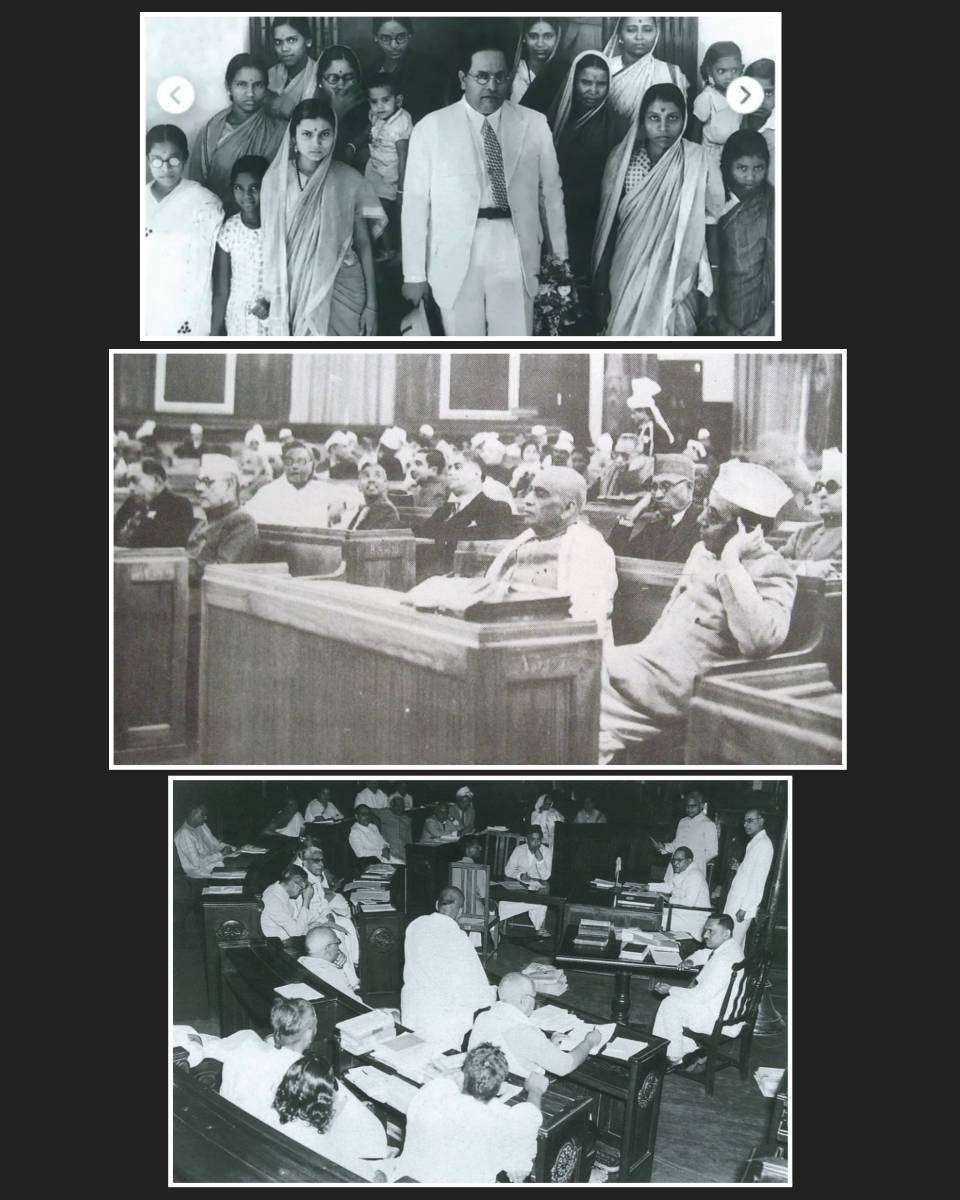
Sources: Prime Ministers’ Museum & Library (PMML, formerly Nehru Memorial Museum & Library), Government of India; Dr. Babasaheb Ambedkar: Writings and Speeches (BAWS), Government of India; Public domain historical archival photographs.
Government records indicate that considerable parliamentary time was devoted to discussing different clauses of the Bill. However, despite these discussions, progress remained slow and many provisions failed to move forward as originally expected.
The delays eventually became one of the most significant political issues during Dr. Ambedkar’s tenure as Law Minister.
Historical Importance of the Proposed Reforms
Even though the original Hindu Code Bill did not become law in its initial form, historians widely regard it as one of the most important social reform initiatives in modern Indian history.
The proposals reflected an effort to harmonize personal laws with the constitutional principles of equality, justice and dignity. They also demonstrated the Government’s attempt to modernize family law in accordance with democratic values established by the Constitution of India.
Dr. Ambedkar considered these reforms central to India’s progress as a constitutional democracy. His commitment to legal equality became one of the defining features of his public life.
READ THIS: Why Article 370 Was Removed from Indian Constitution: Official Reasons
The Events That Led to Dr. Ambedkar’s Resignation
By 1951, the Hindu Code Bill had become one of the most debated legislative proposals in independent India. Although the Bill had been introduced with the intention of modernizing Hindu personal laws, it encountered repeated delays in Parliament. Several provisions were discussed at length, while others were postponed or set aside because of political disagreements and differing opinions among members.
Dr. B.R. Ambedkar believed that the reforms proposed in the Hindu Code Bill were essential for creating a more equal society. He was disappointed that despite considerable discussion, the Bill was not receiving the priority he believed it deserved. As Law Minister, he had devoted significant effort to drafting and defending the proposed legislation, making its slow progress a matter of deep concern.
Official archival records show that Ambedkar considered the treatment of the Hindu Code Bill to be one of the principal reasons for leaving the Union Cabinet. His resignation reflected his belief that meaningful legal reform should not be postponed indefinitely.
What Did Dr. Ambedkar Say in His Resignation Statement?
One of the most reliable historical sources is Dr. Ambedkar’s own resignation statement, preserved in the Government of India’s publication Dr. Babasaheb Ambedkar: Writings and Speeches (BAWS). In this statement, Ambedkar explained the circumstances that led to his decision.
He referred to several concerns during his tenure in the Cabinet, including administrative and policy matters. However, he made it clear that the handling of the Hindu Code Bill had become the most important issue influencing his decision to resign. He expressed disappointment that a reform he regarded as fundamental to social justice had not been carried forward with the urgency he expected.
The resignation statement remains one of the most important primary historical documents for understanding this period of India’s legislative history.
Clarifying the Date Mentioned in Viral Social Media Posts
Many social media posts and images claim that Dr. B.R. Ambedkar resigned as Law Minister on 14 July 1951. However, official historical records do not support this specific date.
Documents preserved by the Prime Ministers’ Museum & Library (formerly the Nehru Memorial Museum & Library) show that the resignation process took place during late September 1951.
Correspondence between Prime Minister Jawaharlal Nehru and Dr. Ambedkar confirms that the resignation letter was received on 27 September 1951. Ambedkar’s resignation statement was later associated with parliamentary proceedings in October 1951.
Therefore, while the broader claim that Ambedkar resigned largely because of the fate of the Hindu Code Bill is supported by official records, the date displayed in many viral posts is not confirmed by those official documents.
READ THIS: Why Dr BR Ambedkar Loved Blue Color Meaning, Symbolism & History
What Happened After His Resignation?
Although Dr. Ambedkar left the Cabinet, the debate over reforming Hindu personal laws did not end. The Government continued examining the issues addressed in the original Hindu Code Bill.
Instead of passing one comprehensive law, Parliament later divided the proposals into separate pieces of legislation. Between 1955 and 1956, several landmark Acts were enacted that incorporated many of the reforms originally proposed by Ambedkar.
- Hindu Marriage Act, 1955
- Hindu Succession Act, 1956
- Hindu Minority and Guardianship Act, 1956
- Hindu Adoptions and Maintenance Act, 1956
These laws significantly changed Hindu personal law and introduced important legal protections relating to marriage, inheritance, adoption, guardianship and maintenance. Many historians regard these Acts as carrying forward several objectives that had been included in the original Hindu Code Bill.
The Long-Term Significance of the Hindu Code Bill
The Hindu Code Bill occupies a special place in India’s legal history because it represented one of the earliest attempts to align family law with the constitutional principles of equality, justice and dignity.
Although the original Bill was never enacted as a single law, its influence continued to shape later legislation. The reforms introduced during the mid-1950s expanded legal rights for women and modernized several aspects of Hindu personal law.
Dr. Ambedkar’s efforts demonstrated his belief that constitutional democracy required not only political rights but also legal and social equality within everyday family life.
READ THIS: Bhima Koregaon History: Why January 1 Is a Symbol of Dalit Pride and Indian Constitutional Values
Understanding the Historical Record Carefully
Historical events are often simplified on social media. While short posts and images may highlight an important aspect of history, they sometimes omit important context or present inaccurate dates.
For this reason, historians rely on primary documents such as government publications, parliamentary debates and official archival correspondence. These records provide a clearer understanding of why Dr. Ambedkar resigned and how the Hindu Code Bill influenced one of the most significant political decisions of his career.
Based on these official records, it is accurate to say that Ambedkar strongly supported legal reforms for women and that dissatisfaction over the treatment of the Hindu Code Bill played a central role in his resignation. However, claims regarding the exact date should always be verified using official historical sources.
Conclusion
Dr. B.R. Ambedkar’s contribution to independent India extended far beyond drafting the Constitution. As the nation’s first Law Minister, he sought to introduce comprehensive legal reforms through the Hindu Code Bill, believing that equality before the law should include equal rights for women within the family.
The Bill proposed major reforms relating to inheritance, marriage, divorce, adoption and maintenance. Although political disagreements delayed its progress, Ambedkar’s own resignation statement makes it clear that the handling of the Hindu Code Bill became a principal reason for his resignation from the Union Cabinet.
Official historical records also clarify an important point frequently misunderstood on social media. While the connection between Ambedkar’s resignation and the Hindu Code Bill is well documented, the widely circulated claim that he resigned on 14 July 1951 is not supported by official archival evidence.
Instead, official correspondence places the resignation process in late September 1951, with parliamentary discussion taking place in October 1951.
Today, many of the principles that Ambedkar advocated through the Hindu Code Bill survive in the Hindu law reforms enacted during 1955 and 1956. His vision of justice, equality and legal protection for women continues to influence Indian law and remains an important part of the country’s democratic history.
Official References
- Dr. Ambedkar Foundation, Ministry of Social Justice & Empowerment, Government of India – Official Biography of Dr. B.R. Ambedkar.
- Dr. Babasaheb Ambedkar: Writings and Speeches (BAWS), Volume 14, Government of India – Resignation Statement and documents relating to the Hindu Code Bill.
- Prime Ministers’ Museum & Library (formerly Nehru Memorial Museum & Library) – Official archival correspondence concerning Dr. B.R. Ambedkar’s resignation and the Hindu Code Bill.
- Parliament of India historical legislative records relating to debates on the Hindu Code Bill.
About The Author