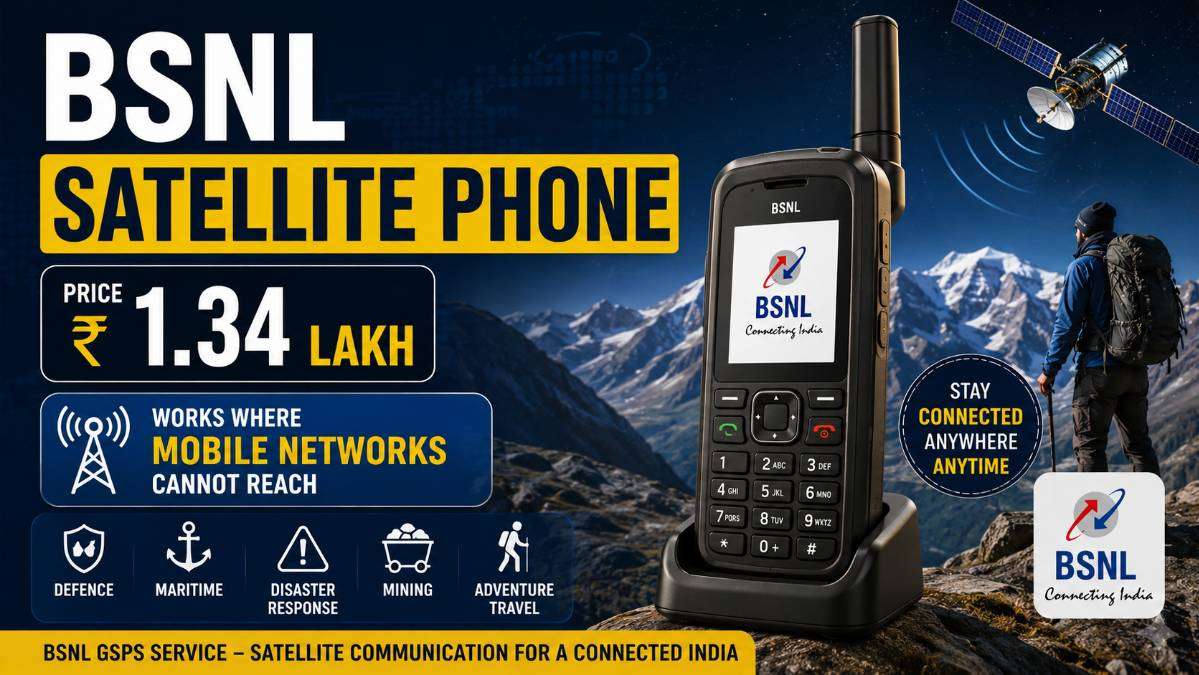
Staying connected is easy in cities and towns where mobile towers are available almost everywhere. However, the situation can be completely different in remote mountains, deep forests, offshore areas and locations affected by natural disasters.
In such places, a normal mobile phone may become useless when there is no cellular network. Satellite communication is designed to address this connectivity gap.
Bharat Sanchar Nigam Limited, commonly known as BSNL, has announced the availability of a satellite phone priced at ₹1,34,166, including applicable taxes, according to information reported about the device.
Unlike an ordinary smartphone or feature phone that depends mainly on nearby mobile towers, a satellite phone can connect through a satellite communication network. This makes it useful in areas where conventional mobile network coverage is unavailable.
The announcement has attracted attention because satellite phones are not devices that most people use in their everyday lives. They are generally associated with specialised communication requirements, emergency operations and remote locations. The high price of the device also clearly places it in a different category from regular consumer mobile phones.
READ THIS: Instagram Public Photos Can Now Be Used for Meta AI Images How to Turn It Off
What Is the BSNL Satellite Phone?
A satellite phone is a communication device that uses satellite connectivity instead of relying entirely on terrestrial mobile towers. A regular mobile phone normally searches for a nearby cellular base station operated by a telecom company. If there is no supported tower or network signal in the area, calls and messages may not work.
Satellite communication follows a different approach. The device communicates through a supported satellite network, allowing communication in certain remote areas where traditional cellular infrastructure cannot provide coverage.
BSNL already provides Global Satellite Phone Service, also known as GSPS. Therefore, it would be inaccurate to say that BSNL has introduced satellite communication services in India for the first time with this particular device. The recent development is better described as BSNL announcing or highlighting the availability of a satellite phone priced at approximately ₹1.34 lakh.
This distinction is important because social media headlines can sometimes create the impression that an entirely new satellite network has suddenly been launched. BSNL’s satellite communication services already existed. The latest attention is focused on the satellite phone device, its price and its potential use in areas without normal mobile coverage.
BSNL Satellite Phone Price in India
The reported price of the satellite phone is ₹1,34,166, inclusive of taxes. This is significantly more expensive than most smartphones available in the Indian market.
However, comparing a satellite phone directly with a normal smartphone may not be appropriate. Modern smartphones are designed for internet browsing, social media, photography, applications, entertainment and regular mobile communication.
A satellite phone is primarily built for reliable communication in specialised situations where normal cellular connectivity may not be available.
The purchase price of the handset should also not be confused with unlimited communication services. Satellite calling and messaging services can have separate plans, included usage limits and additional charges.
Users or organisations interested in the service should verify the latest tariff, eligibility requirements and activation process directly through BSNL and relevant official channels before making a decision.
How Does a Satellite Phone Work Without a Mobile Network?
Normal mobile communication depends heavily on ground-based infrastructure. Telecom operators install mobile towers and other network equipment to provide coverage. A user’s phone connects to this infrastructure when making calls, sending messages or using mobile data.
The problem becomes clear in extremely remote locations. Installing and maintaining mobile towers in mountains, isolated islands, offshore regions or sparsely populated areas can be technically difficult and expensive. Natural disasters may also damage existing communication infrastructure and temporarily disconnect affected regions.
A supported satellite phone can establish communication through a satellite network instead of depending on a nearby conventional mobile tower. This is the main reason such devices are considered valuable for remote and emergency communication.
However, satellite phones are not magic devices that guarantee perfect communication in every possible environment. Satellite visibility, service conditions, authorised network access and other technical factors can affect connectivity. Users must follow the applicable service instructions and legal requirements.
Who Can Benefit from Satellite Communication?
Satellite phones are generally more relevant to organisations, professionals and individuals who regularly operate beyond the reach of standard mobile networks.
Defence and security operations may require communication in remote locations where cellular infrastructure is limited. Maritime users can face similar challenges while operating away from coastal mobile coverage.
Disaster response teams may also need alternative communication systems when floods, cyclones, earthquakes or other emergencies damage normal telecom infrastructure.
Mining operations are often located in isolated areas. Remote project teams, field workers and organisations operating in difficult terrain may also need reliable communication alternatives. Adventure travellers and certain groups travelling through remote regions may find satellite connectivity useful when normal mobile signals are unavailable.
Pilgrimage routes can also pass through mountainous or difficult terrain where network coverage may be inconsistent. In such situations, satellite communication can provide an additional communication option, subject to service availability and applicable rules.
READ THIS: Apple Increases Prices of Macs, iPads & More in India iPhone Prices Remain Unchanged
Can the General Public Use BSNL Satellite Phone Services?
Official government information released in February 2026 stated that BSNL provides Global Satellite Phone Service voice call and SMS facilities to the general public and private enterprises, in addition to relevant government users, under the applicable service framework.
This is an important point because satellite phones have often been viewed as devices used only by government departments, defence agencies or specialised organisations. Official information indicates broader service categories, but that does not mean a person should simply purchase an unknown satellite phone from an unofficial seller and start using it.
Satellite communication equipment and services are subject to applicable rules, procedures and authorised service conditions in India. Anyone planning to obtain such a service should use official channels and confirm the current documentation, subscription process, device availability and tariff details.
Satellite Calling Is Not the Same as Normal BSNL Mobile Calling
One of the biggest misunderstandings surrounding this news is the assumption that the ₹1.34 lakh satellite phone works like a normal BSNL mobile phone with regular unlimited calling plans.
BSNL’s Global Satellite Phone Service is a specialised service. Official government information has referred to separate GSPS plans and usage charges. The tariff structure can differ based on the customer category and selected service plan.
For example, government information published in February 2026 mentioned additional call and SMS charges after included usage under certain plans. The listed charges included ₹18 per minute or SMS for government customers and ₹25 per minute or SMS for commercial customers under the relevant tariff details.
Tariffs and service conditions can be updated. Therefore, customers should always check the latest official BSNL information before purchasing a device or subscribing to a satellite communication service.
Why Is the Satellite Phone So Expensive?
The price may surprise many people, especially when high-end smartphones are available in the same price range. However, satellite phones serve a very different purpose.
The technology, network infrastructure and specialised nature of satellite communication contribute to the overall cost. These devices are also produced for a smaller and more specialised market compared with mass-market smartphones that are manufactured and sold in millions of units.
For an ordinary mobile user living in a city with reliable 4G or 5G coverage, buying a satellite phone may not make practical sense. For an organisation operating in a remote mining area, a maritime team or an emergency response unit, the ability to communicate beyond normal mobile coverage can be far more important than smartphone features such as cameras, gaming performance or social media applications.
READ THIS: RBI Reveals Hidden ₹500 Note Feature How to Check the Latent Image
Why This Development Is Important for India
India has a vast and geographically diverse landscape. While mobile connectivity has expanded significantly, providing uninterrupted terrestrial network coverage in every remote location remains challenging.
Satellite communication can support connectivity requirements in places where building conventional telecom infrastructure is difficult. It can also provide an important communication option during emergencies when ground networks are disrupted.
The growing public discussion around BSNL’s satellite phone also helps people understand that mobile towers are not the only way to establish long-distance communication. Satellite-based services have a specialised role in defence, disaster management, maritime operations and remote field activities.
At the same time, consumers should be careful about exaggerated claims on social media. The device should not be promoted as a replacement for every smartphone or as a cheap way to get network coverage everywhere. It is a specialised communication product connected to a specialised service.
Conclusion
BSNL’s ₹1,34,166 satellite phone has gained attention because it can support communication in areas where conventional mobile networks may not reach. The device uses satellite-based communication and is particularly relevant for defence, maritime activities, disaster response, mining, remote operations and other specialised use cases.
However, the news needs to be understood with the correct context. BSNL’s Global Satellite Phone Service already existed, so it is misleading to describe this as India’s first-ever launch of BSNL satellite communication. The recent development is better presented as the availability or announcement of a satellite phone priced at approximately ₹1.34 lakh.
The handset price also does not mean users receive unlimited satellite calls. Service plans, call charges, SMS charges, activation procedures and applicable rules must be considered separately. Anyone interested in the device should verify the latest details through official BSNL and Government of India sources.
For most everyday mobile users, a regular smartphone and cellular network will continue to be the practical choice. However, in locations where mobile towers cannot provide connectivity, satellite communication can play an important and sometimes critical role. That is what makes BSNL’s satellite phone an interesting development in India’s specialised telecom and remote communication sector.
About The Author