Supreme Court Declines Urgent Hearing on Student Protest Plea What CJI Surya Kant Actually Said
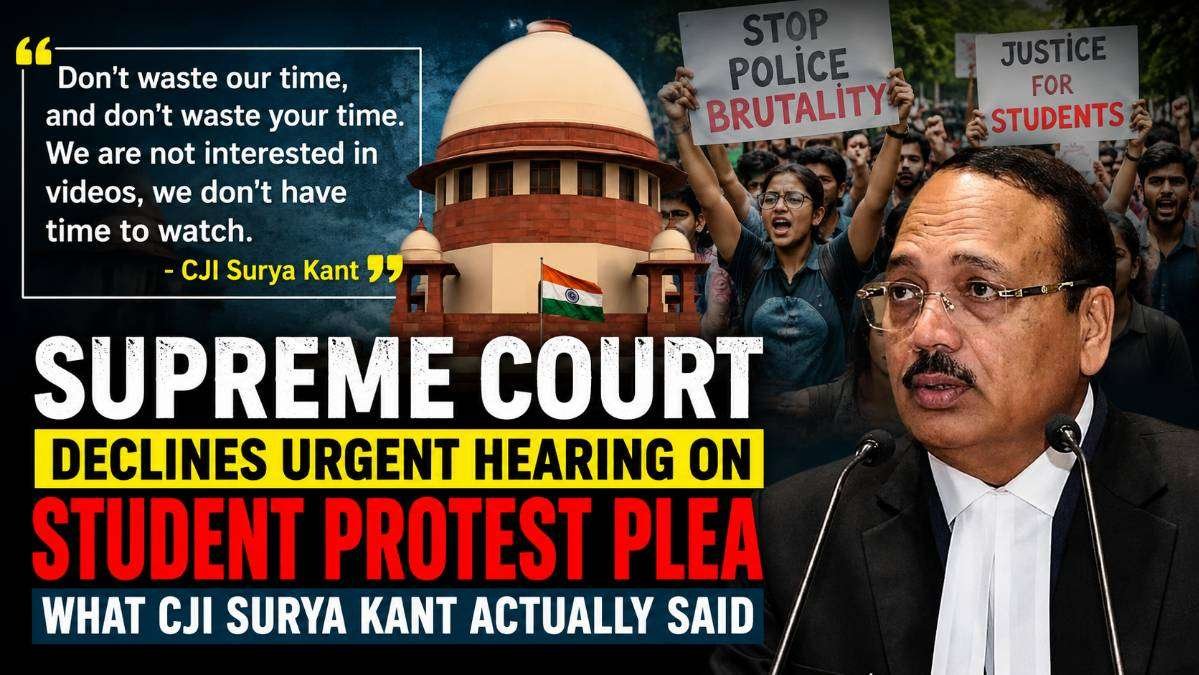
The Supreme Court of India was at the center of public discussion after Chief Justice of India (CJI) Surya Kant made remarks during the mentioning of a petition seeking an urgent hearing over alleged police action against student protesters.
A short video clip and quote from the courtroom quickly went viral on social media, leading to widespread debate and different interpretations of what was actually said.
Several social media posts highlighted only one part of the exchange, quoting the Chief Justice as saying, “Don’t waste our time, and don’t waste your time.
We are not interested in videos; we don’t have time to watch.” While these words were indeed spoken during the hearing, understanding the complete context is essential before drawing conclusions.
What Was the Petition About?
The petition was mentioned before the Supreme Court seeking an urgent hearing regarding allegations of police action against student protesters during a demonstration connected to the NEET issue.
The petitioners argued that the matter required immediate judicial intervention and informed the Court that video recordings of the incident were available. The lawyers requested that the case be listed urgently, citing the seriousness of the allegations and the need for timely judicial consideration.
READ THIS: PM Modi Assures Strict Action on NEET-UG 2026 Paper Leak, Says Students Future Will Be Protected
What Happened During the Hearing?
During the mentioning of the matter, the Bench led by Chief Justice Surya Kant heard the request for urgent listing. As the petitioner’s counsel referred to video evidence, the Chief Justice responded that the Court was not interested in watching videos at that stage and asked the lawyer not to waste the Court’s time.
The Bench eventually declined to grant an urgent hearing. Importantly, this decision was related only to the request for immediate listing of the case. The Court did not pronounce any judgment on the truth or falsity of the allegations made in the petition.
The Viral Quote and Its Context
The remarks that circulated widely on social media were genuine. However, many posts shared only a portion of the courtroom conversation without explaining the circumstances in which the statements were made.
The Chief Justice’s comments were made while deciding whether the matter required urgent listing before the Court. They were not a general observation that courts refuse to examine video evidence in judicial proceedings.
In many cases, Indian courts regularly examine video recordings, CCTV footage, digital evidence, and electronic records whenever they become relevant during the hearing of a case. Therefore, the viral quote should not be interpreted as a rejection of video evidence in general.
Reactions Following the Hearing
The courtroom exchange attracted significant attention across legal circles, social media platforms, and political discussions. Some opposition leaders and activists expressed disappointment, arguing that allegations involving student protesters deserved urgent judicial attention.
On the other hand, several legal experts pointed out that deciding whether a case deserves urgent listing is entirely within the discretion of the Court. They emphasized that declining an urgent hearing does not amount to dismissing the petition itself or deciding the merits of the allegations.
Understanding Urgent Listing in the Supreme Court
Every day, the Supreme Court receives numerous requests seeking urgent hearings. The Bench evaluates each request based on its urgency, legal necessity, and available judicial time.
Not every petition is listed immediately. In many instances, matters are scheduled according to the Court’s regular procedure unless exceptional circumstances justify urgent intervention.
Therefore, refusing urgent listing should not automatically be viewed as the Court refusing to hear the matter permanently. It simply means that the Bench did not find sufficient grounds to treat the matter as requiring immediate hearing at that particular moment.
Why Context Matters
Social media often spreads short clips or isolated quotations that may not fully explain what happened inside a courtroom. Judicial proceedings usually involve detailed legal arguments, procedural discussions, and context that cannot be captured through a single sentence.
When only one statement is shared without explaining the surrounding discussion, it can create misunderstandings among the public. Reading verified reports from established legal news organizations and official court records provides a more accurate understanding of such events.
Conclusion
The remarks attributed to Chief Justice Surya Kant are authentic and were made during a Supreme Court hearing. However, they were delivered while considering a request for an urgent hearing, not while deciding the actual merits of the petition or rejecting video evidence as a legal principle.
The Supreme Court’s decision was limited to declining urgent listing of the matter. No findings were made regarding the allegations against the police, and the viral social media posts often omit this important procedural context.
As public interest in judicial proceedings continues to grow, it is essential to rely on verified legal reporting and understand the full context before forming opinions. Accurate information helps preserve public trust and encourages informed discussion on matters of national importance.
About The Author