India Planned World’s Highest Cricket Stadium in Ladakh: Official Facts, Location & Project Status
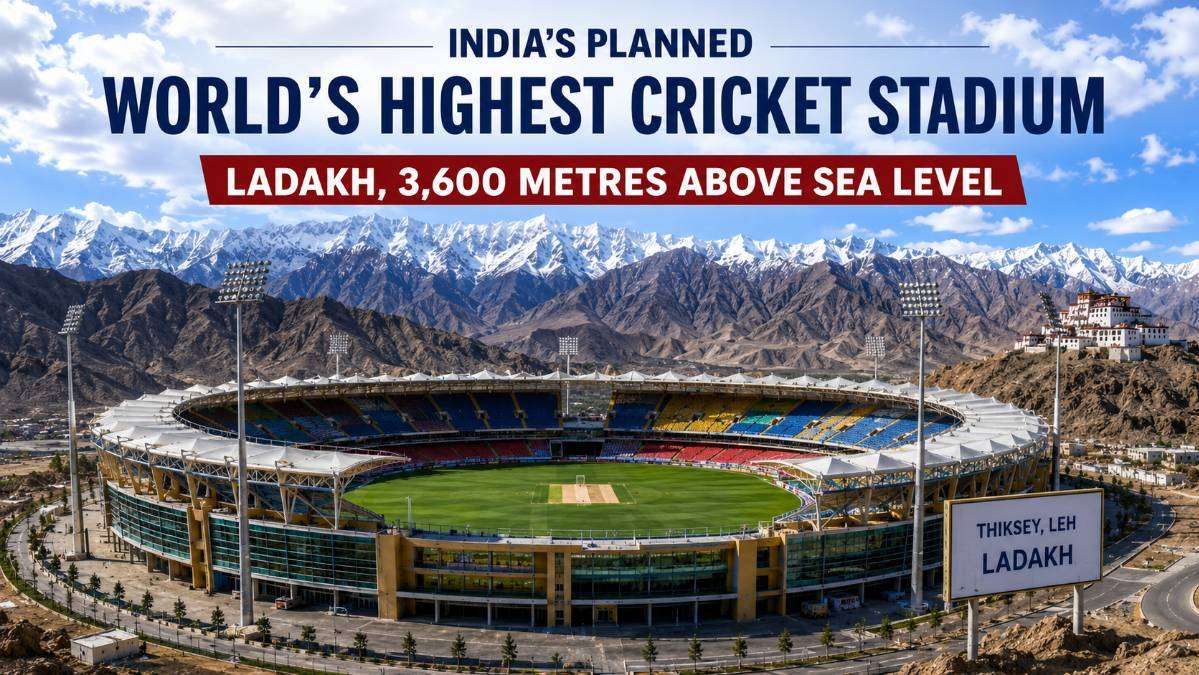
India is moving forward with plans to establish what is expected to become the world’s highest cricket stadium in the Union Territory of Ladakh. According to official announcements by the Ladakh Administration, the proposed international-standard stadium will be developed near Thiksey in Leh district at an altitude of approximately 3,600 metres (11,800 feet) above sea level.
The project has attracted nationwide attention because it has the potential to surpass the existing highest cricket ground located in Pissan Valley. However, official records also make it clear that the stadium is currently a proposed development and has not yet been completed or inaugurated.
Official Project Announcement
The proposal was highlighted by the Administration of the Union Territory of Ladakh during the inauguration of several sports infrastructure projects in Leh. Officials stated that the new cricket stadium is intended to meet international standards while encouraging sporting activities among young athletes living in the Himalayan region.
The administration described the project as part of a broader strategy to improve sports infrastructure across Ladakh. Alongside the proposed cricket stadium, authorities have invested in football grounds, synthetic athletic tracks, indoor sports facilities and training infrastructure designed to support local athletes.
READ THIS: Apple Increases Prices of Macs, iPads & More in India iPhone Prices Remain Unchanged
Location and Planned Features
The stadium has been proposed near Thiksey, approximately 20 kilometres from Leh city. At nearly 3,600 metres above sea level, the venue would become one of the most unique cricket facilities anywhere in the world because of its high-altitude location surrounded by the Himalayan mountain range.
Officials have indicated that the stadium will be developed as an international-standard cricket venue capable of hosting domestic and potentially international matches after completion, subject to approvals from the relevant cricket authorities.
The estimated project cost has been reported at approximately ₹100 crore to ₹116 crore in official statements and government communications.
READ THIS: Today Chess News 2026 Praggnanandhaa Triumphs, Magnus Carlsen Struggles & India Chess Rise
Why the Altitude Matters
High-altitude sports venues present unique opportunities and engineering challenges. The thinner air at elevations above 3,500 metres affects player endurance, ball movement and overall athletic performance. Construction also requires specialized planning because of harsh winters, freezing temperatures and shorter working seasons.
If completed according to the proposed design, the stadium would become the highest cricket venue in the world, overtaking the cricket ground in Pissan Valley.
Current Status of the Project
Although the announcement has generated significant public interest, official information indicates that the stadium remains a planned infrastructure project.
- Construction has not yet been officially declared complete.
- No inauguration date has been announced.
- No official schedule for hosting cricket matches has been released.
- The project continues to be part of Ladakh’s long-term sports infrastructure development plan.
Any claims suggesting that the stadium is already operational are not supported by official government announcements.
Sports Development in Ladakh
The proposed stadium reflects the administration’s broader effort to strengthen sports facilities in the region. In recent years, Ladakh has witnessed the development of synthetic football grounds, athletic tracks, indoor sports complexes and youth training centres aimed at increasing participation in organized sports.
Officials believe that improved infrastructure can encourage greater involvement in cricket, football, athletics and winter sports while creating opportunities for athletes from remote Himalayan communities.
Engineering Challenges
Building a modern cricket stadium at such a high altitude requires careful planning. Engineers must consider ground stability, snowfall, temperature variations, transportation of construction materials and long-term maintenance requirements.
The region’s climate also limits the construction season, making project scheduling more complex than similar developments in lower-altitude locations.
What Has Been Officially Verified
- The Ladakh Administration has officially announced plans for an international-standard cricket stadium.
- The proposed location is near Thiksey in Leh district.
- The planned altitude is approximately 3,600 metres above sea level.
- The stadium is expected to become the world’s highest cricket stadium after completion.
- The project is not yet complete and has not been inaugurated.
READ THIS: BIS-Certified Helmet Rules in India 2026 Official MoRTH & BIS Guidelines
Clarifying Viral Images
Several images circulating online claim to show the completed stadium. However, many of these images clearly state that they are “AI representative images” or conceptual illustrations. They should not be interpreted as photographs of the actual proposed facility.
As of the latest official information available, no completed photographs of the stadium have been released by the Ladakh Administration.
Timeline
- Project Announcement: Officially announced by the Ladakh Administration.
- Location Confirmed: Near Thiksey, Leh district.
- Planned Elevation: Approximately 3,600 metres.
- Current Status: Proposed project; construction not officially completed.
Conclusion
The proposal to build the world’s highest cricket stadium represents one of India’s most ambitious sports infrastructure projects in a high-altitude region.
Official announcements from the Ladakh Administration confirm that the stadium is planned near Thiksey at an elevation of approximately 3,600 metres, where it is expected to become the world’s highest cricket venue after completion.
At present, however, the project remains under development, and there has been no official confirmation that construction has been completed or that the stadium is ready to host matches.
Readers should therefore distinguish between verified government information and AI-generated or conceptual images circulating online.
As the project progresses, official announcements from the Ladakh Administration and relevant sports authorities will provide the most reliable updates on construction milestones and future operations.
About The Author