RBI Polymer ₹10 & ₹20 Notes Approved Government Clears Field Trials, Paper Currency to Continue
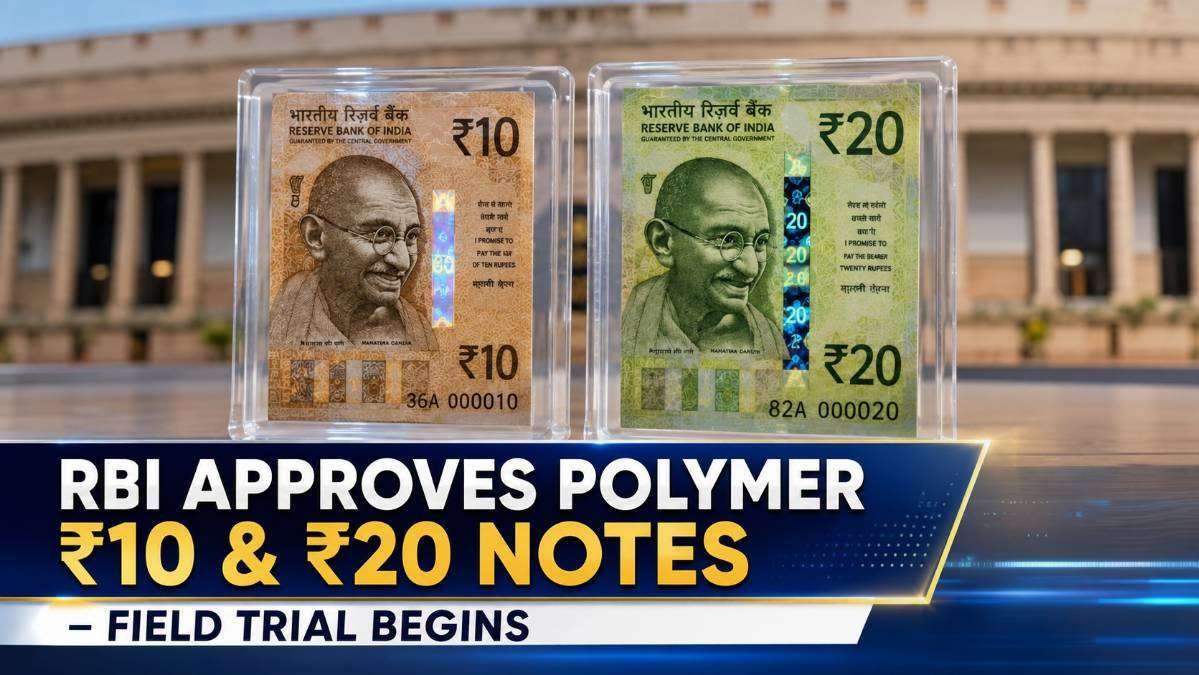
The Government of India has approved the Reserve Bank of India (RBI) to conduct field trials of polymer (plastic) banknotes in ₹10 and ₹20 denominations.
The decision has generated widespread interest on social media, with many posts claiming that plastic notes will soon replace paper currency across India. However, the official position is more measured.
The approval is only for a pilot project to test the performance of polymer notes under Indian conditions. Existing paper notes will continue to remain legal tender, and no nationwide replacement has been announced.
Government Approves RBI’s Proposal
Minister of State for Finance Pankaj Chaudhary informed Parliament that the Central Government has approved the RBI’s proposal submitted under Section 25 of the Reserve Bank of India Act, 1934. The proposal allows the RBI to introduce polymer ₹10 and ₹20 banknotes on a trial basis.
The RBI plans to issue:
- 100 crore (1 billion) polymer ₹10 notes
- 100 crore (1 billion) polymer ₹20 notes
These notes will be circulated during field trials to evaluate their performance before any decision is taken on wider adoption.
Why is RBI Testing Polymer Notes?
Lower denomination notes such as ₹10 and ₹20 are used frequently and wear out much faster than higher-value notes. Polymer banknotes are expected to solve this problem by offering:
- Longer lifespan than paper currency
- Resistance to water and moisture
- Better protection against dirt and tearing
- Advanced anti-counterfeit security features
- Lower replacement costs over time
Several countries have already adopted polymer currency because of these advantages.
READ THIS: Flipkart Food Delivery Launch Confirmed Bengaluru to Be First Pilot City, CEO Announces New Service
Will Existing Paper Notes Be Discontinued?
No. This is one of the biggest misconceptions circulating online.
The Government has clearly stated that there is currently no plan to replace existing paper currency with polymer notes. During the pilot project, paper and polymer notes will circulate together, and all existing ₹10 and ₹20 paper notes will remain valid legal tender.
What Will RBI Evaluate During the Trial?
- Durability under different weather conditions
- Resistance to folding and repeated handling
- Performance in ATMs and cash-counting machines
- Public acceptance
- Cost-effectiveness compared to paper notes
If the trial produces satisfactory results, the RBI may consider regular issuance of polymer notes in the future.
India Has Tested Polymer Notes Before
This is not India’s first experiment with polymer currency.
In 2013, the RBI introduced polymer ₹10 notes on a limited trial basis in selected cities. Discussions continued in later years, but the proposal was not implemented nationwide. The latest approval marks the largest pilot project undertaken so far.
READ THIS: INDmoney Launches Free Income Tax Filing for AY 2026-27 Everything Investors Need to Know
Countries Using Polymer Currency
Many countries already use polymer banknotes, including:
- Australia
- Canada
- United Kingdom
- New Zealand
- Singapore
- Malaysia
- Romania
- Vietnam
These countries adopted polymer notes because they generally last longer and offer improved security against counterfeiting.
READ THIS: Google Selfie Video Account Recovery New Security Feature
Will the Design Change?
The RBI has not yet released the official design of the trial polymer notes. The field-trial notes are expected to retain familiar denomination features while incorporating polymer substrate and enhanced security elements. Any official design will be announced by the RBI before circulation.
Conclusion
The approval of polymer ₹10 and ₹20 banknotes represents an important step toward improving the durability and security of India’s currency. However, it is important to understand that this is only a pilot project.
Existing paper notes remain fully valid, and no nationwide rollout has been announced. The RBI will study the trial results before deciding whether polymer notes should become a permanent part of India’s currency system.
Frequently Asked Questions (FAQs)
1. Has RBI officially launched plastic notes?
No. RBI has received approval only for field trials of polymer ₹10 and ₹20 notes.
2. Will existing ₹10 and ₹20 paper notes become invalid?
No. Existing paper notes will continue to remain legal tender.
3. How many polymer notes will be printed?
100 crore ₹10 notes and 100 crore ₹20 notes, totaling 200 crore notes for the pilot project.
4. Why are polymer notes better?
They last longer, resist water and dirt, are more durable, and include stronger anti-counterfeit features.
5. When will polymer notes be available across India?
There is no nationwide rollout date. Any wider circulation will depend on the success of the field trials.
About The Author