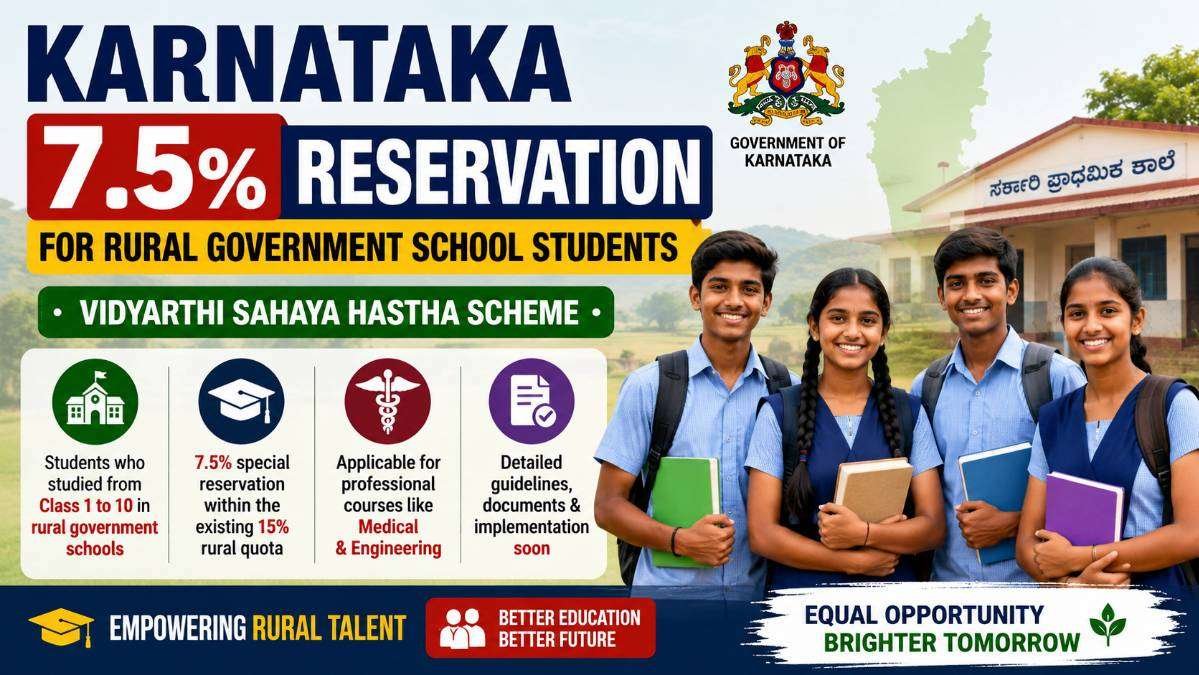
Karnataka has announced a new education initiative aimed at improving access to professional higher education for students who have studied in rural government schools.
The scheme, named Vidyarthi Sahayahasta, was announced by Karnataka Chief Minister D. K. Shivakumar during the state’s 80th Independence Day celebrations on August 15, 2026.
Under the announcement, eligible students who studied from Class 1 to Class 10 in rural government schools will receive a 7.5 per cent special reservation within the existing 15 per cent rural reservation for admission to professional courses. The announcement is particularly significant for students aspiring to pursue courses such as medicine and engineering.
However, students and parents should understand one important point. The newly announced 7.5 per cent provision should not be interpreted as an additional 7.5 per cent reservation that will simply be added to the existing 15 per cent rural quota. Reports explaining the announcement indicate that the special 7.5 per cent provision will operate within the existing rural reservation framework.
What Is the Vidyarthi Sahayahasta Scheme?
Vidyarthi Sahayahasta is a Karnataka government initiative intended to provide greater opportunities in professional education to students from rural government schools.
The main focus of the announcement is students who have studied in rural government schools from Class 1 through Class 10. The government has linked the initiative with admission to professional higher education, including fields such as medical and engineering education.
The idea behind the initiative is to help students who may have had fewer educational resources and less access to expensive coaching and other facilities compared with students studying in well-resourced urban institutions.
The announcement therefore places emphasis not simply on where a student lives, but on the student’s schooling background.
Who Can Benefit From the 7.5% Reservation?
Based on the announcement and available reports, the main eligibility condition is that the student should have studied from Class 1 to Class 10 in eligible rural government schools.
This distinction is important because rural residence by itself does not appear to be sufficient under the announced criterion.
- Students who studied Classes 1 to 10 in rural government schools may be eligible.
- Students who live in a rural area but studied in private schools should not automatically assume that they are eligible.
- Students who studied in urban government schools are not covered by the rural-school criterion announced for this scheme.
- Students will still have to satisfy the normal eligibility requirements of the professional course and admission process.
The government is expected to issue detailed guidelines explaining how the schooling requirement will be verified and which certificates students will have to submit.
Is the 7.5% Reservation Additional to the Existing 15% Rural Quota?
This is one of the most important points students need to understand correctly.
Karnataka already has a rural reservation framework. The new announcement refers to a 7.5 per cent special reservation within the existing 15 per cent rural reservation.
Therefore, it would be misleading to describe the announcement simply as an additional 7.5 per cent quota on top of the existing 15 per cent rural reservation.
Students should wait for the official seat-allocation and implementation guidelines before calculating how many seats will actually be available under the new provision.
What Does Horizontal Reservation Mean?
The term horizontal reservation can sometimes create confusion among students.
Horizontal reservation generally operates across the existing vertical reservation categories. It is different from simply creating a completely separate category of seats.
In this case, the announced 7.5 per cent special provision is intended to benefit the specified group of rural government-school students within the existing rural reservation framework.
The exact method by which the seats will be distributed across different categories will become clearer when the Karnataka government and the relevant admission authorities issue detailed guidelines.
Which Courses Are Expected to Be Covered?
The announcement concerns professional higher education. Reports on the scheme specifically mention medical and engineering courses.
This means the announcement could be particularly important for students preparing for professional admission processes such as medical and engineering counselling in Karnataka.
However, students should not assume that every professional course is automatically covered until the government publishes a complete course-wise list.
READ THIS: QR Code Payment Explained What Information Is Stored in UPI QR?
What Does This Mean for Medical Students?
Medical aspirants are among the students who could be significantly affected by the announcement because medical education has been specifically mentioned in reports about the scheme.
Students seeking admission through NEET should nevertheless wait for the official counselling instructions before assuming how the new provision will appear in the seat matrix.
The announcement itself establishes the policy direction, but the actual admission process requires detailed rules covering eligibility, documentation, seat allocation and verification.
Therefore, NEET candidates should continue following the official Karnataka counselling instructions and should not rely solely on social media posts or unofficial claims about the new reservation.
What Does This Mean for Engineering Students?
Engineering students could also benefit from the initiative because engineering has been specifically identified among the professional education areas covered by the announcement.
For students participating in Karnataka engineering admissions, the important authorities and admission notifications will determine how the provision is reflected in the seat matrix and counselling process.
Students should therefore check the official Karnataka admission notification when the detailed rules are released instead of assuming that the announced percentage automatically guarantees a seat.
Why Has Karnataka Introduced This Initiative?
The scheme is aimed at addressing differences in educational opportunities between rural and urban students.
Students studying in rural government schools can face several challenges. These may include limited access to specialised coaching, fewer educational resources, longer travel distances, limited exposure to professional-course preparation and financial difficulties.
Professional courses such as medicine and engineering are highly competitive. Students from financially stronger families may have greater access to coaching and other preparation resources.
The government initiative is intended to provide an additional pathway for students who have completed their schooling in rural government institutions. The broader objective is to improve access to professional education and create better opportunities for students from rural backgrounds.
Does Living in a Rural Area Automatically Make a Student Eligible?
No. Students should be careful about this point.
The announced eligibility is linked to studying in rural government schools from Class 1 to Class 10. Therefore, simply having a rural residential address should not be treated as automatic eligibility for the new provision.
For example, a student who lives in a village but completed Classes 1 to 10 in a private school should not assume that the 7.5 per cent benefit will apply.
Similarly, a student who studied in a government school located in an urban area should not automatically claim the rural-school benefit.
What Documents May Be Required?
The exact document requirements for the newly announced 7.5 per cent provision have not yet been fully explained in the available implementation information.
Existing Karnataka rural-reservation procedures have used certificates verifying that a candidate studied from Class 1 to Class 10 in a rural area. Official Karnataka-related documentation also refers to rural-study certificates and verification through education authorities.
However, students should not assume that the existing certificate procedure is automatically identical to the requirements of the new Vidyarthi Sahayahasta provision.
The government or admission authority must issue the final instructions explaining which certificate, format and verification procedure will apply.
Will Students Need a Separate 7.5% Reservation Certificate?
This is not yet completely clear from the announcement.
Students should wait for the official guidelines before obtaining documents specifically for the new provision. The final notification should clarify whether an existing rural-study certificate will be sufficient or whether a separate verification process will be introduced.
Students should also make sure that their school records, transfer certificate, study records and other educational documents accurately reflect their schooling history, because these records may become important during verification.
When Will the New Reservation Be Implemented?
The announcement was made on August 15, 2026. However, the detailed implementation process is still important because an announcement does not by itself provide every operational detail required for admission counselling.
As of August 18, 2026, students should look for further notifications from the Karnataka government and the relevant admission authorities regarding the implementation date, eligibility verification, documents and seat allocation.
This is particularly important for students involved in ongoing or upcoming 2026 admission processes.
What Students Should Check Before Claiming the Benefit
Students should verify the following points before selecting the reservation option during an admission process:
- Whether the course is covered under the final notification.
- Whether the student satisfies the rural government-school study requirement.
- Whether Classes 1 to 10 were completed according to the prescribed rules.
- Whether the required rural-study certificate is available.
- Whether the certificate has been issued or verified by the competent authority.
- Whether the reservation is available for the particular counselling year.
- Whether the student’s category and other eligibility conditions are satisfied.
Why Students Should Not Believe Every Social Media Claim
Whenever a new reservation policy is announced, many messages and videos can circulate on WhatsApp, Instagram, YouTube and other social media platforms.
Some posts may incorrectly claim that every rural student will receive a guaranteed 7.5 per cent quota or that the new reservation is an additional 7.5 per cent over the existing rural reservation.
Students should be careful with such claims.
The safest approach is to wait for the official government notification, admission notification and final seat matrix before making decisions about counselling or document submission.
READ THIS: Google Selfie Video Account Recovery New Security Feature
What Is Confirmed and What Is Still Awaited?
Several aspects of the announcement are already clear, while other details require further clarification.
Confirmed From the Announcement
- The scheme is called Vidyarthi Sahayahasta.
- The initiative targets students from rural government schools.
- The schooling requirement announced is from Class 1 to Class 10.
- A 7.5 per cent special reservation has been announced.
- The provision is reported as being within the existing 15 per cent rural reservation.
- Professional education, including medical and engineering courses, is part of the announcement.
Details Still Awaiting Final Guidelines
- Exact implementation date.
- Complete list of courses covered.
- Detailed certificate requirements.
- Verification procedure.
- Exact seat-allocation method.
- How the provision will appear in the relevant counselling seat matrix.
- Whether and how it will apply to each ongoing admission cycle.
What Rural Government School Students Should Do Now
Students who believe they may qualify should not panic or rush to submit unnecessary documents.
Instead, they should keep their school records and certificates ready, including documents showing their Class 1 to Class 10 study history. They should also regularly check official admission notifications when counselling begins.
Students preparing for engineering should follow the relevant Karnataka admission authority and counselling notifications. Medical aspirants should similarly follow the official Karnataka medical counselling instructions and the applicable NEET admission process.
If a student has any doubt about whether a particular school qualifies as a rural government school, the student should seek clarification from the concerned school or education authority rather than relying on an unofficial social media post.
Conclusion
The Karnataka government’s Vidyarthi Sahayahasta announcement is an important development for students who have completed their schooling in rural government schools. The proposed 7.5 per cent special reservation could provide additional opportunities for eligible students seeking admission to professional courses such as medicine and engineering.
At the same time, students need to understand the announcement correctly. The 7.5 per cent provision should not be presented as a simple additional quota on top of the existing 15 per cent rural reservation. Current reporting describes it as a special provision within the existing 15 per cent rural reservation.
The next major step will be the release of detailed government and admission guidelines. Those guidelines are expected to clarify the exact eligibility conditions, certificates, verification procedure, courses covered, seat allocation and implementation timeline.
Until those details are officially released, students should avoid making admission decisions based on unverified claims. The best approach is to keep the necessary educational records ready and follow official Karnataka government and admission authority notifications.
For rural government-school students dreaming of entering professional education, the announcement could become an important opportunity. The actual benefit, however, will depend on the final rules and how the reservation is implemented during the admission process.
About The Author