India is a country known for its remarkable linguistic diversity. People across different regions speak and write in many languages, each carrying its own history, literature, culture, and identity. In this diverse country, the question of which language should be used for the official work of the Union became an important issue during the making of the Constitution.
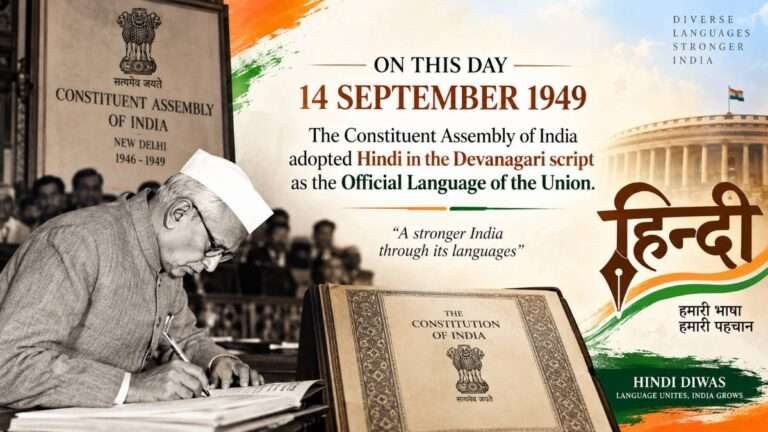
One of the most important dates in this history is 14 September 1949. On this day, the Constituent Assembly of India adopted Hindi, written in the Devanagari script, as the official language of the Union. The decision later became an important part of the language provisions of the Constitution of India.
Every year, 14 September is observed as Hindi Diwas to remember this historic decision and to highlight the importance and development of the Hindi language.
What Happened on 14 September 1949?
The language question was one of the major subjects discussed by the Constituent Assembly while preparing the Constitution. India had just become independent, and the members of the Assembly had to decide how the Union government would conduct its official business in a country with many languages.
After extensive discussions and debates, the Constituent Assembly adopted provisions relating to the official language on 14 September 1949. Hindi in the Devanagari script was selected as the official language of the Union.
The decision was significant because it established the constitutional framework for the language to be used for official purposes of the Union. However, the language arrangement was not simply a decision to replace every other language with Hindi. The Constitution also provided for the continued use of English for certain official purposes.
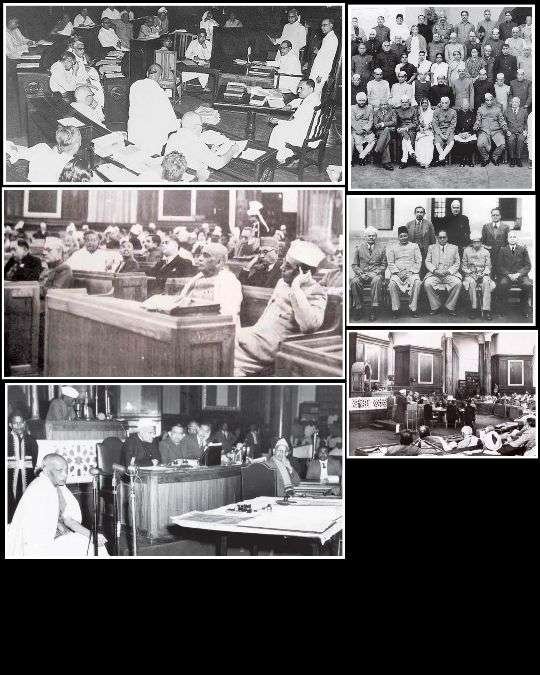
Parliament Museum and Archives, Parliament of India (use this credit only if this image was sourced from the Parliament Museum/Archives or an official Parliament publication).
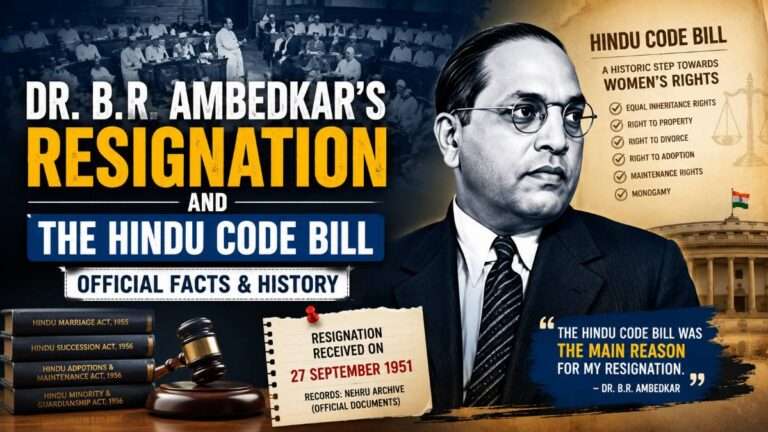
READ THIS: Dr. B.R. Ambedkar Resignation and the Hindu Code Bill Official Facts
Hindi and the Constitution of India
The decision taken by the Constituent Assembly was incorporated into the Constitution of India. When the Constitution came into force on 26 January 1950, its language provisions became part of the country’s constitutional framework.
Article 343 and the Official Language of the Union
Article 343 is one of the most important constitutional provisions concerning the official language of the Union. It states that the official language of the Union shall be Hindi in Devanagari script.
The Constitution also makes provisions regarding the form of numerals to be used for the official purposes of the Union. These provisions form the constitutional foundation of India’s official language policy.
Therefore, when discussing the status of Hindi, it is important to use the correct constitutional terminology. Hindi is the official language of the Union; it should not be described as the national language of India.
Hindi the National Language of India?
This is one of the most common points of confusion surrounding Hindi in India.
India does not have a national language declared by the Constitution. Hindi is the official language of the Union under Article 343, but the Constitution does not describe Hindi as the national language of the country.
India has a large number of constitutionally recognised languages, reflecting the country’s linguistic diversity. The Eighth Schedule of the Constitution currently contains 22 languages, including Hindi, Kannada, Tamil, Telugu, Malayalam, Marathi, Bengali, Gujarati, Punjabi, Urdu, Assamese, Odia and Sanskrit, among others.
Using the expression “national language” when referring to Hindi can therefore create a misleading impression. The constitutionally accurate description is that Hindi in Devanagari script is the official language of the Union.
What Was the Role of English?
The language decision of 1949 also included an important provision concerning English. The Constitution originally provided for the continued use of English for official purposes of the Union for a period of fifteen years from the commencement of the Constitution.
This arrangement was intended to provide a period of transition. However, the question of language remained politically and socially important, and the use of English continued beyond the original transitional period.
Parliament later enacted the Official Languages Act, 1963. The Act provided for the continued use of English in addition to Hindi for specified official purposes of the Union and for parliamentary business.
As a result, the present language arrangement of the Union is more complex than the simple statement that Hindi replaced English. Hindi has the constitutional status of the official language of the Union, while English continues to be used for several official purposes under the law.
Why Was the Language Question Important?
The language question was particularly sensitive because India had never been a linguistically uniform country. Different regions had developed their own languages, scripts, literary traditions, and cultural identities over centuries.
For the members of the Constituent Assembly, the challenge was to establish an official language arrangement while respecting India’s linguistic diversity.
The debates reflected different views about Hindi, English and the other Indian languages. Some members strongly supported Hindi as a symbol of India’s cultural identity, while others expressed concerns about imposing one language on people from regions where Hindi was not commonly spoken.
The eventual constitutional framework attempted to balance these competing concerns. Hindi was given the status specified in Article 343, while English continued to have an important role and the Constitution recognised the linguistic diversity of the country in several other provisions.
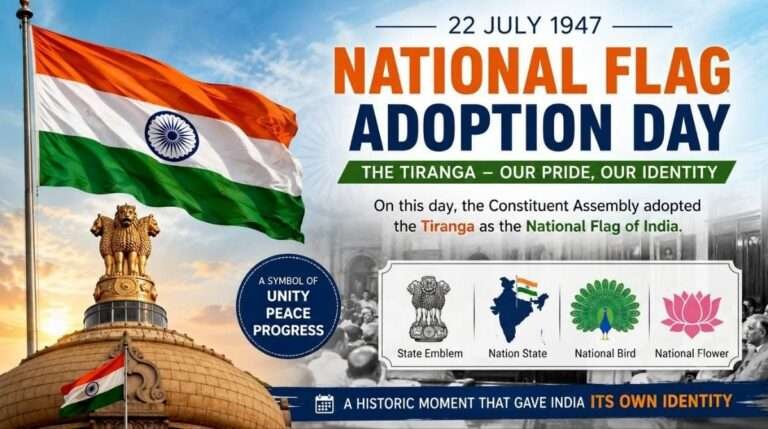
READ THIS: National Flag Adoption Day 2026 History, Significance, Facts and the Story Behind India Tiranga
Part XVII of the Constitution and Language Provisions
The official language provisions of the Constitution are mainly contained in Part XVII. These provisions cover several aspects of language administration.
Article 343
Article 343 deals with the official language of the Union and specifies Hindi in the Devanagari script.
Article 344
Article 344 deals with the Official Language Commission and a committee of Parliament associated with official language matters.
Article 345
Article 345 concerns the official language or languages that may be adopted by a State for its official purposes, subject to the constitutional framework.
Article 346
Article 346 deals with communication between one State and another and between a State and the Union.
Article 348
Article 348 contains provisions concerning the language to be used in the Supreme Court, High Courts and authoritative texts of certain laws and constitutional instruments.
Article 350A and Article 350B
These provisions address aspects of linguistic minorities, including facilities for instruction in the mother tongue at the primary stage and the role of the Special Officer for Linguistic Minorities.
Article 351
Article 351 contains a directive concerning the development of Hindi. It calls upon the Union to promote the spread and development of Hindi so that it can serve as a medium of expression for India’s composite culture.
Why Is 14 September Celebrated as Hindi Diwas?
The historical decision of 14 September 1949 is remembered every year through Hindi Diwas.
Government departments and institutions mark the occasion through various programmes, competitions, discussions, writing activities and other initiatives related to the Hindi language.
The day is not merely a celebration of a language. It also provides an opportunity to reflect on the role of language in administration, education, literature, communication and India’s cultural life.
The Official Languages Act, 1963
The constitutional language arrangement continued to develop after 1950. One of the most important legislative developments was the Official Languages Act, 1963.
The Act addressed the continued use of English for official purposes of the Union. It helped establish the legal framework under which Hindi and English continue to be used in the Union government’s official work.
This development is important when discussing Hindi Diwas because the events of 14 September 1949 should not be viewed in isolation. The language policy of India developed over several years through constitutional provisions, parliamentary legislation and government policy.
The Importance of India’s Linguistic Diversity
India’s language system is a reflection of its social and cultural diversity. Languages such as Hindi, Kannada, Tamil, Telugu, Malayalam, Bengali, Marathi, Gujarati, Punjabi, Assamese, Odia and many others have contributed enormously to Indian literature and culture.
The Constitution recognises this diversity in several ways. The Eighth Schedule currently includes 22 languages, while constitutional provisions also provide safeguards and recognition in relation to linguistic minorities.
Hindi therefore occupies an important position in India’s constitutional system, but its position exists alongside the country’s wider multilingual character.
READ THIS: History of OK The Real Origin of the World’s Most Famous Word
Hindi’s Role in Modern India
Hindi is widely used across India in administration, education, media, entertainment, publishing and everyday communication. It has also developed considerably through interaction with other Indian languages and with languages from outside India.
Modern Hindi is used in newspapers, television, films, digital media, government communication, literature and social media. Its vocabulary and styles have continued to evolve with changes in society and technology.
The growth of digital communication has created another important space for Hindi. Websites, mobile applications, online news platforms and social media have made it possible for Hindi content to reach audiences across India and around the world.
14 September 1949: Why the Date Still Matters
The importance of 14 September 1949 goes beyond remembering a constitutional decision. It represents one stage in India’s long journey towards developing an administrative system suited to an independent and multilingual nation.
The Constituent Assembly had the difficult task of balancing national communication with regional linguistic identities. The language provisions that emerged from this process continue to influence the functioning of the Union government today.
Hindi Diwas therefore provides an opportunity to understand both the importance of Hindi and the broader linguistic diversity of India.
Conclusion
14 September 1949 holds a special place in India’s constitutional history. On that day, the Constituent Assembly adopted Hindi in the Devanagari script as the official language of the Union. The decision was later reflected in Article 343 of the Constitution, which came into force on 26 January 1950.
At the same time, India’s language policy did not eliminate English or diminish the country’s multilingual character. The Official Languages Act, 1963, provided for the continued use of English for specified official purposes, while the Constitution recognised and protected India’s wider linguistic diversity.
It is also important to remember that Hindi is not constitutionally designated as India’s national language. The accurate description is that Hindi in Devanagari script is the official language of the Union.
Every year, Hindi Diwas on 14 September offers an opportunity to remember the historic decision of the Constituent Assembly, appreciate the contribution of Hindi, and at the same time recognise the many languages that together form India’s rich linguistic heritage.
About The Author