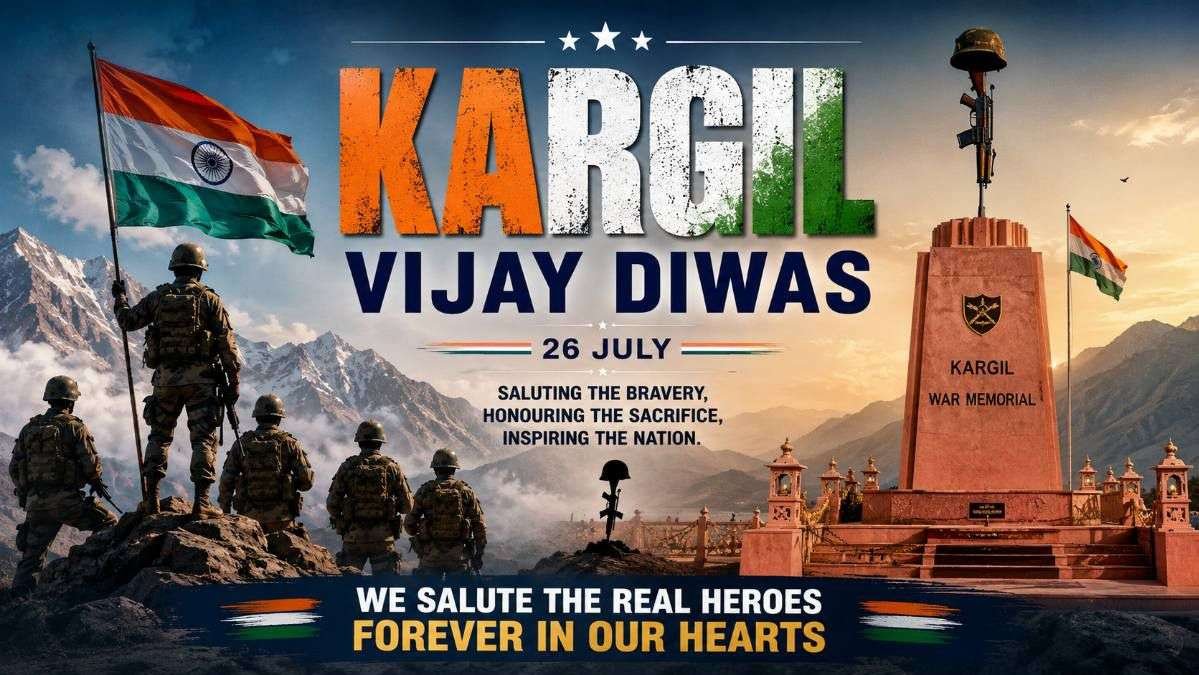
Every year on 26 July, India proudly observes Kargil Vijay Diwas to commemorate one of the most remarkable victories in the country’s military history.
The day is dedicated to honoring the courage, determination, and ultimate sacrifice of the Indian Armed Forces during the Kargil War of 1999. It is not merely a celebration of military success but also a reminder of the patriotism, resilience, and unity that define the spirit of India.
Kargil Vijay Diwas serves as an opportunity for every citizen to remember the brave soldiers who fought under extremely difficult conditions to protect the nation’s sovereignty. Their extraordinary courage continues to inspire generations of Indians to value peace, freedom, and national integrity.
READ THIS: ravindra kaushik
What is Kargil Vijay Diwas?
Kargil Vijay Diwas marks India’s victory in the Kargil War, which officially concluded on 26 July 1999. After weeks of intense fighting in the rugged mountains of Jammu and Kashmir’s Kargil region, the Indian Army successfully recaptured strategic positions that had been occupied by Pakistani intruders.
The victory was achieved through Operation Vijay, a large-scale military campaign launched by India to reclaim its territory. The operation showcased the exceptional bravery, discipline, and professionalism of the Indian Army, Indian Air Force, and supporting forces.
Since then, 26 July has been observed every year as Kargil Vijay Diwas to honor the soldiers who defended the nation with unmatched courage.
READ THIS: Dr. Shrikant Jichkar Biography: Verified Education, IAS, IPS & Political Career
The Background of the Kargil War
The Kargil War began in May 1999 when Pakistani soldiers and armed infiltrators secretly crossed the Line of Control (LoC) and occupied several strategic mountain peaks in the Kargil sector. These positions overlooked National Highway 1A, an important route connecting Srinagar and Leh.
The infiltration was initially detected by local shepherds and later confirmed by the Indian Army. The enemy had occupied high-altitude positions ranging between 16,000 and 18,000 feet, making military operations extremely challenging.
The difficult terrain, freezing temperatures, steep cliffs, and constant enemy fire made the battle one of the toughest mountain wars fought in modern military history.
Operation Vijay: India’s Determined Response
To remove the infiltrators and restore territorial control, India launched Operation Vijay. Thousands of soldiers from different regiments were deployed to the Kargil region.
The Indian Air Force also joined the mission under Operation Safed Sagar, providing aerial support by targeting enemy supply lines and strategic positions.
Unlike conventional warfare, Indian soldiers had to climb nearly vertical mountain slopes while carrying heavy equipment, often under direct enemy observation. Despite these challenges, they displayed extraordinary courage and determination throughout the operation.
After nearly two months of fierce fighting, India successfully regained most of the occupied positions. On 26 July 1999, the Indian government officially declared the successful completion of Operation Vijay.
The Challenges Faced by Indian Soldiers
The Kargil conflict tested the endurance of every soldier involved in the operation. The battlefields were located at extremely high altitudes where oxygen levels were significantly lower than normal.
Troops had to survive freezing temperatures, icy winds, rocky terrain, and continuous enemy shelling. Many soldiers climbed steep mountain peaks during the night to surprise enemy forces while carrying weapons, ammunition, and supplies.
The harsh weather conditions often proved as dangerous as the enemy itself. Nevertheless, the courage displayed by Indian soldiers became a shining example of commitment and patriotism.
Heroes of the Kargil War
The Kargil War produced countless stories of heroism that continue to inspire millions.
Captain Vikram Batra, awarded the Param Vir Chakra posthumously, became a national hero for his fearless leadership and famous words, “Yeh Dil Maange More.”
Lieutenant Manoj Kumar Pandey, another Param Vir Chakra awardee, displayed unmatched bravery while leading assaults against enemy positions despite sustaining severe injuries.
Grenadier Yogendra Singh Yadav, who survived despite multiple bullet injuries, played a vital role in capturing Tiger Hill and was awarded the Param Vir Chakra.
Rifleman Sanjay Kumar demonstrated exceptional courage by single-handedly attacking enemy bunkers, earning the nation’s highest military honor.
These brave soldiers represent the spirit of sacrifice shown by hundreds of officers and jawans who fought during the war.
READ THIS: National Flag Adoption Day 2026 History, Significance, Facts and the Story Behind India Tiranga
The Importance of Tiger Hill
Tiger Hill became one of the most significant battlefields during the Kargil War. Due to its strategic location, it allowed the enemy to observe and target important transportation routes.
The battle to recapture Tiger Hill was extremely difficult because of its height and steep rocky slopes. Indian soldiers launched daring assaults under harsh weather conditions and eventually succeeded in reclaiming the peak.
The victory at Tiger Hill became one of the defining moments of Operation Vijay and boosted the morale of the entire nation.
Remembering the Fallen Heroes
More than 500 Indian soldiers made the supreme sacrifice during the Kargil War, while many others sustained serious injuries. Their courage ensured that India’s territorial integrity remained protected.
Every year, the Kargil War Memorial at Dras in Ladakh becomes the center of national remembrance. Families of martyrs, military veterans, government officials, and citizens gather to pay tribute through wreath-laying ceremonies and memorial services.
The names of the fallen heroes engraved on the memorial walls remind every visitor that freedom comes at a great cost.
How India Observes Kargil Vijay Diwas
Kargil Vijay Diwas is celebrated across the country with deep respect and patriotic pride.
- Tributes are paid at war memorials.
- Schools and colleges organize patriotic events, speeches, and essay competitions.
- The Armed Forces conduct commemorative ceremonies.
- Cultural programs honor the bravery of soldiers.
- Citizens share messages of gratitude and remember the sacrifices made by the armed forces.
Many people also visit military museums and memorials to learn more about the history of the Kargil War and India’s defense forces.
Lessons from the Kargil War
The Kargil War teaches valuable lessons about national security, preparedness, teamwork, and resilience. It highlighted the importance of intelligence gathering, military modernization, and coordinated operations among different branches of the armed forces.
More importantly, it demonstrated that determination, unity, and courage can overcome even the most difficult challenges.
The sacrifices made during the war continue to inspire young Indians to serve the nation with honesty, dedication, and responsibility.
READ THIS: Dr. B.R. Ambedkar Resignation and the Hindu Code Bill Official Facts
Why Kargil Vijay Diwas Matters Today
Although more than two decades have passed since the Kargil War, its significance remains as strong as ever. Kargil Vijay Diwas reminds us that peace should never be taken for granted. It also reminds every citizen that the safety and security enjoyed today are possible because countless soldiers continue to guard the nation’s borders under challenging conditions.
The observance also strengthens the bond between civilians and the armed forces by recognizing the sacrifices made by military personnel and their families.
For the younger generation, Kargil Vijay Diwas is an opportunity to understand India’s military history and appreciate the values of courage, discipline, patriotism, and selfless service.
Conclusion
Kargil Vijay Diwas is much more than a day of celebratio it is a solemn tribute to the bravery, sacrifice, and unwavering commitment of India’s armed forces.
The victory achieved during the Kargil War in 1999 stands as one of the proudest chapters in India’s history, reminding the nation that courage and determination can overcome even the greatest challenges.
As we observe Kargil Vijay Diwas every year on 26 July, we remember the heroes who laid down their lives so that future generations could live in peace and freedom. Their sacrifices continue to inspire millions of Indians to place the nation above self and uphold the values of unity, integrity, and patriotism.
Let us honor every soldier who served during Operation Vijay by expressing gratitude not only on Kargil Vijay Diwas but throughout the year. Their courage will forever remain a symbol of India’s strength, resilience, and unwavering spirit.
About The Author