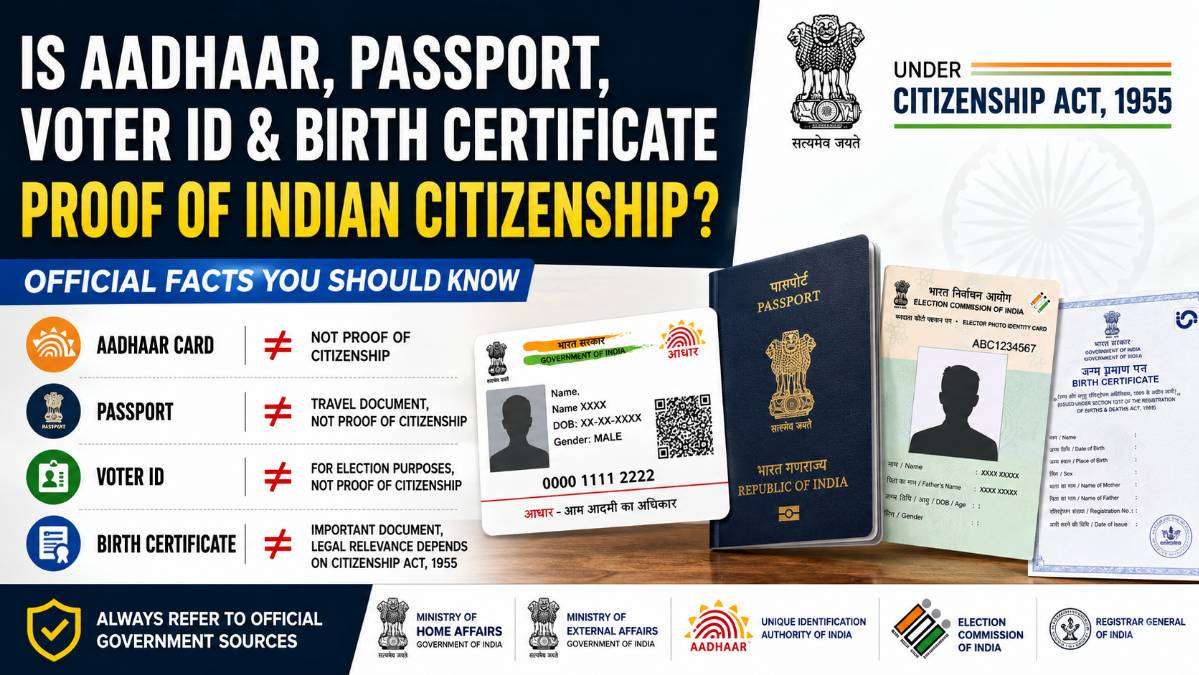
Several discussions have recently focused on whether documents such as the Aadhaar Card, Passport, Voter ID, and Birth Certificate can be considered proof of Indian citizenship. To understand the correct legal position, it is important to rely only on official Government of India information and the provisions of the Citizenship Act, 1955.
This article explains the role of these documents based on official government sources without relying on speculation or unofficial claims.
Understanding Indian Citizenship
Indian citizenship is governed by the Citizenship Act, 1955, along with the Citizenship Rules framed under the Act. Citizenship in India may be acquired through birth, descent, registration, naturalization, or incorporation of territory, depending on the eligibility conditions specified in the law.
India does not issue a universal “Citizenship Card” to every citizen. Instead, citizenship is determined according to the provisions of the Citizenship Act and supporting legal documents applicable to an individual’s circumstances.
Aadhaar Card Proof of Indian Citizenship?
According to the Unique Identification Authority of India (UIDAI), an Aadhaar number is issued as proof of identity after verification of demographic and biometric information. However, UIDAI clearly states that Aadhaar is not proof of citizenship or nationality.
The Aadhaar Act provides identity verification services and helps residents access various government services and benefits. The document establishes identity and, where applicable, address, but it does not determine or certify whether a person is an Indian citizen.
READ THIS: Gruha Lakshmi Scheme Verification 2026: Karnataka Government Checking Beneficiary Records
Indian Passport Proof of Citizenship?
An Indian Passport is issued by the Ministry of External Affairs under the Passports Act, 1967. It serves as an official travel document that allows Indian passport holders to travel internationally.
The Ministry of External Affairs has clarified that a passport is primarily a travel document issued after verification under the Passports Act. While the passport application process includes verification of the applicant’s credentials, the passport itself is not treated as a standalone legal document that conclusively establishes Indian citizenship in every legal situation.
The passport remains one of the most important identity documents issued by the Government of India for international travel.
Voter ID Proof of Citizenship?
The Election Photo Identity Card (EPIC), commonly known as the Voter ID card, is issued by the Election Commission of India to eligible electors whose names are included in the electoral roll.
The primary purpose of the Voter ID is to enable eligible electors to participate in elections and to establish their identity during voting. While only Indian citizens are eligible to register as voters under election laws, the Voter ID card itself is not recognized as conclusive proof of citizenship for every legal purpose.
What About the Birth Certificate?
A Birth Certificate is issued under the Registration of Births and Deaths Act after the registration of birth. It records important details such as the individual’s name, date of birth, place of birth, and parents’ information.
The legal significance of a Birth Certificate depends on the provisions of the Citizenship Act, 1955. Whether a person acquires Indian citizenship by birth depends on factors such as the person’s date of birth and, for certain periods under the law, the citizenship status of the parents.
READ THIS: SSP Scholarship 2026-27 Started? Complete Guide for Degree, Diploma, ITI & PUC Students
Therefore, a Birth Certificate is an important civil record, but its role in determining citizenship depends upon the applicable legal provisions.
How Is Indian Citizenship Determined?
Citizenship is determined according to the provisions of the Citizenship Act, 1955. The Act provides different methods through which citizenship may be acquired:
- Citizenship by Birth
- Citizenship by Descent
- Citizenship by Registration
- Citizenship by Naturalization
- Citizenship through Incorporation of Territory
The applicable provisions depend on the facts of each individual case. Government authorities may examine relevant documents and legal requirements while determining citizenship wherever necessary.
Official Government Guidance
The Government of India has consistently clarified the purpose of different documents issued by various authorities:
- Aadhaar: Identity document; not proof of citizenship (UIDAI).
- Passport: Official travel document issued under the Passports Act, 1967 (Ministry of External Affairs).
- Voter ID: Identity document for electoral purposes issued by the Election Commission of India.
- Birth Certificate: Official civil registration document issued under birth registration laws; its relevance to citizenship depends on the Citizenship Act, 1955.
Each document serves a specific legal purpose and should be used accordingly.
Conclusion
Based on official Government of India information, Aadhaar Card, Passport, Voter ID, and Birth Certificate each serve different legal and administrative purposes. Aadhaar is an identity document and is not proof of citizenship.
A passport is an official travel document issued under the Passports Act. A Voter ID is issued for electoral purposes, while a Birth Certificate is an important civil registration record whose legal relevance to citizenship depends on the provisions of the Citizenship Act, 1955.
Citizenship in India is determined only in accordance with the Citizenship Act, 1955 and applicable laws. For accurate information, citizens should always rely on official government authorities such as the Ministry of Home Affairs (MHA), Ministry of External Affairs (MEA), UIDAI, the Election Commission of India (ECI), and the Office of the Registrar General of India.
About The Author