Dharmendra Pradhan Resigns as Union Education Minister Amid NEET-UG 2026 Controversy Full Story, Reasons & Impact
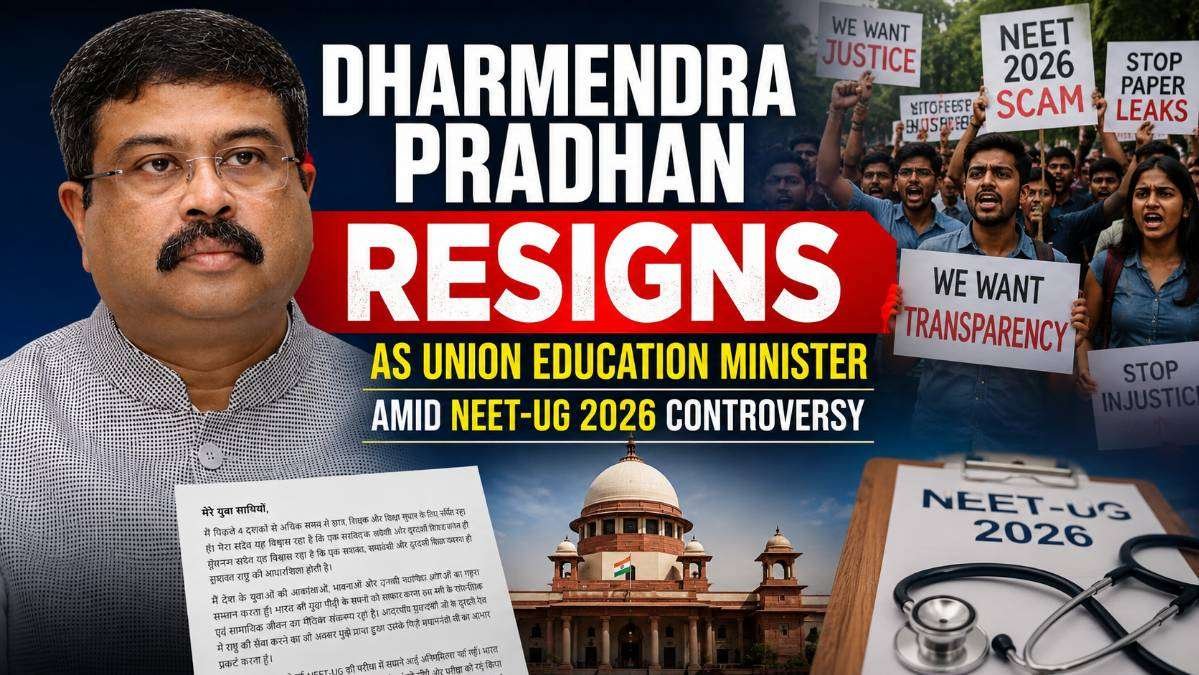
India witnessed one of the most significant political developments in the education sector when Union Education Minister Dharmendra Pradhan submitted his resignation following weeks of nationwide protests over the NEET-UG 2026 examination controversy.
The resignation came after growing pressure from students, parents, educational organizations, and opposition parties demanding accountability for alleged irregularities in one of India’s largest entrance examinations.
The development has attracted nationwide attention because the National Eligibility-cum-Entrance Test (NEET-UG) is the gateway for admission to undergraduate medical and dental courses across the country.
Every year, millions of students spend months and sometimes years preparing for the examination. Therefore, any allegation related to examination security, transparency, or fairness immediately becomes a matter of national importance.
Dharmendra Pradhan, who served as the Union Education Minister for several years, announced his decision through a detailed resignation letter addressed to the youth of India.
In the letter, he accepted moral responsibility for the controversy while defending the government’s efforts to investigate the matter and protect students’ interests.
Background of the NEET-UG 2026 Controversy
The controversy began after allegations surfaced regarding irregularities during the NEET-UG 2026 examination. Students from several states raised concerns over the conduct of the examination, while reports of possible paper leaks and other examination-related issues started circulating on social media and news platforms.
As concerns increased, students organized peaceful demonstrations demanding transparency in the investigation. Parents and educational experts also requested immediate clarification from the authorities to restore confidence in the examination system.
Since NEET is one of the most competitive examinations in India, even a small irregularity can affect the future of thousands of deserving candidates. The issue soon transformed from an examination-related concern into a nationwide discussion about the credibility of public examinations.
Government’s Immediate Response
Following the emergence of allegations, the Government of India initiated multiple measures to investigate the matter. According to official statements referenced in the resignation letter, the government ordered a Central Bureau of Investigation (CBI) probe into the alleged irregularities.
Authorities also announced that students affected by the controversy would be given another opportunity through a re-examination wherever necessary. The government stated that its primary objective was to ensure that deserving students were not deprived of opportunities because of administrative failures or examination malpractice.
Officials further indicated that reforms would be introduced to strengthen the security and transparency of future entrance examinations.
Decision to Introduce Computer-Based Testing
One of the major announcements mentioned in the resignation letter was the government’s decision to gradually transition future NEET examinations to a Computer-Based Test (CBT) format.
The move is expected to reduce the possibility of question paper leaks, improve examination management, strengthen security measures, and ensure quicker evaluation of answer sheets.
Many education experts have welcomed the proposal, although they also emphasized that implementing such a large-scale digital examination would require significant preparation and infrastructure development across the country.
The proposal reflects the government’s attempt to modernize India’s examination system while addressing concerns that emerged during the recent controversy.
Dharmendra Pradhan’s Resignation Letter
In his resignation letter, Dharmendra Pradhan addressed the youth of India and reflected on his long association with education reforms. He stated that he had spent more than two decades working for students, teachers, and educational development.
He thanked Prime Minister Narendra Modi for giving him the opportunity to serve as Union Education Minister and said the position had been one of the greatest responsibilities of his public life.
The former minister acknowledged that irregularities had emerged during the NEET-UG 2026 examination and said the government responded immediately by initiating an investigation and announcing corrective measures.
He also emphasized that he had accepted responsibility from the very first day of the controversy and had never attempted to avoid accountability.
Appeal to Students
A major theme throughout the resignation letter is the importance of protecting students’ futures. Dharmendra Pradhan wrote that India’s youth represent the country’s greatest strength and that their aspirations deserve respect and protection.
He said every effort should be made to ensure that honest and hardworking students are not forced to suffer because of irregularities beyond their control.
According to the letter, the government’s priority throughout the crisis remained the successful conduct of examinations for more than twenty lakh candidates while maintaining fairness and transparency.
Nationwide Student Protests
The controversy triggered demonstrations across several cities in India. Student organizations demanded a transparent investigation, strict punishment for anyone found responsible for examination malpractice, and stronger safeguards for future examinations.
Many students expressed concern that years of preparation and hard work should not be overshadowed by administrative failures. Parents also joined the discussions, urging authorities to act quickly so that admissions to medical colleges would not face unnecessary delays.
Educational institutions, coaching organizations, and academic experts closely monitored the developments because the outcome would significantly affect the academic calendar for medical admissions across the country.
Growing Political Pressure
As public demonstrations expanded, opposition political parties criticized the government’s handling of the examination controversy and demanded ministerial accountability.
The issue became one of the most debated national topics, with discussions taking place in political circles, educational institutions, television debates, and social media platforms.
While government leaders defended the steps already taken, opposition parties argued that stronger action was necessary to restore public confidence in India’s examination system.
Against this backdrop of increasing political and public pressure, Dharmendra Pradhan submitted his resignation, stating that he wanted students to focus on their education and future rather than prolonged controversy.
Analysis of the Resignation Letter
In his resignation letter, Dharmendra Pradhan emphasized that the issue surrounding NEET-UG 2026 was not merely an administrative challenge but one that directly affected the dreams and aspirations of millions of young Indians. He stated that he had accepted responsibility from the very beginning and never attempted to distance himself from the controversy.
The former minister wrote that every deserving student should receive a fair opportunity based on merit and that no student’s future should be damaged because of examination-related irregularities.
He also expressed confidence in India’s democratic institutions and called upon students to remain focused on education rather than misinformation or political polarization.
Throughout the letter, he repeatedly thanked Prime Minister Narendra Modi, his Cabinet colleagues, ministry officials, teachers, and education professionals for their cooperation during his tenure. He concluded by saying that although he was leaving the post of Education Minister, he would continue serving the nation in every possible capacity.
Government’s Reform Measures
The controversy has accelerated discussions about long-term reforms in India’s public examination system. During the government’s response to the crisis, several important reforms were announced to strengthen transparency and improve examination security.
Among the most significant proposals is the gradual transition of NEET examinations to a Computer-Based Test (CBT) format. Officials believe that digital examinations can reduce the risk of paper leaks, improve question paper security, minimize human intervention, and speed up evaluation.
The government also strengthened the ongoing investigation through the Central Bureau of Investigation (CBI), with the objective of identifying everyone responsible for any examination malpractice. Authorities have repeatedly stated that strict legal action will be taken wherever evidence supports criminal wrongdoing.
Education experts have also recommended stronger cybersecurity systems, better coordination between examination agencies and state authorities, improved surveillance at examination centres, and faster communication with students during emergencies.
Impact on Students and Medical Admissions
The NEET-UG controversy created uncertainty for millions of students preparing for admission to undergraduate medical and dental courses. Many candidates had invested years of hard work, financial resources, and emotional commitment toward achieving their dream of becoming doctors.
The possibility of examination irregularities naturally created anxiety among students and parents. Questions regarding counselling schedules, admission timelines, seat allocation, and academic calendars became major concerns.
Educational institutions also faced challenges while planning admissions because they had to wait for official decisions regarding investigations, re-examinations, and counselling schedules.
Experts believe that restoring public confidence is now one of the government’s highest priorities. Students expect future entrance examinations to be conducted with stronger safeguards so that merit alone determines admission.
Political Reactions
The resignation generated widespread political reactions across India. Leaders from the ruling National Democratic Alliance (NDA) acknowledged Dharmendra Pradhan’s contribution to educational reforms while emphasizing that the government acted quickly by ordering an investigation into the allegations.
Opposition parties described the resignation as an important step toward accountability but argued that broader institutional reforms are also necessary. Several opposition leaders demanded comprehensive changes in examination governance to prevent similar incidents in the future.
Political analysts observed that the resignation reflects the increasing importance of accountability in matters involving public examinations, particularly those affecting millions of young citizens.
Public Response
Public opinion remained divided following the resignation. Some people viewed it as an example of political accountability, while others believed that meaningful institutional reforms would ultimately matter more than a ministerial resignation.
Students and parents generally welcomed assurances that investigations would continue and that the interests of deserving candidates would remain protected. Many education experts stressed that rebuilding trust in national examinations would require transparent investigations, timely communication, and consistent implementation of reforms.
What Happens Next?
Although the resignation marks a major political development, the investigation into the alleged examination irregularities continues. Authorities are expected to complete their inquiries and take legal action wherever evidence establishes wrongdoing.
The Ministry of Education will also continue implementing examination reforms aimed at improving security, transparency, and fairness. Any future policy decisions regarding NEET and other national entrance examinations are expected to focus on strengthening institutional credibility while minimizing disruption to students.
Students have been advised to rely only on official announcements from the Ministry of Education, the National Testing Agency (NTA), and other government agencies for updates regarding examinations and counselling schedules.
Why This Development Matters
The resignation of a Union Education Minister over a national examination controversy highlights the importance of maintaining integrity in India’s education system. Public examinations determine the future of millions of students, making transparency and accountability essential for preserving trust in educational institutions.
The incident also demonstrates how student voices, public participation, and institutional accountability can influence governance. Regardless of political viewpoints, the primary objective remains protecting the interests of honest students whose academic futures depend upon fair and transparent examinations.
Conclusion
Dharmendra Pradhan’s resignation represents a significant moment in India’s education and political landscape. It follows widespread concerns over the conduct of the NEET-UG 2026 examination and reflects the intense public scrutiny surrounding one of the country’s most important entrance tests.
In his resignation letter, Pradhan accepted responsibility, expressed gratitude to Prime Minister Narendra Modi and his colleagues, and reaffirmed his commitment to serving the nation.
At the same time, the Government of India has announced investigations and examination reforms intended to strengthen transparency and restore public confidence.
While the resignation closes one chapter of the controversy, the larger challenge now lies in ensuring that India’s examination system becomes more secure, transparent, and trustworthy.
The findings of the ongoing investigation, together with future reforms, will play an important role in shaping public confidence in national entrance examinations for years to come.
Students, parents, and educational institutions will now closely watch the government’s next steps. Their shared expectation is clear: every deserving student should receive a fair opportunity, every examination should uphold the highest standards of integrity, and every future reform should reinforce trust in India’s education system.
About The Author