Does Kissing Your Partner for 22 Minutes Daily Add 7 Years to Your Life? What Science Really Says
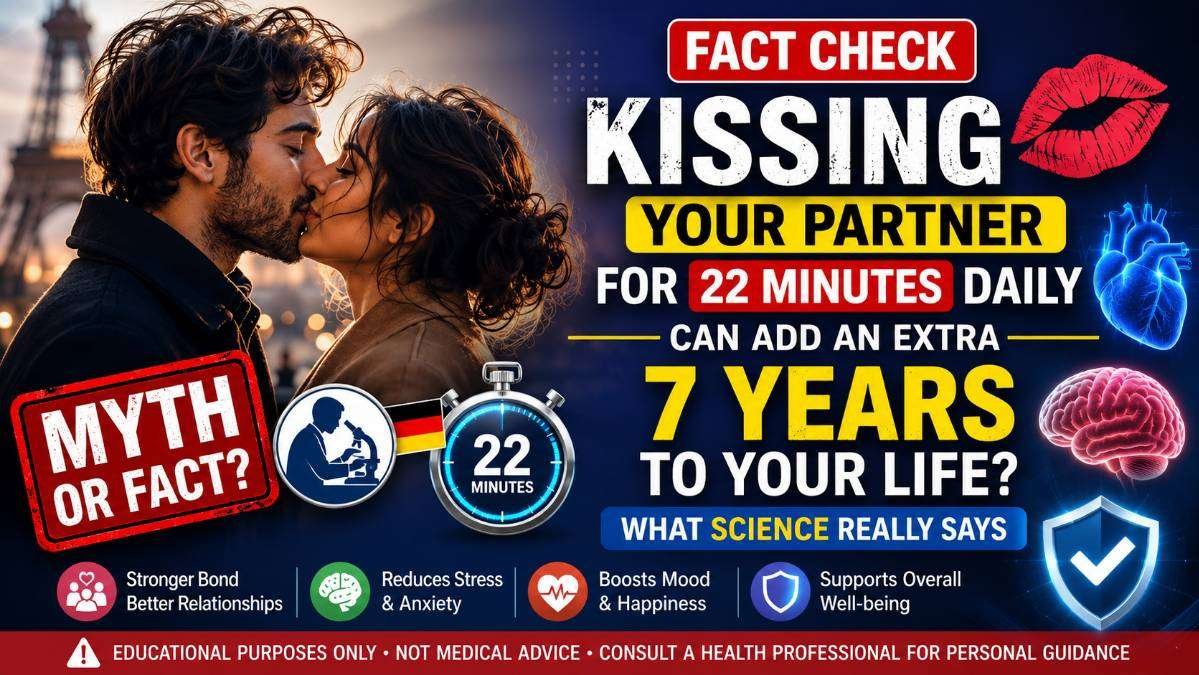
Social media is filled with eye-catching “psychology facts” that spread quickly because they sound fascinating. One recent claim says that kissing your partner for 22 minutes every day can add an extra seven years to your life, supposedly based on research conducted by German scientists. At first glance, this statement sounds convincing.
After all, many people know that healthy relationships can improve emotional well-being. But does science actually support such a precise claim?
Before accepting or sharing information like this, it is important to ask a simple question: Where is the scientific evidence? Surprisingly, many viral posts fail this basic test.
- They often mention unnamed scientists or vague research without providing the name of a university, a published study, or a peer-reviewed journal.
This article examines the claim using information from peer-reviewed scientific research and reliable health organizations. Instead of relying on social media posts or unverified websites, we will explore what researchers have actually discovered about kissing, relationships, stress, and overall health. The goal is not to dismiss the positive effects of affection but to separate scientifically supported facts from internet myths.
A Viral Claim That Sparked Curiosity
Imagine scrolling through social media and coming across a colorful image that confidently states:
“Kissing your partner for 22 minutes daily can add an extra seven years to your life, according to German scientists.”
READ THIS: Sitting for 8 Hours a Day? How Long Desk Hours May Affect Heart Health
It is easy to understand why thousands of people believe and share this message. The statement sounds specific, scientific, and hopeful. The mention of “German scientists” makes it appear even more trustworthy, even though no actual researchers, universities, or published studies are identified.
Scientific discoveries rarely make such exact promises about human lifespan. Researchers generally avoid guaranteeing that one single daily habit will increase life expectancy by a fixed number of years because human health depends on countless factors, including genetics, nutrition, physical activity, sleep, medical care, mental health, environmental conditions, and lifestyle choices.
This raises an important question. If kissing really could extend life by seven years, why has no major medical organization or public health authority announced such a remarkable discovery?
Searching for the Original Research
The first step in verifying any scientific claim is locating the original research. Reliable scientific findings are usually published in peer-reviewed journals, where independent experts carefully evaluate the methods, evidence, and conclusions before publication.
When researchers searched scientific literature databases and publications discussing romantic relationships, kissing, and human health, they found no peer-reviewed study demonstrating that kissing for exactly 22 minutes each day increases lifespan by seven years.
Likewise, no official publication from major German research organizations has reported this finding. The claim does not appear in publications associated with respected institutions such as the Max Planck Society or Germany’s public health authorities.
This absence of evidence is significant because extraordinary claims require equally strong scientific proof.
Why Exact Numbers Can Be Misleading
One reason this viral claim attracts attention is the precise number it uses. Rather than saying “kiss more often,” it specifies 22 minutes and promises exactly seven additional years of life.
Specific numbers often make statements appear more scientific, even when no evidence supports them. However, researchers normally report results using statistical measurements, confidence intervals, and probabilities instead of absolute guarantees.
For example, scientists might report that regular physical activity reduces the risk of certain diseases or that healthy eating is associated with lower mortality rates. They rarely claim that one behavior alone will extend every person’s life by a precise number of years.
Therefore, the exact figures in this viral message should immediately encourage readers to look for supporting evidence rather than accepting the statement at face value.
What Science Actually Says About Kissing
Although the viral claim itself is unsupported, this does not mean kissing has no health benefits. Researchers have spent years studying how affection influences emotional and physical well-being.
Scientific studies suggest that romantic kissing may contribute to emotional bonding between partners. During affectionate interactions, the human body can release hormones such as oxytocin, often called the “bonding hormone,” while reducing stress-related hormones like cortisol in certain situations.
These physiological changes may help couples feel closer, more relaxed, and emotionally connected. However, researchers emphasize that these are short-term biological responses. They should not be interpreted as evidence that kissing alone dramatically extends human lifespan.
Another area of research has examined how intimate kissing influences the oral microbiome by exchanging bacteria between partners. Scientists have found measurable biological changes, but these findings do not support claims about adding years to life expectancy.
Understanding the Difference Between Association and Cause
A common misunderstanding in health reporting is confusing association with cause.
Suppose researchers observe that couples in happy relationships generally enjoy better health. This does not automatically mean kissing itself is responsible for every health benefit.
Healthy relationships often include many positive habits, such as emotional support, healthier eating, regular medical care, encouragement to exercise, better sleep patterns, and reduced loneliness. These factors work together and may contribute to improved health over many years.
Because human health is influenced by numerous interconnected factors, scientists avoid attributing increased life expectancy to one simple activity unless overwhelming evidence exists.
READ THIS: Black Mold on Onions Official Food Safety Guide and Safe Handling
An Everyday Example
Consider two couples who both enjoy affectionate relationships.
The first couple exercises regularly, eats balanced meals, gets enough sleep, avoids smoking, attends regular medical check-ups, and supports each other emotionally. The second couple also kisses frequently but has poor eating habits, chronic stress, very little physical activity, and untreated medical conditions.
Even if both couples spend the same amount of time kissing each day, their long-term health outcomes may be completely different because overall lifestyle plays a much greater role than any single affectionate behavior.
This example illustrates why scientists evaluate health using comprehensive evidence rather than focusing on one isolated activity.
Scientific Evidence: What Research Really Shows
One of the biggest challenges in today’s digital world is distinguishing scientific evidence from attractive social media content. A statement that includes words like “scientists discovered” or “research proves” often appears trustworthy, even when no actual study is cited.
This is exactly why health experts encourage people to verify information through peer-reviewed journals and recognized research institutions instead of relying solely on viral posts.
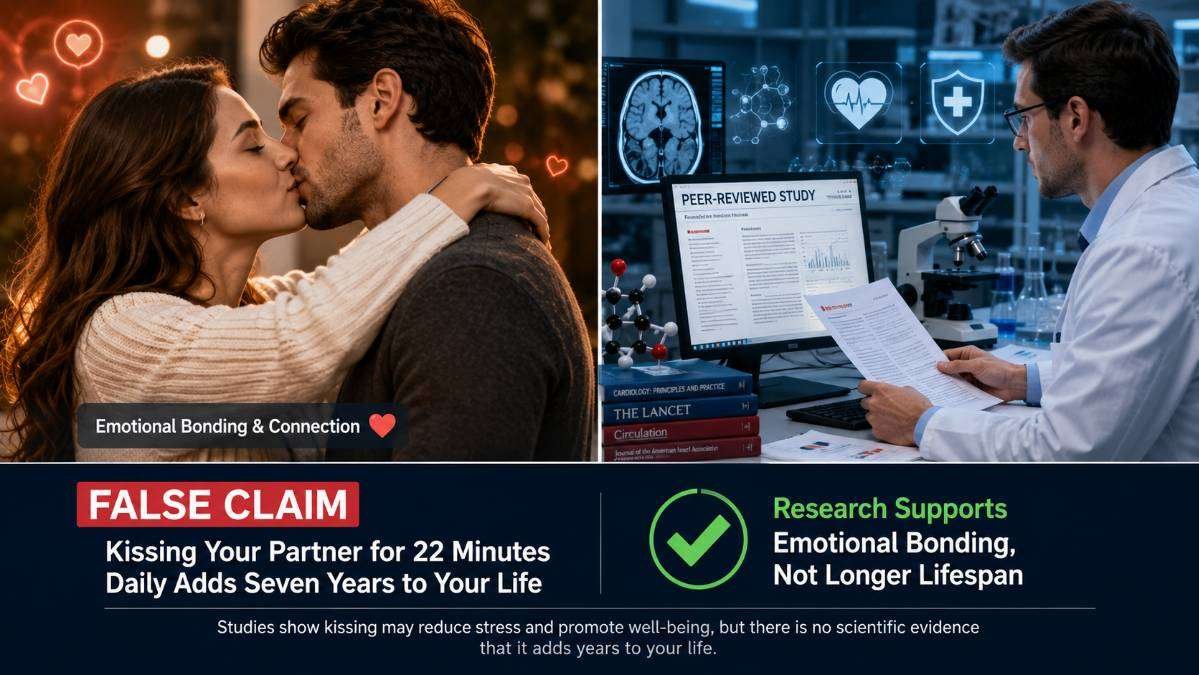
When researchers examined the claim that kissing your partner for 22 minutes every day adds seven years to your life, they found no published scientific evidence supporting this statement. No peer-reviewed journal has reported such findings, and no official German research organization has released this conclusion.
What Happens Inside the Body During a Kiss?
Kissing is much more than simply touching lips. It involves multiple senses, including touch, smell, taste, and emotional connection. Scientists have discovered that romantic kissing activates several regions of the brain associated with emotions, reward, and bonding.
During affectionate moments, the body may release chemicals such as oxytocin, which is often called the “bonding hormone.” Oxytocin plays an important role in strengthening emotional attachment between partners. At the same time, some studies suggest that cortisol, a hormone related to stress, may decrease after positive romantic interactions.
These biological responses help explain why many people feel calmer, happier, or emotionally closer after sharing affection with someone they love. However, researchers emphasize that these temporary hormonal changes should not be interpreted as proof that kissing alone extends lifespan.
Stress Reduction Is Not the Same as Longer Life
Stress affects both physical and mental health. Chronic stress has been linked to increased risks of cardiovascular disease, sleep disturbances, anxiety, and weakened immune function. Because of this, scientists are interested in activities that naturally reduce stress.
Affectionate behaviors—including hugging, holding hands, and kissing—may help lower stress levels in healthy relationships. This is supported by several psychological studies that observed improved emotional well-being among couples who regularly expressed affection.
However, reducing stress does not automatically mean a person will live a specific number of additional years. Human longevity depends on many different variables working together over decades. While lower stress contributes to better health, it cannot be translated into a guarantee of exactly seven extra years of life.
The Importance of Healthy Relationships
Researchers consistently report that people who enjoy supportive and emotionally stable relationships often experience better overall health than individuals experiencing long-term loneliness or chronic relationship conflict.
This does not mean marriage or romance automatically guarantees good health. Instead, supportive relationships may encourage healthier lifestyles. Partners often remind each other to attend medical appointments, eat nutritious meals, exercise regularly, take prescribed medication, and avoid unhealthy habits.
For example, imagine a couple who regularly prepares balanced meals together, enjoys evening walks, encourages each other during stressful situations, and communicates openly. Their improved health may result from their combined lifestyle rather than from kissing alone.
This is an important distinction because scientific research studies the complete picture instead of focusing on a single behavior.
German Research and the Origin of the Claim
The viral message specifically mentions “German scientists,” giving readers the impression that a respected research team reached this conclusion. However, extensive searches of scientific databases reveal no study from Germany stating that kissing for 22 minutes daily increases life expectancy by seven years.
Germany is home to internationally respected research institutions, including the Max Planck Society and numerous leading universities. These organizations regularly publish peer-reviewed studies that are openly available through scientific journals.
If researchers had truly discovered a simple daily habit capable of extending human life by seven years, such a finding would almost certainly receive worldwide attention through medical journals, universities, and international health organizations. No such publication exists.
What Studies About Kissing Actually Investigate
Although the viral lifespan claim is unsupported, scientists have investigated several interesting aspects of romantic kissing.
One area of research examines how kissing influences emotional attachment between couples. Another investigates the exchange of bacteria during intimate kissing and how it affects the oral microbiome. Researchers have also explored brain activity during affectionate interactions using modern imaging techniques.
These studies improve our understanding of human relationships and biology, but none conclude that a daily 22-minute kissing routine extends lifespan.
The Oral Microbiome: An Interesting Discovery
One well-known scientific study found that intimate kissing allows millions of bacteria to be exchanged between partners. Researchers observed that couples who kiss frequently often develop more similar oral microbiomes over time.
This finding attracted considerable media attention because it demonstrated how closely connected romantic partners can become biologically. Nevertheless, the researchers did not suggest that this bacterial exchange increases life expectancy.
Scientific discoveries often become exaggerated when summarized on social media. A genuine finding about bacterial exchange may gradually transform into unsupported claims about dramatically extending lifespan, even though the original research never made such statements.
How Internet Myths Spread
Many viral health myths follow a similar pattern. A real scientific study is published, media outlets simplify the findings, social media users shorten the explanation even further, and eventually an entirely different claim begins circulating online.
As this process continues, important details disappear. Researchers’ careful language is replaced with absolute statements like “Scientists prove…” or “Research confirms…” without mentioning study limitations or providing references.
This is why checking original scientific publications remains essential before accepting extraordinary health claims.
READ THIS: Does Airplane Mode Charge Your Phone Faster? Official Google & Apple Battery Charging Guide
A Practical Example
Imagine someone begins kissing their partner for 22 minutes every day after reading the viral post. At the same time, they continue smoking, rarely exercise, consume an unhealthy diet, sleep only a few hours each night, and ignore regular medical check-ups.
Would kissing alone protect them from the health risks associated with these lifestyle choices? Scientific evidence says no.
Conversely, another individual may show affection toward their partner, exercise regularly, eat nutritious food, avoid tobacco, maintain a healthy body weight, sleep adequately, manage stress effectively, and receive preventive healthcare. Their improved long-term health is far more likely to result from this combination of healthy behaviors rather than from one specific activity.
This example illustrates why medical science evaluates health holistically rather than searching for one magical daily habit capable of dramatically increasing lifespan.
Frequently Asked Questions (FAQ)
1. There any scientific evidence that kissing for 22 minutes every day adds seven years to your life?
No. Based on currently available peer-reviewed scientific research, there is no evidence supporting the claim that kissing for exactly 22 minutes every day increases life expectancy by seven years. No published study from German scientists or any internationally recognized medical organization has reached this conclusion.
2. Does kissing provide any health benefits?
Yes. Scientific studies suggest that romantic kissing may temporarily reduce stress, strengthen emotional bonding, increase feelings of closeness, and improve relationship satisfaction. These benefits are supported by research, but they should not be confused with claims about dramatically extending lifespan.
3. Why do so many people believe this claim?
Social media often spreads information much faster than scientific research. Posts that include phrases such as “scientists discovered” or “research proves” appear convincing, especially when they include exact numbers. However, many viral posts fail to provide links to the original scientific publication, making it difficult to verify whether the information is accurate.
4. Can healthy relationships improve overall health?
Yes. Numerous scientific studies have shown that supportive and emotionally healthy relationships are associated with improved mental well-being, lower stress, better cardiovascular health, and healthier lifestyle habits. However, these benefits result from many factors working together rather than one specific activity such as kissing.
How to Verify Viral Health Claims
The internet provides instant access to information, but not all information is equally reliable. Before believing or sharing any health-related claim, consider asking a few important questions.
- Does the post mention the name of the research study?
- Is the study published in a peer-reviewed scientific journal?
- Does it identify the university or research institution?
- Have recognized medical organizations reported the same findings?
- Can the information be confirmed through trusted scientific sources?
If the answer to these questions is “no,” it is wise to treat the claim with caution until reliable evidence becomes available.
Official and Scientific Sources Used
- National Center for Biotechnology Information (NCBI) – PubMed Central (Peer-reviewed scientific literature)
- Max Planck Society (Germany)
- World Health Organization (WHO)
- American Psychological Association (APA)
- Scientific research on romantic relationships, stress hormones, oxytocin, cortisol, and oral microbiome published in peer-reviewed journals.
Final Fact Check
After reviewing available scientific literature and information from reliable research organizations, there is no verified evidence that kissing your partner for 22 minutes every day adds seven years to your life.
The statement appears to be an internet myth that has spread widely through social media without citing any original scientific publication. Although kissing can contribute to emotional bonding, relationship satisfaction, and temporary stress reduction, researchers have never concluded that it guarantees a specific increase in human lifespan.
Science encourages careful interpretation of evidence rather than accepting extraordinary claims without proper verification. Human longevity depends on a complex combination of genetics, nutrition, exercise, sleep quality, mental health, medical care, environmental factors, and healthy relationships. No single daily habit has been proven to extend life by a fixed number of years.
Conclusion
Viral health claims often attract attention because they offer simple answers to complex questions. The idea that kissing for exactly 22 minutes every day could add seven years to life is certainly interesting, but scientific evidence does not support it.
That does not mean affection lacks value. Healthy relationships, emotional support, kindness, and regular expressions of affection can positively influence mental well-being and relationship quality.
These benefits are genuine and supported by research. However, they should not be exaggerated into unsupported promises about dramatically increasing lifespan.
The best approach to maintaining long-term health remains well established through decades of scientific research: eat a balanced diet, remain physically active, get sufficient sleep, avoid tobacco, manage stress effectively, attend regular medical check-ups, and maintain positive social relationships. Together, these habits contribute far more to overall health than any single viral claim found on social media.
Disclaimer
Educational Purposes Only: This article is intended solely for educational and informational purposes. It is based on currently available peer-reviewed scientific literature and information from recognized health and research organizations.
It should not be considered medical advice, diagnosis, or treatment. Readers should consult qualified healthcare professionals for personal medical guidance. Scientific knowledge continues to evolve, and future research may provide additional insights into human health and relationships
About The Author